

On this page
Every year, students take the National Eligibility cum Entrance Test (NEET) in India, vying for a highly limited number of MBBS and BDS seats. The intense competition often leaves capable students wondering if their medical aspirations have hit a dead end. However, the healthcare ecosystem relies on much more than doctors. BSc Nursing and allied health sciences courses—such as optometry, physiotherapy, and medical laboratory technology—offer stable, rewarding medical careers with faster entry into the workforce. But the most pressing question for students is: do you actually need NEET to get into them?
Is NEET compulsory for BSc Nursing and allied health courses?
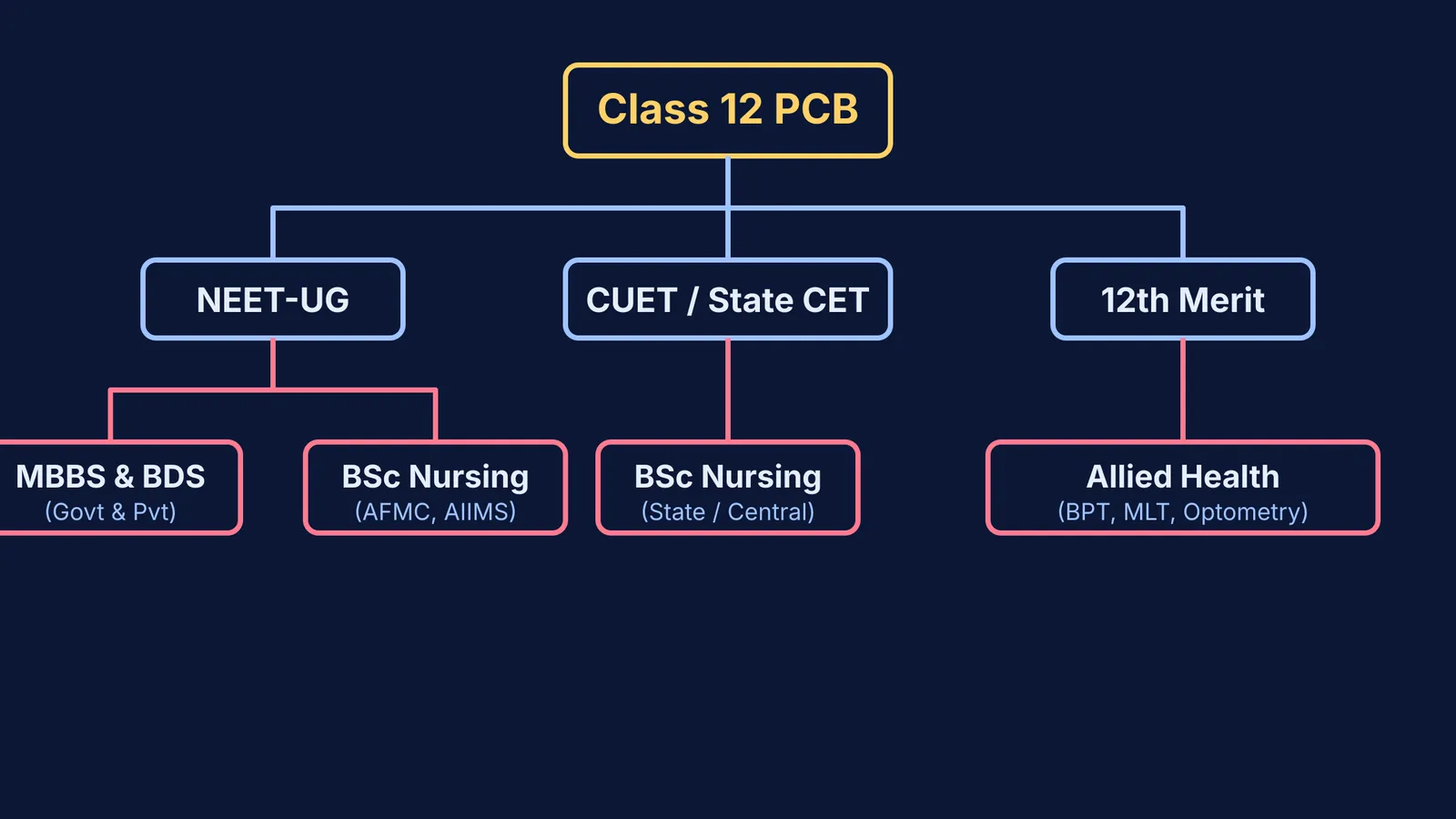
The admission requirement depends entirely on the specific college and the course you choose. According to the Indian Nursing Council, the national regulatory body that sets the curriculum, the core eligibility for a BSc Nursing degree is a minimum age of 17 years by December 31st of the admission year, along with a 45% aggregate in Physics, Chemistry, and Biology (PCB) for general category candidates. Crucially, the Council allows universities the freedom to decide their own entrance mechanisms.
If you are aiming for top-tier central government institutes, a NEET-UG score is completely mandatory. For instance, the Armed Forces Medical Services (AFMS) strictly relies on NEET scores to shortlist candidates for its 220 BSc Nursing seats across prestigious military colleges like AFMC Pune (Join Indian Army). Central medical institutes such as AIIMS, JIPMER, and BHU similarly require NEET-UG for their nursing programs.
However, NEET is not the only route into the healthcare sector. Many central and state universities admit students through the Common University Entrance Test (CUET) or conduct their own state-level Common Entrance Tests (CETs), such as Maharashtra's MH-CET or West Bengal's JENPAS-UG. Furthermore, for allied health courses, institutes like AIIMS conduct a completely separate paramedical entrance exam for subjects like optometry and radiography. This means you can secure a seat in a world-class institute without relying on your NEET score (AIIMS Exams).
What are the top allied health science courses after 12th?
Allied health professionals work directly alongside doctors and surgeons to handle vital diagnostics, technical machinery, and physical rehabilitation. To ensure uniform education standards across the country, the National Commission for Allied and Healthcare Professions Act, 2021 standardises degree durations and requires a minimum of 3,600 hours of study over three to six years for healthcare professionals.
Some of the most popular and in-demand paths include:
Bachelor of Physiotherapy (BPT): An intensive degree dedicated to treating physical injuries, improving mobility, and managing chronic pain. Under new national guidelines, this is transitioning toward a 5-year duration, which includes a mandatory 1-year clinical internship. Physiotherapists are crucial for post-operative recovery and sports medicine.
Bachelor of Medical Laboratory Science (B.MLS / BSc MLT): A 4-year course focused on analyzing blood, tissue, and fluid samples. Lab technicians form the backbone of modern diagnostics, as the majority of medical treatment decisions rely directly on their laboratory results.
BSc Radiology & Imaging Technology: This program trains students to safely operate complex diagnostic machines like X-rays, MRI, and CT scanners. Technologists must balance high-quality imaging with strict radiation safety protocols.
Bachelor of Optometry (B.Optom): A 4-year program specializing in primary eye care, vision testing, and lens prescription. While ophthalmologists (who hold an MBBS) perform eye surgeries, optometrists handle routine vision health and corrective diagnostics.
If you are preparing for these diverse entrance exams, Fermi's AI tutor can help you master the necessary biology and chemistry concepts. Rather than just handing you an answer key, Fermi holds a line of reasoning across a session, notices where you are stuck, and decides whether to explain, ask, or show. You can practice fundamental topics directly relevant to allied health and nursing, such as the formed elements of blood or the hormonal changes of parturition and lactation, right in the platform.
How to choose a medical career without MBBS?
When choosing between nursing and an allied health path, it helps to approach the decision systematically. Use this framework to narrow down your options:
Check your timeline: Can you commit to a longer study period for a BPT, or do you prefer a standard BSc in MLT or Radiology to enter the workforce sooner?
Assess patient interaction: Decide what kind of clinical environment suits your personality. Do you want direct, bedside patient care (Nursing, Physiotherapy), or do you prefer behind-the-scenes diagnostic and technical work (Medical Lab Technology, Radiology)?
Verify exam requirements: Check if your target college strictly requires NEET, CUET, or a state CET. If you missed the entrance exam window entirely, do not panic. Look for reputed private universities that offer merit-based admission directly using your Class 12 PCB board marks.
Confirm the council: Always ensure your target college is recognised by the respective national or state regulatory body—such as the Indian Nursing Council or the NCAHP. Graduating from an unrecognised institution can prevent you from legally practising in clinical settings.


