

On this page
Your phone opens when it sees you. An airport gate waves you through. A school app sorts the annual-day photos by who is in them. All three rest on one idea: turn a face into a list of numbers, then measure how far apart two lists are. Once you see that, questions about errors and consent get easier.
How does face recognition actually work?
A typical modern system follows four steps:
Find the face in the picture and crop it.
Line it up so the eyes and mouth sit in roughly the same place every time.
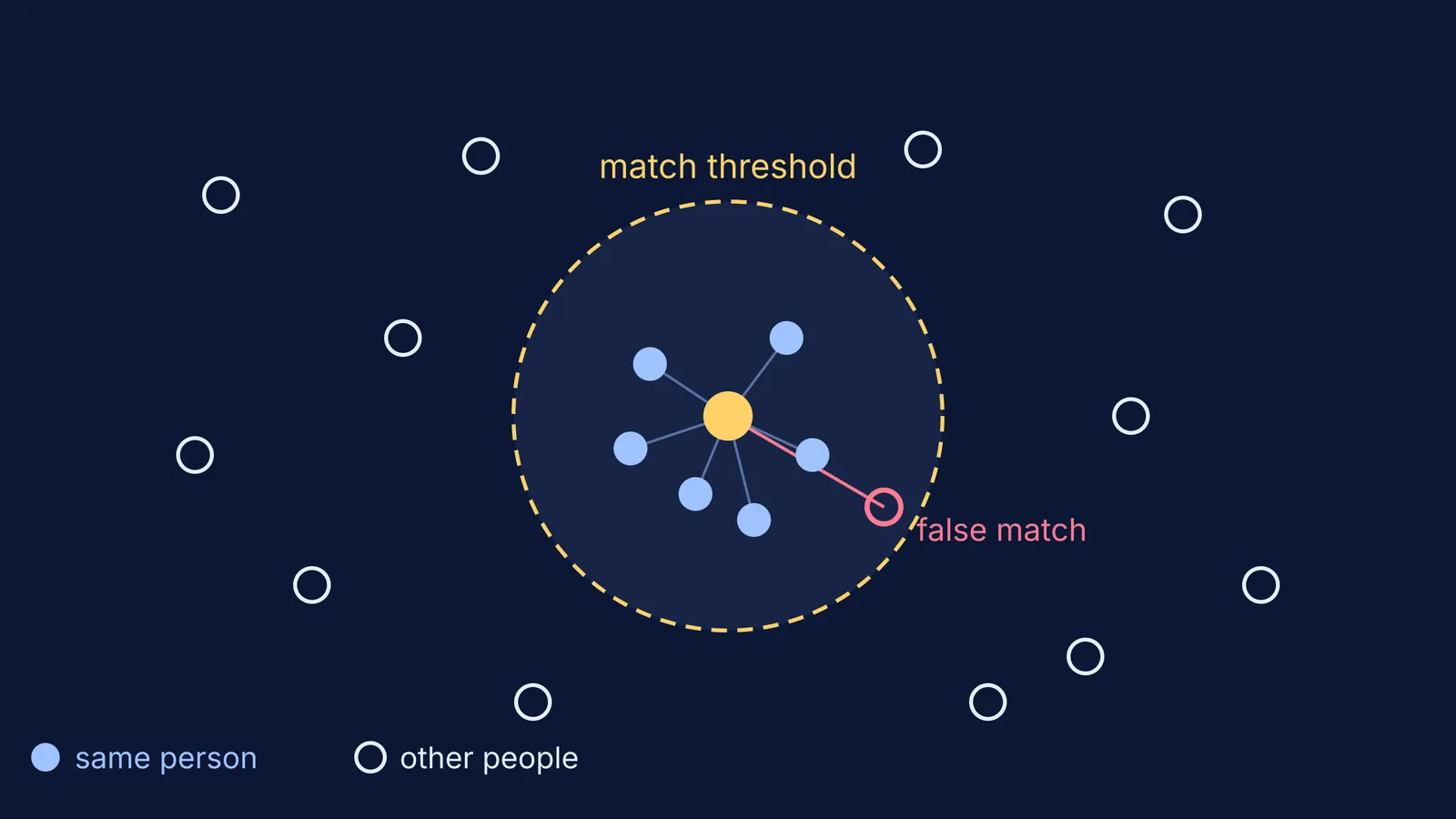
Turn it into numbers. A neural network converts the face into a fixed-length list of numbers, called an embedding.
Compare distances. If two embeddings are closer than a set threshold, the system calls them the same person.
The 2015 FaceNet paper by Florian Schroff, Dmitry Kalenichenko and James Philbin describes this clearly: the network learns a mapping from face images to a compact space where distances directly correspond to a measure of face similarity (Schroff et al., CVPR 2015; arXiv abstract). FaceNet stored each face in only 128 bytes and reported 99.63% accuracy on the Labeled Faces in the Wild benchmark (arXiv).
One-to-one verification asks "is this the person they claim to be?", as when your phone checks you. One-to-many identification asks "who is this?" by searching a whole database.
Why does face recognition make more mistakes for some people?
One major public test comes from the US National Institute of Standards and Technology. In December 2019, NIST tested 189 algorithms from 99 developers on 18.27 million images of 8.49 million people (NIST news release; full report, NISTIR 8280).
In one-to-one matching, NIST found higher false positive rates for Asian and African American faces than for Caucasian faces, with differences often ranging from 10 to 100 times depending on the algorithm.
Some algorithms developed in Asian countries showed no such dramatic difference between Asian and Caucasian faces.
In one-to-many matching, NIST saw higher false positive rates for African American women.
An earlier study pointed to one likely cause: the photos systems learn from. Joy Buolamwini and Timnit Gebru found that two widely used face datasets were 79.6% and 86.2% lighter-skinned (Gender Shades, 2018). When they tested three commercial gender-classification systems, error rates reached 34.7% for darker-skinned women, against a maximum of 0.8% for lighter-skinned men (same source). That study measured guessing gender, not matching identity, but the lesson carries over: a system can only be as fair as the faces it was trained and tested on.
The NIST exception for some Asian-built algorithms fits the same idea, though that is our reading, not a cause NIST proved. Either way, a single overall accuracy figure can hide large gaps between groups.
Is face recognition safe to use?
It depends on what a mistake costs. If your phone fails to recognise you, you type your PIN. If a one-to-many search wrongly matches a stranger to a suspect, the cost lands on someone who did nothing. And unlike a password, you cannot change your face after a leak. So ask: one-to-one or one-to-many, and who pays if it is wrong?
What should students know about photos and consent?
India now has rules on personal data. The Digital Personal Data Protection Rules were notified on 14 November 2025, with an eighteen-month period for phased compliance, so many duties are still phasing in (PIB backgrounder). Under the framework, consent must be clear and informed, and you may withdraw it at any time. When a child's data is involved, verifiable consent from a parent or guardian is required, except for essential services such as healthcare, education or real-time safety. Organisations must answer requests to access, correct or erase data within ninety days (same source).
A quick checklist before you post, upload or tap "allow":
Whose faces are in it? Ask each person.
Is the app asking to scan faces? Read the notice for the specific purpose.
Can you say no and still use the app?
Can you delete the photos and the face data later, and who do you ask?
A script for a friend: "Can I post this one? If you'd rather not, I'll crop you out." A script for a school or app: "What is the face data used for, how long is it kept, and how do I opt out?"
For a wider check of study apps, see privacy in learning apps for Indian parents. Related reads: how large language models turn text into numbers and why AI-writing detectors give false positives.
How can you learn the maths behind it?
The core idea is the distance between two points, the same distance formula you use in coordinate geometry, stretched to many more dimensions. If that still feels shaky, Fermi's AI tutor can work out what you already know and build a plan for the session, and the Fermi Concept Library has a lesson for each concept in mathematics and computing.


