On this page
It is 10:40 pm, your child has a Class 12 board paper tomorrow, and the DJ at an open-air wedding down the road is rattling the windows. The law is clearer than most families think.
What time do loudspeakers have to stop in India?
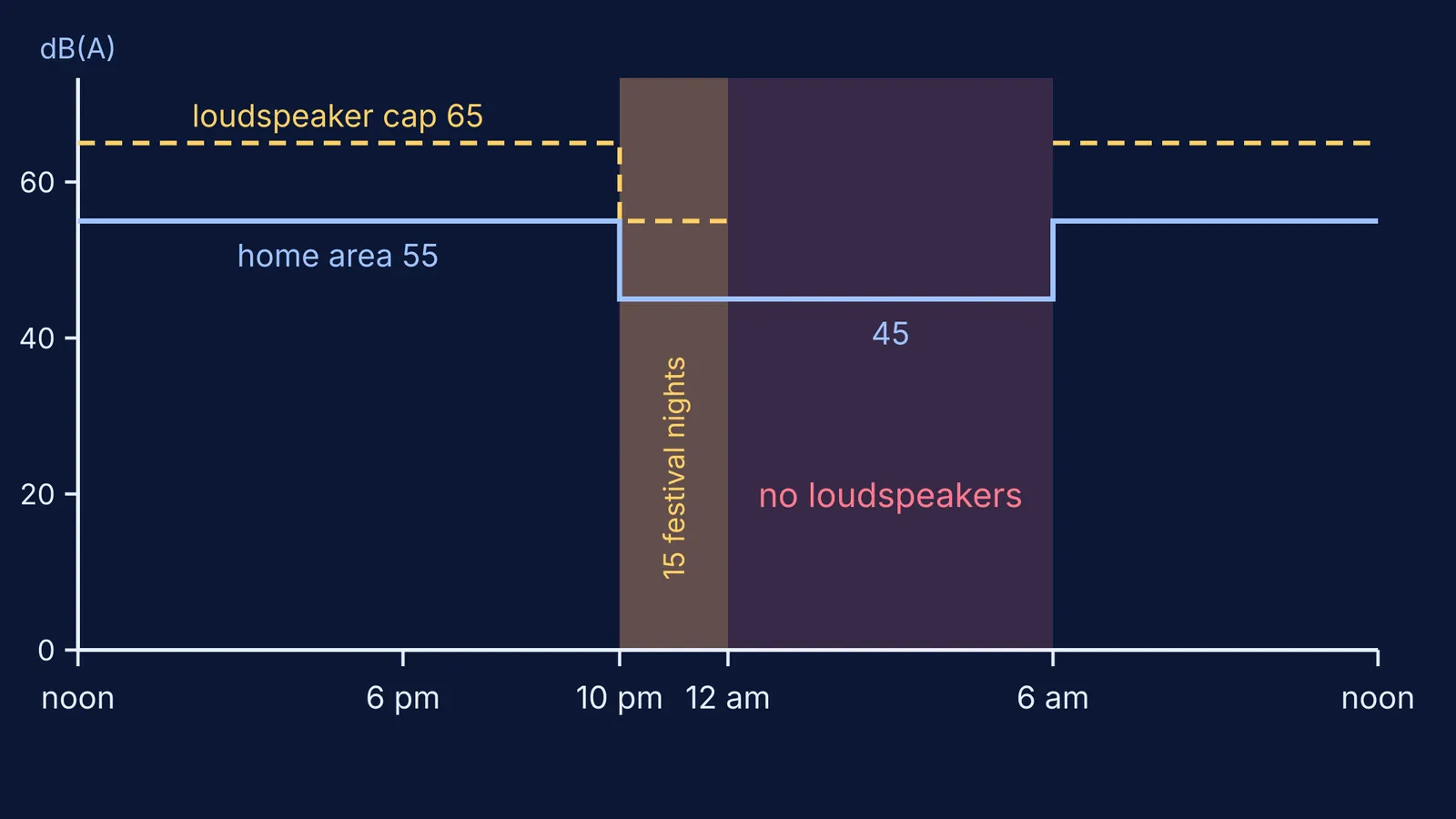
Under the Noise Pollution (Regulation and Control) Rules, 2000, "night time" means 10 pm to 6 am, according to the 2010 amendment published in the Gazette of India. That amendment says a loudspeaker, public address system or sound amplifier "shall not be used at night time" except in closed premises such as banquet halls and auditoriums, or during a public emergency.
A 2002 amendment lets a state government allow loudspeakers from 10 pm to midnight on cultural or religious festive occasions, for no more than 15 days in a calendar year. Since 2010 the state should normally announce those days in advance. So after midnight, or on a night not on your state's list, the loudspeaker should be off.
Daytime has limits too. Under the 2010 amendment, noise at the boundary of a public place using a loudspeaker must stay within 10 dB(A) above the area's standard or 75 dB(A), whichever is lower. The Delhi Pollution Control Committee's noise standards put residential areas at 55 dB(A) by day and 45 dB(A) at night, so the daytime loudspeaker cap in a residential area works out to 65 dB(A). Under the November 2000 amendment, a silence zone covers at least 100 metres around hospitals, schools and courts, and the DPCC says loudspeakers are banned there.
Who do you complain to about loudspeaker noise?
The rules give enforcement to an "authority", defined in the November 2000 amendment as a District Magistrate, a Police Commissioner, or a designated officer not below the rank of Deputy Superintendent of Police. Rule 7 lets you complain when noise is 10 dB(A) or more above the standard, and the 2010 amendment added any breach of the night-time restrictions.
Use them in this order:
While it is happening at night: call 112, which the Ministry of Home Affairs has made the national emergency number for police, fire and ambulance, or ring your local police station.
The next working day: hand a short written complaint to the police station or the District Magistrate's office, and copy your State Pollution Control Board. Nyaaya's legal explainer lists the police and the Pollution Control Board as places to complain.
If it keeps happening: go back with your dated notes and ask what action was taken.
Before you call, note the date, start time, exact landmark, the source (DJ, pandal, rally) and organiser if known, and take a short video with the time on screen.
What should you say when you call the police?
Stay calm and factual:
"Good evening. I want to report a loudspeaker being used after 10 pm at [landmark, area]. It is [a DJ at an outdoor wedding]. It started at [time] and is still on now. My child has a Class 12 board exam tomorrow morning. Under the Noise Pollution Rules, loudspeakers are not allowed between 10 pm and 6 am. Please send someone to stop it. My name is [name], my number is [number]. Could you give me a reference number?"
How can your child keep studying through the noise?
Noise hurts some kinds of study more than others. A 2013 review of research on children by Maria Klatte and colleagues found that noise can disrupt reading and recall of written lists, and that most studies it covered found meaningful background speech harmed recall.
So change what you study, not just where:
Keep reading, definitions and memorising for quiet hours. Loudspeakers must stay off until 6 am, so early mornings are a reliable quiet window.
Use loud hours for work on paper: numericals, diagrams, equations, a timed section of a past paper.
Move to the room furthest from the noise, shut the windows, and hang a heavy curtain. Bass carries furthest; this explainer on why you hear only the bass from a neighbour's music shows why.
Foam earplugs help with practice problems and with sleep. Do not turn headphones up loud to drown the noise out.
For the loud-hour slot, the Fermi Problem Library has worked problems with a step-by-step solver that explains the reasoning. If your home is noisy all year, see our guide to finding a quiet study space in a joint family home and the physics of cutting noise at home.
What can parents set up before exam season?
Save the numbers of your local police station and your State Pollution Control Board's regional office.
Find out which festival nights your state has notified for late loudspeaker use.
If a shamiana goes up near you, ask the family politely, in daylight, to keep music low after 10 pm on exam nights.
Save the call script tonight, before you need it.