On this page
It is 11 pm and the sangeet next door is still going. Through your wall the words and cymbals have vanished, leaving a steady thud-thud-thud. The wall and the gaps around it are filtering the music, and two Class 9 sound ideas explain how.
Why do we hear only bass from a neighbour's music?
The wall lets low notes through more easily than high ones, and low notes bend around edges and through gaps far better.
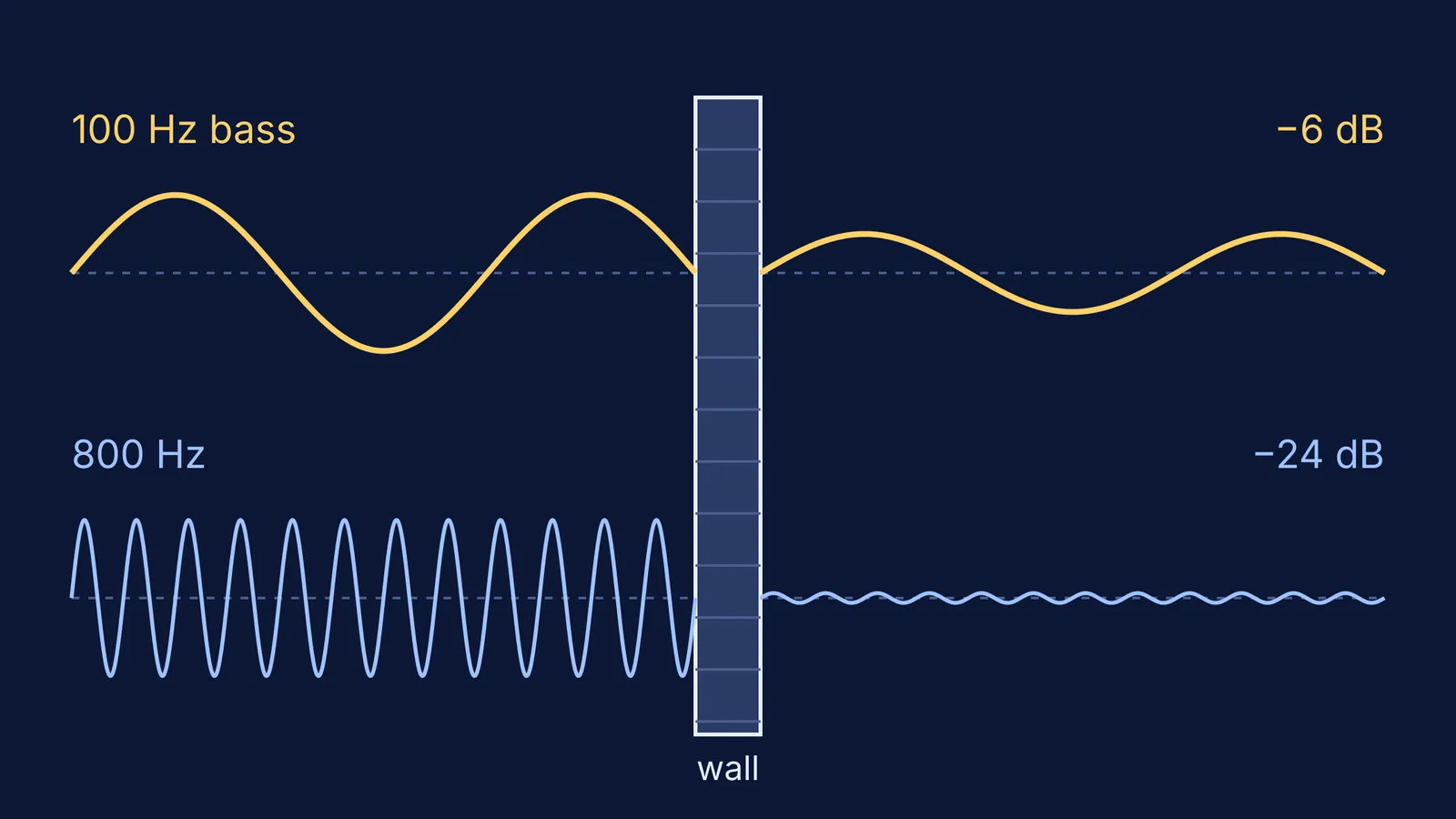
Start with the wall. Acoustics has a rule of thumb called the mass law: doubling the mass per unit area of a panel, or doubling the frequency for a given mass, increases the sound transmission loss by six decibels, according to the ASA/ANSI acoustical terminology standard. In plain words, a heavy wall is hard to shake quickly. A high note pushes and pulls too fast for the wall to follow. A bass note pushes slowly, the wall sways a little in step, and its far side acts like a large, quiet speaker in your room.
Here is what that rule means in numbers. Going from a 100 Hz bass note to an 800 Hz note is three doublings (100, 200, 400, 800), so the mass law predicts about 18 dB more loss for the higher note. Going up to 3200 Hz is five doublings, or about 30 dB more. Every 10 dB is a factor of 10 in sound intensity, as HyperPhysics explains on its decibel page, so 30 dB means the high note is cut roughly 1000 times more than the bass.
Real walls are messier: doors, windows and resonances change the numbers, but the broad trend holds. It is also why soundproofing is costly, since doubling a wall's mass buys only about 6 dB.
How does wavelength decide what bends around walls?
The second effect comes from the wave relation you learn in Class 9: speed = frequency x wavelength, or v = fλ. The speed of sound in air at 20 °C is about 344 m/s, according to HyperPhysics' speed of sound page. Divide by the frequency and you get the wavelength:
100 Hz bass: 344 / 100 = about 3.4 m
1000 Hz (within the range of speech): about 34 cm
4000 Hz (cymbals, the s in words): about 8.6 cm
Diffraction is the bending of waves around small obstacles and their spreading out beyond small openings (HyperPhysics on diffraction of sound). The same page notes that diffraction is stronger for longer wavelengths, so you hear low frequencies around obstacles better than high ones. That is part of why distant thunder rumbles instead of cracking, though air also absorbs high frequencies more.
So a 3.4 m bass wave leaking through a window, ventilator or door gap spreads into every corner of your room, while an 8.6 cm treble wave travels more like a beam and leaves a sound shadow. We have a longer explanation of why sound bends around corners but light does not if you want the full comparison.
How can you test this with a phone speaker at home?
You need a phone with a free tone-generator app or website, a room with a door, and ten minutes. Keep the volume comfortable and skip earphones.
The wavelengths below use the same 344 m/s figure from HyperPhysics' speed of sound page.
Put the phone on a table in the room and play a 200 Hz tone (wavelength about 1.7 m). Tiny phone speakers play very deep notes weakly, so avoid 50 Hz.
Stand in the doorway, in line with the phone, and rate the loudness from 1 to 5.
Step sideways into the corridor so the wall hides the phone. Rate it again.
Repeat with a 4000 Hz tone (wavelength about 8.6 cm), set to sound about as loud in the doorway.
Close the door and listen to both tones from outside.
Your prediction: the 4000 Hz tone drops much more behind the wall, and again when the door shuts; the 200 Hz tone fades only a little. Compare the drops, not raw loudness, because your ears are not equally sensitive to every frequency.
If this is hard to picture, the Fermi Simulation Lab has interactive simulations for ideas that are easier to see than to read.
What does this mean for exams and for the noise next door?
For exams, this answers questions like "why can you hear someone around a corner but not see them?" Our guide to the wavelength range of audible sound gives the numbers at both ends, and our Class 9 sound chapter guide ties it to the syllabus.
For the noise itself, physics gives you a calm thing to say: "Uncle, the songs are fine, it is the bass that comes through our wall. Could you turn the bass down a little after 10?" Asking for less bass, not silence, matches how walls work.
If v = fλ still feels shaky, the Fermi Concept Library gives every concept in physics its own lesson, so you can fill the gap before the next test.