

On this page
If you stand around the corner from a room, you can hear the people inside talking, but you cannot see them. Both sound and light travel as waves, so why do they behave so differently when they meet an obstacle?
The answer lies in a fundamental property of all waves called diffraction. This single concept explains why low-pitched sounds carry so far, why light casts sharp shadows, and why you need microscopic slits to see light act like a wave.
Why does sound bend around corners but light does not?
Diffraction is the deviation of waves from straight-line propagation due to an obstacle or through an aperture 1.
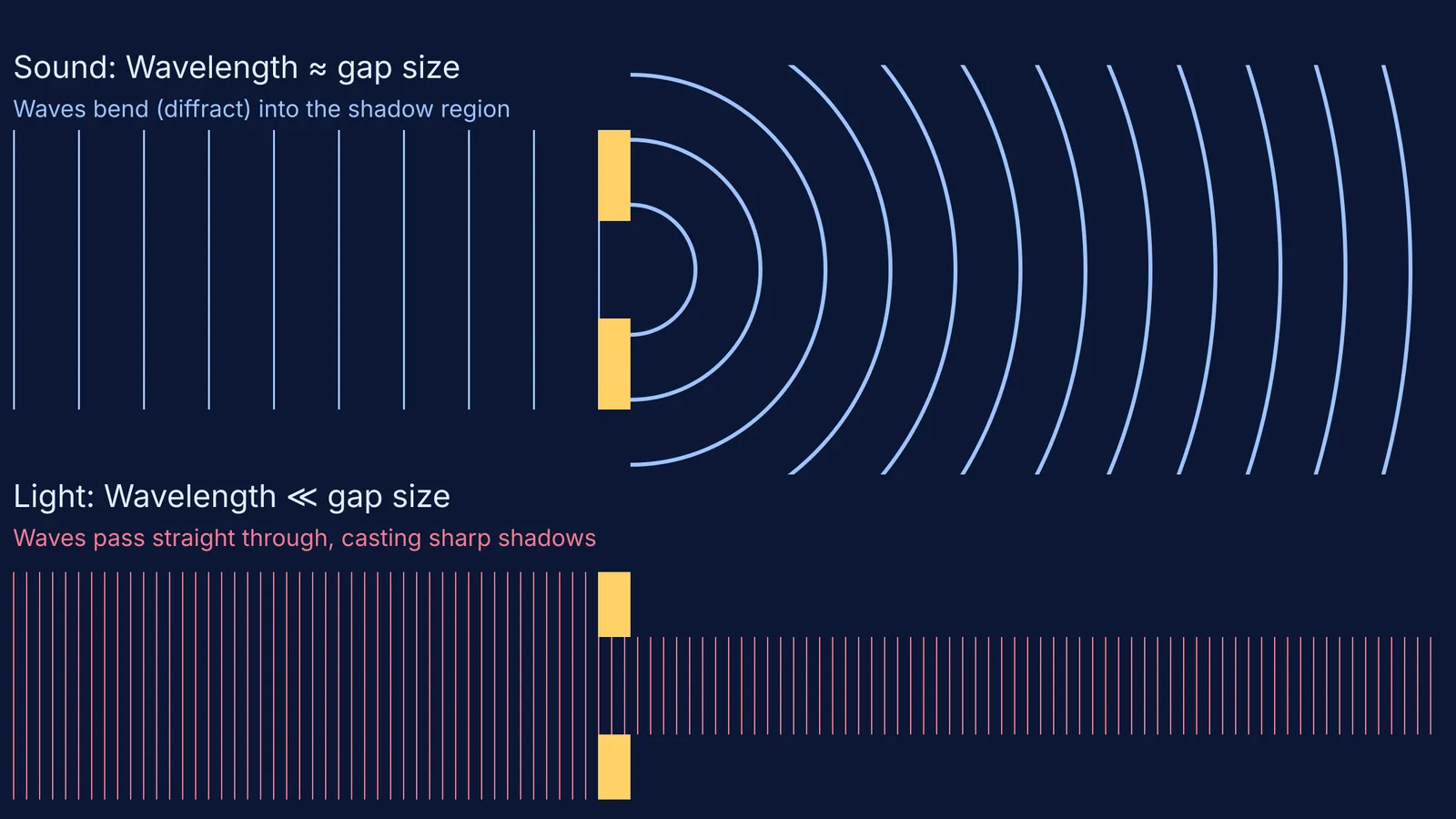
For this bending to be noticeable, the wavelength of the wave must be close to the size of the gap or the obstacle it is passing through. This relationship is what separates the everyday behaviour of sound and light.
Audible sound has wavelengths from 1.7 centimetres to 17 metres 2. An ordinary interior doorway is about one metre wide. Because the wavelength of human speech is roughly the same scale as the door, sound waves diffract strongly. As they pass through the doorway, they spread out in a wide arc, filling the space on the other side. This is why sound easily reaches you even when there is no direct line of sight.
Visible light has wavelengths from 400 to 700 nanometres 3. A doorway is millions of times wider than the wavelength of light. When the gap is vastly larger than the wavelength, the wave does not bend. Instead, it travels straight through, casting a sharp shadow. To the human eye, light appears to travel only in perfect straight lines.
A worked example: calculating the spread
You can prove this difference using the core formula of single-slit diffraction. The angle at which a wave spreads out (θ) is determined by the ratio of its wavelength (λ) to the width of the gap (d).
Let us compare a typical sound wave and a light wave passing through the same one-metre doorway:
The sound wave: A sound wave near the lower limit of human hearing (20 Hz) has a wavelength of roughly 17 metres 2. A mid-range sound wave might have a wavelength of about 1 metre. When a 1-metre wave passes through a 1-metre doorway, the ratio λ/d is 1. This results in a massive diffraction angle, spreading the sound widely into the adjacent room.
The light wave: The human eye is most sensitive to green light, which has a wavelength of about 555 nanometres 3. Passing through the same 1-metre doorway, the ratio λ/d is 0.000000555. The resulting angle of diffraction is virtually zero. The light simply travels straight ahead, leaving everything outside its direct path in darkness.
This principle applies across the entire electromagnetic spectrum. AM radio waves have much longer wavelengths than FM radio waves, which is why AM signals diffract more easily over hills and around buildings, giving them a vastly longer range.
Will light ever bend around an obstacle?
Yes, but only if the obstacle or gap is microscopic.
If you pass a beam of light through a microscopic slit, the light will diffract just as sound does through a doorway. The light will spread out and create a pattern of bright and dark fringes on a screen behind it.
You can see this effect in everyday life without lab equipment. If you look at a bright point of light through a fine mesh, such as an umbrella fabric or a feather, you will see a cross-shaped pattern of light spreading out. The gaps between the threads are small enough to force the light waves to bend and interfere with each other. This physical bending is entirely separate from the dispersion of white light by a glass prism, which separates colours using refraction, not diffraction.
How do you solve wave optics in exams?
In JEE and NEET, diffraction and interference are standard tests of your wave optics understanding. You will often need to calculate the width of the central maximum in a single-slit setup, or relate phase difference to path difference.
When you study waves, make sure you can visualise what the formulas represent. Understanding the physical difference between displacement and pressure waves in sound or knowing why a central maximum is twice as wide as the secondary ones makes the mathematics much easier to apply under time pressure. The trick is to link the abstract geometry back to the physical reality of wave crests and troughs.
If you are struggling to picture why wavelength matters, the Fermi Concept Library has a complete lesson mapping out the principles of wave optics. For more complex exam questions, the Fermi Problem Library has worked problems with a step-by-step solver that explains the reasoning rather than printing an answer.


