On this page
You may have seen a B.Sc. in physician assistant on a college list, or heard of a "PA" working in a hospital's heart unit. In India this is an allied health degree, not a medical degree, and that difference shapes your whole career.
What is a physician assistant course in India?
The profession comes under the National Commission for Allied and Healthcare Professions Act, 2021, whose Schedule lists "Physician Associate or Physician Assistant" in Category 9, Medical Technologists and Physician Associate. The Act describes a PA as someone trained in a medical model to perform preventive, diagnostic and therapeutic services with physician supervision.
The NCAHP's competency-based curriculum for Physician Associates recommends the title "Physician Associate" and sets out the course:
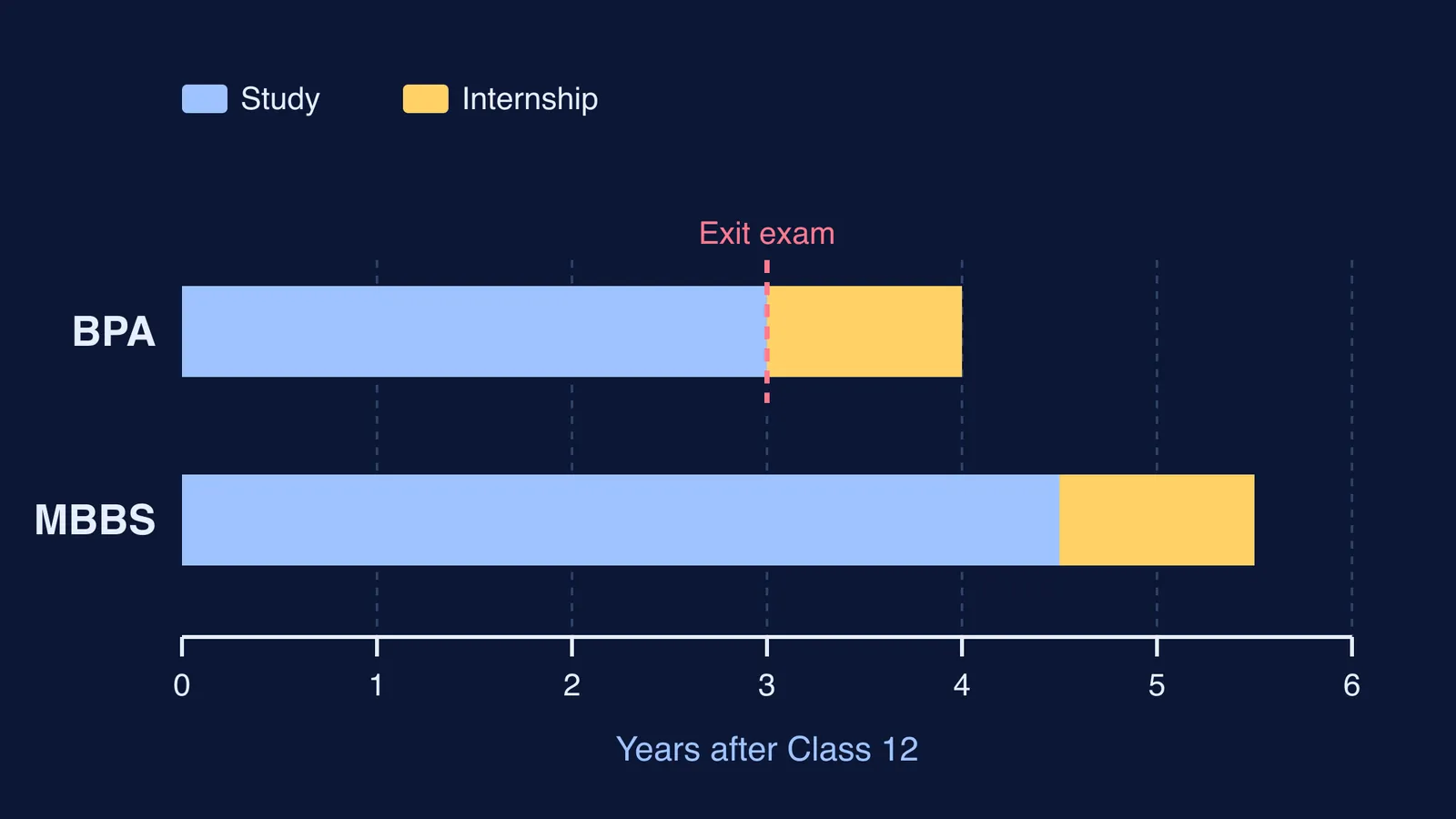
Bachelor of Physician Associate studies (BPA): 4 years, with the final year a 12-month clinical internship.
Recommended entry: Class 12 with at least 50% in each of Physics, Chemistry and Biology, a minimum age of 17, and a common entrance test in those subjects plus English.
No lateral entry for now, so nurses and other allied professionals cannot switch in through a bridge route.
A third-party exit exam at the end of year 3; you need both the degree and a pass to begin clinical practice.
Master of Physician Associate studies (MPA): at least 2 more years, in a surgery or medicine stream.
The Health Ministry launched this curriculum on 23 April 2025 as one of ten allied health curricula. A July 2026 government release lists Physician Associates among 16 NCAHP curricula to be implemented mandatorily from the 2026-27 academic year.
What do physician assistants do in surgery and cardiology teams?
India's PA cadre began in 1992 to ease staff shortages, particularly in cardiology and cardiothoracic surgery, according to the NCAHP handbook. The same handbook estimates that about 10,000 PAs work in India, mostly in private and tertiary hospitals, and that more than 130 institutions offer PA programmes.
In a tertiary hospital, the handbook's list of PA functions includes:
Acting as first or second assistant in operations such as cardiac surgery, organ transplants and cancer surgery.
Minor procedures such as wound suturing, biopsies and debridement.
Monitoring critically ill patients in ICUs, emergency departments and post-operative units.
Joining clinical rounds and contributing to diagnosis, treatment plans and follow-up.
Its job description for a junior PA in cardiology is specific. The PA takes histories and examines patients, orders tests limited to blood tests, ECGs, chest X-rays, treadmill tests and echocardiograms, interprets ECGs, and presents cases to the supervising cardiologist. In the cath lab, the PA assists in procedures and manages anticoagulation and puncture-site care. The supervising cardiologist sets these duties in advance, and the PA's skills are reassessed every year.
What can an MBBS doctor do that a PA cannot?
The National Medical Commission Act, 2019 allows only people on the medical register to practise medicine, as PRS Legislative Research's summary explains. A registered MBBS graduate can practise medicine in their own right. A PA cannot; the PA curriculum handbook says PAs "may also be given restrictive prescriptive rights under the supervision of the physicians with whom they work".
The training gap is real too. MBBS is 4.5 years of study plus a one-year compulsory rotating internship, as the NMC restated in April 2026. The BPA is 3 years of study plus a one-year internship. The handbook's career ladder runs from Junior PA to Senior PA Grade I, and from BPA to MPA and PhD: a separate track, not a shortcut into MBBS.
Weighing nearby options? Compare allied health sciences courses, the cardiac care technologist route and how MBBS leads to specialisation.
Is a physician assistant course right for you?
Use this quick check. If four or five are true for you, a PA course is worth a closer look.
You want hands-on patient care in a hospital team, not a lab or equipment role.
You are comfortable working under a doctor's direction for your whole career.
You like biology enough to study anatomy, physiology, pathology and pharmacology in depth.
You can handle long shifts in ICUs, emergency rooms and operating theatres.
Running your own practice as a doctor is not your main goal.
Before you pay a fee, ask the college these five questions:
"Which university awards the degree, and does the course follow the NCAHP Physician Associate curriculum?"
"Which hospital runs the 12-month internship, and does it have cardiology and cardiac surgery departments?"
"How do you prepare students for the exit exam?"
"Where did your last two batches get jobs, and in which departments?"
"Do you offer the MPA, and in surgery or medicine?"
The first year is heavy on anatomy and physiology. If topics like the heart and circulation feel shaky, the Fermi Concept Library has its own lesson for every biology concept, and the Fermi Simulation Lab has interactive simulations for ideas that are easier to see than to read.
Before deciding, read the handbook's chapter on PA roles: it shows the actual job.