

On this page
While MBBS and BDS get the most attention after 12th PCB, the modern healthcare system runs on the shoulders of allied health professionals. From the person who reads your MRI to the expert who designs a rehabilitation plan, allied health science courses are a vital and growing career path.
What are allied health science courses?
The National Commission for Allied and Healthcare Professions (NCAHP) Act, 2021 officially recognises 56 professions grouped into 10 broad categories (PRS India). Before the NCAHP Act, the allied healthcare sector was largely unregulated, leading to confusion about which degrees were legitimate. Now, with 10 distinct categories—such as Trauma and Burn Care, Ophthalmic Sciences, and Nutrition Science—students have a much clearer map of where their studies will lead.
Degrees require between 2,000 and 3,600 hours of training spread over two to six years. Just as doctors register with the National Medical Commission, allied healthcare graduates must now register with State or Central Councils to legally practice.
Which allied health science courses are officially recognised?
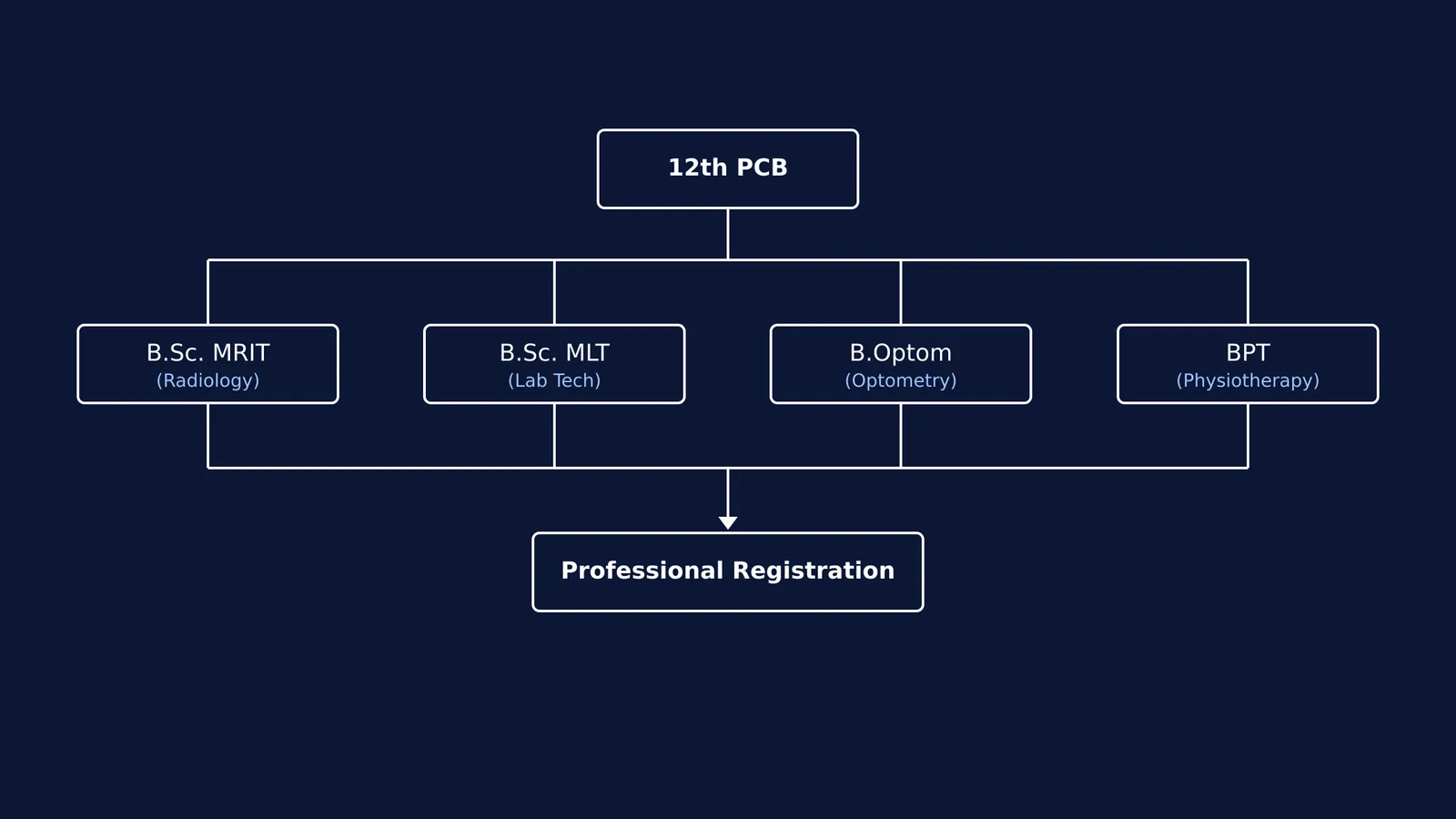
If you have passed your 12th board exams with Physics, Chemistry and Biology (PCB), several recognised bachelor's degrees are open to you. Here are four in high demand:
B.Sc. Medical Laboratory Technology (MLT): These professionals run diagnostic tests on blood, tissues and other samples. They are the backbone of pathology departments.
B.Sc. Medical Radiology and Imaging Technology (MRIT): Radiographers operate complex machines like X-rays, CT scanners and MRI machines, ensuring the images are clear enough for a doctor to read.
Bachelor of Optometry (B.Optom): Optometrists test vision, prescribe corrective lenses and detect eye diseases. They often work in eye hospitals or set up their own clinics.
Bachelor of Physiotherapy (BPT): Physiotherapists help patients recover from injuries, surgeries or neurological conditions through physical movement rather than medication.
Beyond these four, there are highly specialised paths. For example, a B.Sc. in Cardiac Care Technology trains students to assist in heart-related surgeries, while a B.Sc. in Anaesthesia and Operation Theatre Technology (AOTT) focuses on surgical support and ICU management. Each of these requires a solid foundation in human anatomy and physiology.
As you weigh your options and prepare for entrance exams, clearing your Class 12 concepts is the first step. If you are struggling with a biology topic, you can ask Fermi's AI tutor for help. It works out what you already know and builds a plan for the session, so you sit down to a clear next step.
Do you need NEET for allied health science courses?
The short answer is no, not usually. While NEET-UG is mandatory for MBBS, BDS and AYUSH courses, it is generally not required for B.Sc. MLT, B.Optom or most other paramedical degrees.
Admissions are typically granted based on merit (your aggregate marks in 12th PCB) or through university-specific entrance exams. Institutions like AIIMS and PGIMER conduct their own separate entrance tests for their paramedical courses. State medical universities often conduct their own state-level counselling based on Class 12 board marks or a dedicated state entrance test. It is highly recommended to check the official website of the specific university or the Directorate of Medical Education of your state for the most current notification. However, the NCAHP has indicated that a common entrance test could become mandatory for these courses in the future to maintain uniform standards.
A decision checklist for students and parents
Choosing a career path outside the traditional medical degrees can feel uncertain. If you are exploring this route, here is a framework to help you decide:
Check the recognition: Ensure the college is affiliated with a UGC-recognised university and follows NCAHP guidelines.
Look at the lab facilities: Because these degrees are heavily practical, the college must have modern, working equipment.
Ask about clinical postings: A degree is only as good as the hands-on experience it provides. Ask where past students did their mandatory internships.
Talk it through: Parents and students often have different expectations. Our guide on when your child's career choice differs from yours can help structure these conversations.
If you decide to take a state-level entrance exam for one of these courses, you might need to catch up on some Class 11 and 12 science. Using the Fermi Problem Library provides a step-by-step solver that explains the reasoning behind each step. Or, if you are far behind and need a triage plan, read our guide on how to clear your JEE or NEET backlog.


