

On this page
Getting into a medical college in India is a major achievement, but the 5.5-year MBBS is only the beginning of a doctor's training. Whether you want to perform surgery, manage a hospital, or join the civil services, the path from a fresh graduate to a practicing specialist involves mandatory clinical rotations, high-stakes entrance exams, and careful career planning.
What is the compulsory rotating internship?
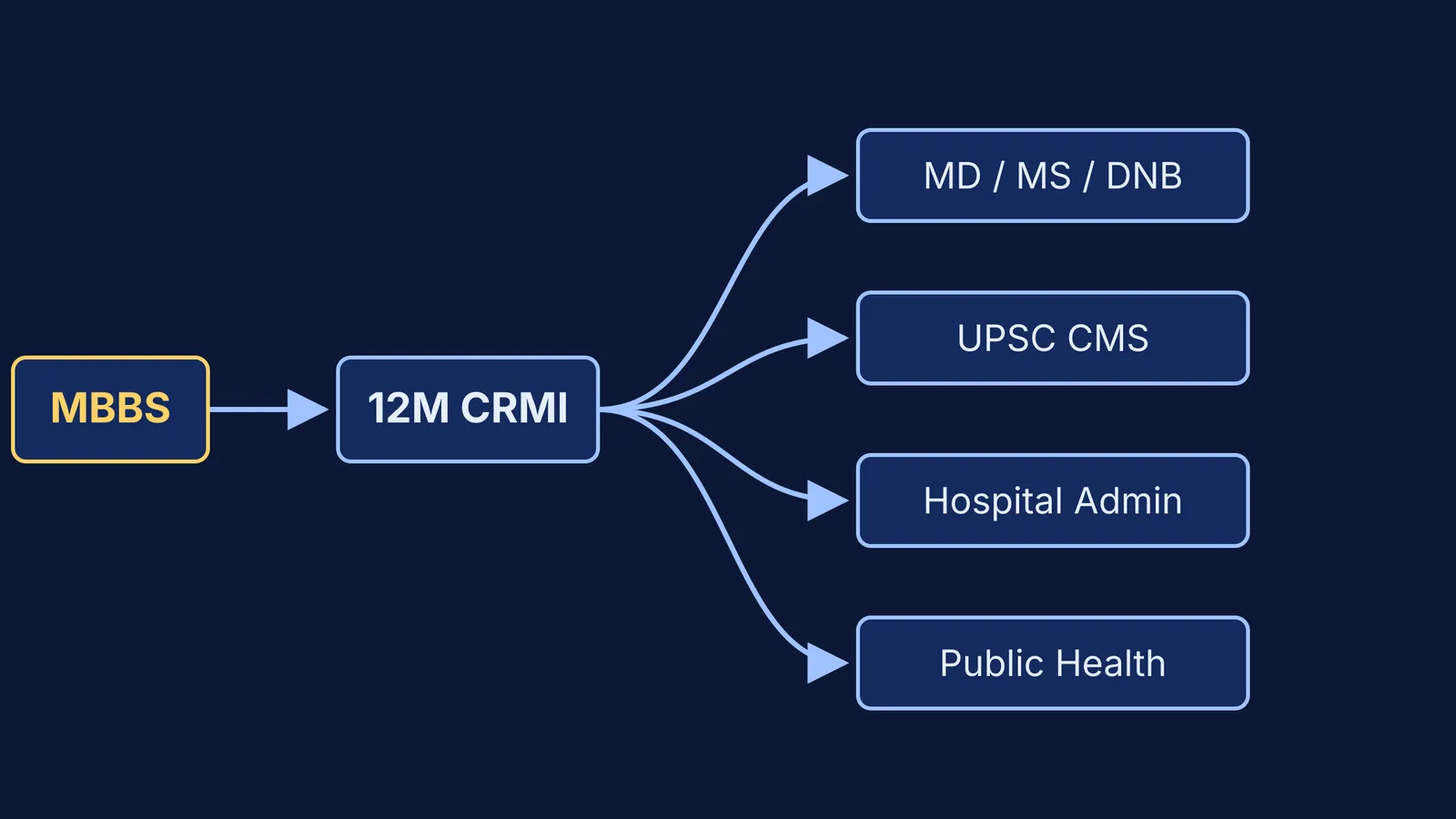
Before you can be a fully registered doctor, the National Medical Commission (NMC) requires a Compulsory Rotating Medical Internship (CRMI). This training lasts exactly 12 months and takes place in the hospital attached to your medical college.
During this year, you rotate through departments like general medicine, surgery, paediatrics, and community medicine. You are paid a stipend, and you are allowed a maximum of 15 days of leave. Only after you receive your completion certificate can you register with a State Medical Council or the NMC. Foreign medical graduates must also complete this internship in India after clearing their qualifying exam.
Which PG entrance exam should you take?
Once registered, most doctors aim for a postgraduate (PG) degree to specialise. The competition is intense. For the 2026 academic year, more than 2.65 lakh candidates appeared for the National Eligibility cum Entrance Test for Postgraduate (NEET PG).
NEET PG: The primary gateway for MD (Doctor of Medicine) and MS (Master of Surgery) programmes across government and private colleges.
INI-CET: The Institute of National Importance Combined Entrance Test. This is for admission to premier institutes like AIIMS, JIPMER, and PGIMER.
NExT: The National Exit Test is being piloted by the NMC to eventually replace both the final-year MBBS university exams and NEET PG. A full nationwide rollout is targeted for 2029.
Relying only on reading notes is a common trap; why rereading feels like learning, and what to do instead is a crucial lesson for such a competitive exam. If you know a student who is struggling with where to start in physics or biology, Fermi's AI tutor can work out what they already know and build a plan for the session, so they sit down to a clear next step.
What are the alternatives to clinical specialisation?
A 3-year MD or MS is not the only path. The Indian government reports that the country now has a doctor-population ratio of 1:811, which is better than the World Health Organization's recommendation of 1:1000. As the healthcare sector grows, so do alternative roles:
Government Service (UPSC CMS): You can join the central government through the Combined Medical Services exam. In 2026, the UPSC announced 1,358 vacancies for medical officers in the Railways and Central Health Service.
Hospital Administration (MBA/MHA): Managing large hospitals requires medical knowledge and business skills. Many doctors pursue a Master of Hospital Administration to move into healthcare management.
Public Health (MPH): If you are interested in policy, disease prevention, or working with organisations like the WHO, a Master of Public Health is the standard route.
Clinical Fellowships: Shorter, focused fellowships (like critical care or diabetology) let you gain specific skills without committing to a full three-year degree.
If you and your parents are weighing these options and don't see eye to eye, it can be a stressful time. Reading about when your child's career choice differs from yours can help families find common ground.
How do you decide your next step?
Choosing what happens after your MBBS comes down to what you want your daily life to look like. Do you want to see patients every day, or would you rather design health policies?
Talk to seniors: Speak to doctors who are 5 to 10 years ahead of you in different fields. Ask them about their work hours and stress levels.
Use your internship: The 12-month rotation is your chance to test-drive different specialties. Pay attention to which wards excite you and which ones drain you.
Set a timeline: If you plan to take NEET PG, decide how many attempts you are willing to make before considering an alternative like hospital administration or the UPSC CMS.
Whichever route you choose, the key is to build a study routine that lasts longer than a week during your preparation phase. The medical field is vast, and an MBBS is a broad degree that offers careers far beyond the clinic.


