On this page
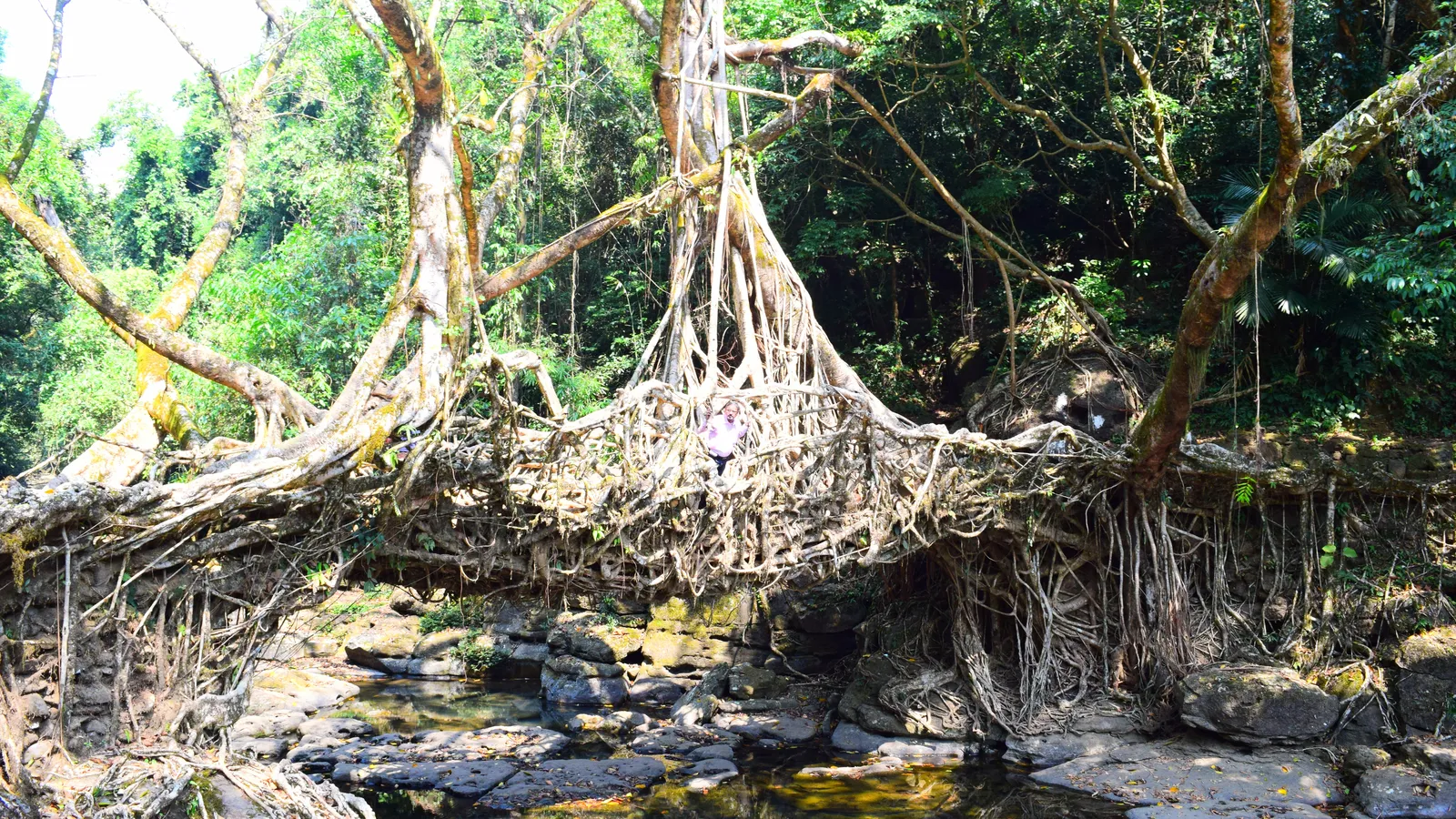
Picture a footbridge that grows thicker as it ages instead of rusting. In the Khasi and Jaintia Hills of Meghalaya, communities grow such bridges from the living roots of the rubber fig, Ficus elastica. A team led by researchers from the Technical University of Munich and the University of Freiburg surveyed them in 2015, 2016 and 2017 and published the results in Scientific Reports in 2019.
How are living root bridges made?
The survey by Ludwig, Middleton and colleagues describes a slow method:
Plant a cutting. A Ficus elastica cutting is planted on one bank of a river or canyon.
Build a guide. Once the tree is mature, it drops aerial roots from its branches. Builders wind these roots onto a deadwood framework, mainly bamboo, and steer them across the gap.
Root the far end. When a root reaches the other bank it is planted in the soil. It then shortens, thickens and sends out daughter roots, which are trained the same way.
Tie and twist. Roots are knotted or twisted together, either at a single point or along their length, and young free-hanging roots are used to tie older ones together.
Keep going. Generations of builders add to the same bridge over decades or centuries, rarely with a clear or consistent plan.
The survey documented 76 bridges between 2 and 52.7 metres long, and 58 of the 73 measured lengths, almost 80%, were shorter than 20 metres (Ludwig et al., 2019). Some bridges are several hundred years old. One bridge the team examined, with roots about 7, 18 and 66 years old, was still not fully functional after 66 years of growth.
The temporary bamboo scaffold has clever physics of its own, which we explain in why puja pandals are built from bamboo.
Why does a root bridge get stronger as it ages?
The 2019 paper points to three processes:
Roots come under tension. Once anchored, the roots visibly tighten, straighten and thicken. The authors link this to tension wood, which makes newly anchored aerial roots contract and press against their neighbours.
Roots fuse. Where roots are pressed together they start to inosculate: two living plant parts graft naturally into one. The finished joint can be so smooth that the original roots cannot be told apart.
Roots grow wider. A root can keep adding wood through secondary growth, possibly in response to load, so a thin cord slowly becomes a thick beam.
The roots also change shape with their job. 72% of the measured vertical roots had a roughly circular cross-section. Among roots of comparable size (cross-sections under 140 mm²), horizontal roots were more oval, taller than they were wide, and inverted-T cross-sections appeared only in horizontal roots, with the extra growth on the lower side (Ludwig et al., 2019).
The authors found no published description of how these fused joints form inside the roots. For the opposite trick, keeping a tree small on purpose, read the plant biology of how a bonsai stays small.
How much load can a living root bridge carry?
Neither study we checked reports a measured load capacity for a whole bridge. The 2019 survey lists the loads a bridge faces (its own weight, wind on the tree, people crossing, and floodwater in the monsoon) and says each bridge's mix of growth and maintenance makes "simple mechanical analysis unfeasible".
The closest load study is a 2019 conference paper by F. A. Hassan and C. J. Burgoyne at ICCEA 2019, held in the University of Moratuwa repository. They pulled 56 free-hanging aerial roots in tension and compared them with test results from 41 roots that had been prestressed almost to failure. Strength and stiffness fell as root diameter rose, and prestressed roots were stronger and stiffer on average. They also built a 3D model of the Nohwet root bridge from 92 photographs for a finite element analysis under three loading conditions. Their conclusion: a bridge's real strength comes from roots grown in successive layers over several decades, forming a complex network.
Worked example: can a root's shape make it stiffer?
You can test the 2019 survey's shape finding with Class 11 physics. A beam resists bending through its second moment of area, I, which depends on shape as well as area.
Circle of radius r: I = πr⁴/4.
Ellipse with half-width a and half-height b, bent up and down: I = πab³/4.
Keep the same area, so ab = r², and make it twice as tall as wide, so b = 2a. Then a = r/√2 and b = √2 r.
Substitute: I = π(r/√2)(√2 r)³/4 = 2 × πr⁴/4.
Same amount of wood, twice the bending stiffness. Material placed far from the centre does more work, which is why steel girders are I-shaped. The 2019 paper suggests bending loads could explain the root shapes but did not test it, so treat it as a hypothesis worth arguing about.
If second moment of area is new to you, the Fermi Concept Library covers every concept in physics, chemistry, biology, mathematics and computing, if you want to fill that gap first. For the steel-and-concrete way to cross a river in the Northeast, see how the Bogibeel bridge was built across the Brahmaputra.