On this page
On 25 December 2018 the Prime Minister dedicated the Bogibeel bridge, which crosses the Brahmaputra between the Dibrugarh and Dhemaji districts of Assam (PIB). In May 2017 he had opened the 9.15 km Dhola-Sadiya bridge further upstream (PIB). They solve the same problem in opposite ways, and both teach physics you study for boards and JEE.
How was Bogibeel bridge built?
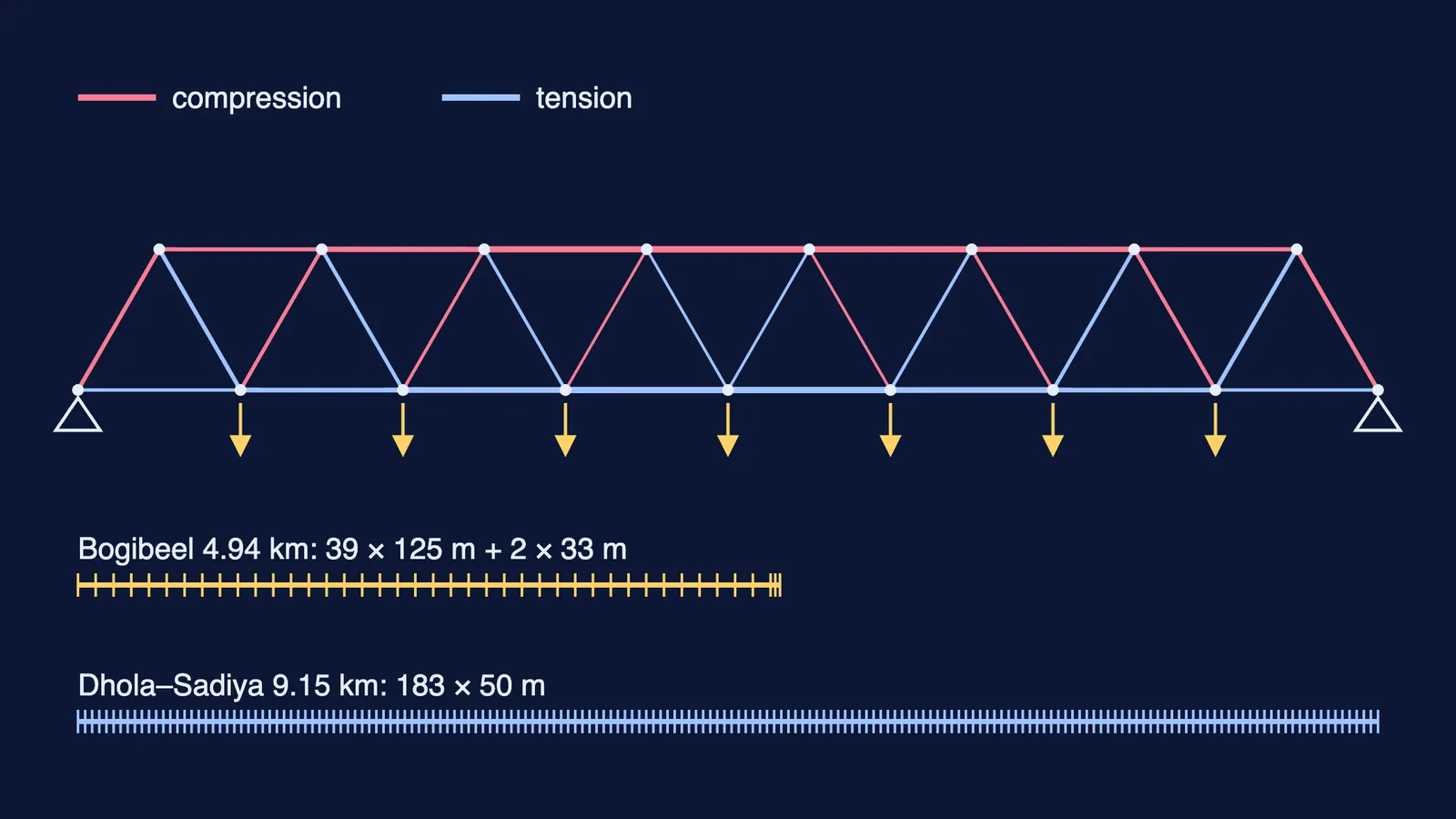
Bogibeel is 4.94 km long, with a double-track broad-gauge railway on the lower deck and a three-lane road on the upper deck, reports Railway Gazette. Its welded steel superstructure has 39 spans of 125 m and two spans of 33 m. Check the arithmetic yourself: 39 × 125 + 2 × 33 = 4,941 m.
The design is a Warren truss: top and bottom chords joined by zigzag diagonals that form a row of triangles. Hindustan Construction Co (HCC) told Railway Gazette it is India's first fully welded Warren truss girder type steel bridge, its members joined by welds rather than rivets or bolts.
The steel was erected by incremental launching: the girder is assembled behind one end and pushed forward over the piers a section at a time, instead of being lifted into place over the water. HCC told the magazine this was the technique's first use for superstructure erection in India, and says Bogibeel is the world's longest incrementally launched steel bridge. The report also records:
Gammon India built the concrete piers; a consortium of HCC, DSD Brückenbau and VNR Infrastructures built the steel superstructure.
Copper-bearing steel plates reduce corrosion, and a material protection system deals with the humidity.
The bridge is designed for earthquakes of magnitude above 7.0.
Approved in 1997, construction did not begin until 2007, and the cost rose from Rs 18 billion to Rs 59 billion.
Why are triangles so strong?
A triangle cannot change shape unless a side changes length; a square can fold into a rhombus without any side stretching. So a truss is built from triangles: a load at the joints becomes pure pushing (compression) or pulling (tension) along each member.
With supports at its ends, the truss's top chord is squeezed, the bottom chord stretched, and the diagonals alternate. Forces are largest in the chords at mid-span and in the diagonals near the supports, as the diagram at the top shows.
This is the method of joints: at every joint, the member forces must add to zero in both directions. If you get stuck on which members push and which pull, the Fermi Problem Library has worked problems with a step-by-step solver that explains the reasoning rather than printing an answer. For a steel railway bridge built on a different principle, see how the Forth Bridge cantilever was explained with a human model.
How is the Dhola-Sadiya bridge different?
Dhola-Sadiya, also known as the Bhupen Hazarika bridge, is concrete, not a steel truss. Construction World reports 183 spans: 101 over the floodplains and 82 over the river. Indian Infrastructure gives each span as 50 m, and 183 × 50 m is exactly the official 9,150 m.
The deck is a segmental concrete box, externally post-tensioned with high-tensile strands.
Each 50 m span was assembled from 15 precast segments, 2,745 segments in all.
The 182 piers each stand on four bored cast-in-situ piles 40 m long.
The site is in seismic zone 5, so seismic arresters stop the deck sliding sideways or falling off the piers.
Indian Infrastructure says construction began in 2011 and the bridge cut the Assam-Arunachal trip from six hours to one. PIB says it crosses the Brahmaputra; both engineering reports name the Lohit, a major tributary.
Why is the Brahmaputra so hard to bridge?
Jogendra Nath Sarma and Shukla Acharjee, writing in Geosciences (2018), describe the Brahmaputra in Assam as a wide braided river. The mean channel width in Assam grew from 5,949 m in 1912-1928 to 9,012 m in 2009. Discharge can change by about 17,000 cubic metres per second within 24 hours, and the daily mean sediment discharge during the monsoon is 2.0 million tonnes. The authors list erodible alluvial banks and high width-to-depth ratios among the causes of braiding.
What the river demands, and how each bridge answered:
Length: the channel wanders, so the bridge must span the floodplain too (101 of Dhola-Sadiya's 183 spans, per Construction World).
Depth: the bed is soft sediment, so foundations go deep, like Dhola-Sadiya's 40 m piles.
Time: HCC told Railway Gazette about strong currents, bank erosion and short working periods.
Earthquakes: Bogibeel's magnitude-7 design and Dhola-Sadiya's arresters.
Air: humidity and corrosion, hence Bogibeel's copper-bearing steel plates and protection system.
Other Himalayan rivers are just as restless: see why the Kosi keeps changing its course. Long spans must also be checked for vibration, which is why soldiers break step on a bridge.
Next time you see a photo of Bogibeel, find the chord that is being squeezed.