On this page
The Forth Bridge in Scotland opened on 4 March 1890, designed by the engineers Sir John Fowler and Sir Benjamin Baker (Forth Bridge, Wikipedia). The body that looks after the Forth crossings calls it the world's first major steel structure, and says it held the record for the world's longest span for 28 years (The Forth Bridges). One of its best-known explanations is a photograph of three men, two chairs, sticks and bricks.
What does the Forth Bridge human cantilever photo show?
In a demonstration in 1887, the Japanese engineer Kaichi Watanabe was supported between Fowler and Baker sitting in chairs (Forth Bridge, Wikipedia). The photo shows him suspended between them, their arms forming the cantilever (Kaichi Watanabe, Wikipedia).
The architectural historian Angelo Maggi credits the photograph to Evelyn George Carey, the project's official photographer. He describes Watanabe as a student of Fowler and Baker, and traces how Baker used a living model to explain the cantilever principle in a talk at the Royal Institution in 1887 (Maggi, Journal of Civil Engineering and Architecture, 2019). Maggi quotes a description from Chambers's Journal of 1 September 1888: the men's arms and the anchorage ropes "come into tension", while their bodies and the sticks "come into compression". Readers were asked to "imagine the chairs one-third of a mile apart".
Here is how each part maps onto the steel:
The two seated men are the two cantilevers, each standing on its own pier (the chairs).
Their arms are the top members of the steelwork, pulled in tension.
The sticks pushing from the chair to each hand are the lower members, squeezed in compression.
The short seat slung from their inner hands is the central girder between the two cantilever tips, and Watanabe sitting on it is the load.
The piles of bricks stand for the weighted end piers that hold the outer arms down.
What is a cantilever, and why did the Forth Bridge use one?
A cantilever is a structural element firmly attached to a fixed structure at one end and unsupported at the other (Cantilever, Wikipedia). Temporary cantilevers are often used where falsework (props underneath) cannot be, for example over a river.
The Forth Bridge has two main spans of 1,700 feet; each is made of two 680-foot cantilever arms supporting a central 350-foot span (Forth Bridge, Wikipedia). Safety mattered too. Maggi records that the Tay Bridge collapse of 1879 killed 75 people, and that Fowler and Baker applied safety rules so restrictive that their project appeared to be risk-free (Maggi, 2019).
How do tension and compression work in the human cantilever?
You can put numbers on the photo with one free-body diagram. These are our own illustrative values, not measurements of the 1887 model.
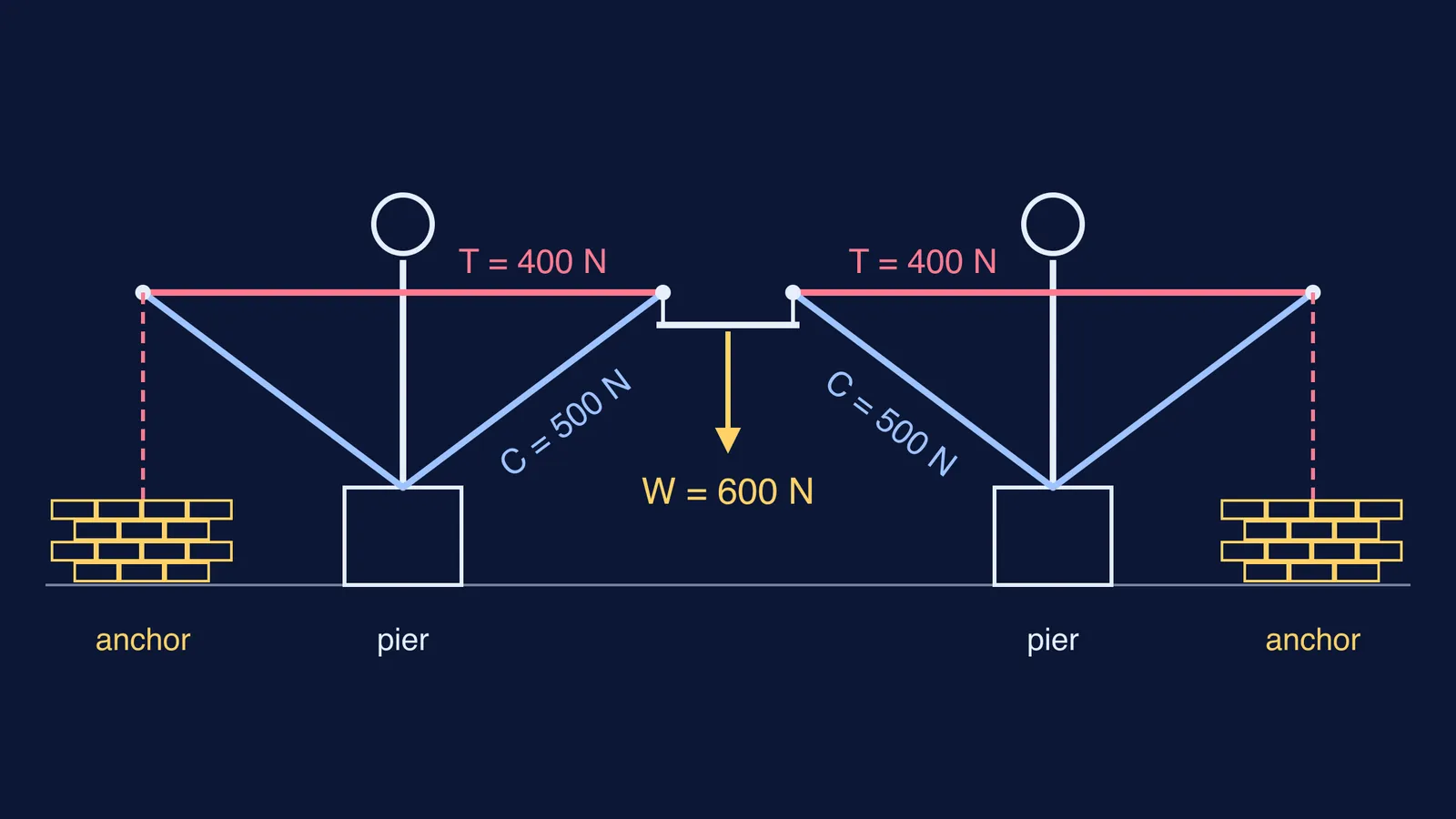
Say the person in the middle weighs W = 600 N. By symmetry each inner hand carries 300 N.
Take the hand 0.8 m out from the shoulder and the foot of the stick 0.6 m below the shoulder. The stick is then 1.0 m long: a 3-4-5 triangle.
At the hand, only the stick can push upward. Its vertical share is 3/5 of its force C, so C × 3/5 = 300 N, giving C = 500 N of compression.
The stick also pushes the hand outward with 4/5 of C, which is 400 N. The arm must pull back with T = 400 N of tension.
Each stick pushes with more force than the 300 N it holds up, and flatter sticks would raise both forces.
Why do the bricks matter?
Take moments about one man's body. The 300 N at his inner hand tries to tip him towards the middle; if his outer hand is the same distance out, it needs a matching 300 N pulling down on it, or he would rotate forward. The bricks are that anchor. On the real bridge, the cantilever end piers are weighted with cast iron for the same reason (Forth Bridge, Wikipedia).
This is the same move as choosing a torque axis to remove unknowns, and the support forces behave like those in a beam resting on two supports.
The Fermi Simulation Lab has interactive simulations for ideas like this, and the Fermi Problem Library has worked problems with a step-by-step solver that explains the reasoning.
How can you build a human cantilever at home or in class?
You need three people, two sturdy chairs, four broom handles and a short plank. Keep everything at sitting height.
Two people sit facing each other, about one plank-length apart.
Each holds a broom handle in each hand, with the foot of each handle braced against the chair.
Rest the plank between the inner hands and add a school bag as the load.
Ask each "beam" what their arms feel (a pull) and what the stick feels (a push).
Now ask a friend to hold each person's outer wrist down. Notice whether the frame feels steadier.
For another engineer who tested ideas on his own structure, read how Gustave Eiffel measured air resistance with his tower.