

On this page
Finding the upward reaction forces on a beam resting on two supports is a core skill in rigid body mechanics for Class 11 physics and entrance examinations like JEE Main. In practical structures and physics problems, loads rarely sit dead in the centre. Vehicles stop off-centre on bridge spans, cranes hoist containers near one pier, and lab weights hang unevenly along a metre scale. Understanding how an off-centre load redistributes normal contact forces between supports turns a two-variable equilibrium problem into a clear, direct calculation.
What conditions govern a beam resting on two supports?
For a rigid horizontal beam to remain stationary without accelerating or rotating, it must satisfy two fundamental laws of static equilibrium detailed in OpenStax University Physics:
Translational equilibrium (ΣF = 0): The vector sum of all external forces acting on the beam must be zero. For a horizontal beam under gravity with vertical reactions, the upward normal forces from the two supports (R_A and R_B) must balance the total downward load: ΣF_y = R_A + R_B − W_total = 0.
Rotational equilibrium (Στ = 0): The vector sum of external torques about any chosen axis must be zero. As defined by HyperPhysics at Georgia State University, torque is the product of applied force and perpendicular lever arm: τ = F × r.
Vertical force balance alone provides only one equation with two unknowns. Rotational equilibrium supplies the second independent equation needed to isolate each reaction. Students encounter this same balance when finding the mass of a metre scale using the principle of moments.
Why should you take moments about one of the supports?
When an object is in static equilibrium, net torque equals zero about every point in space. However, choosing your pivot strategically eliminates unnecessary algebra.
According to static equilibrium principles in OpenStax University Physics, the torque produced by any force acting directly at the pivot is zero because its lever arm is zero (r = 0, so τ = 0). If you place the pivot at support A, reaction force R_A exerts zero moment. It drops out of the torque equation entirely, allowing you to solve for reaction R_B in a single step.
Once R_B is known, R_A follows immediately from vertical equilibrium: R_A = W_total − R_B. Alternatively, taking moments about support B determines R_A independently, giving you a built-in verification check.
How do you calculate reactions for an off-centre load step by step?
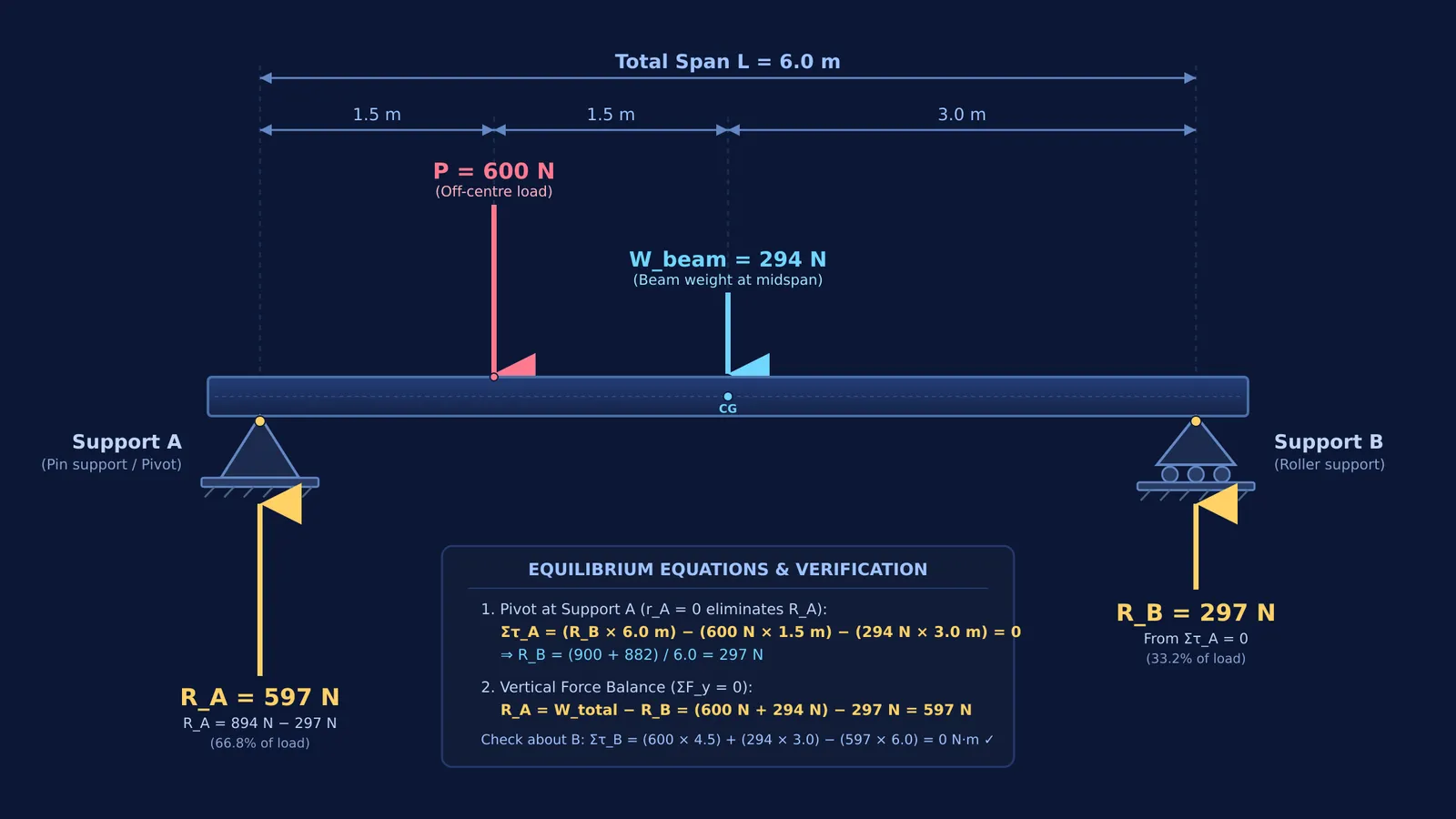
Consider a problem standard in the CBSE Senior Secondary Curriculum and tested by the National Testing Agency: a uniform beam AB of length L = 6.0 m and mass 30 kg rests on supports at its ends, A (x = 0 m) and B (x = 6.0 m). A concentrated downward load P = 600 N is placed at x = 1.5 m from support A. Taking g = 9.8 m/s²:
Identify the forces: The beam's weight acts at its centre of gravity at midspan (x = 3.0 m): W_beam = 30 kg × 9.8 m/s² = 294 N. The point load is P = 600 N at x = 1.5 m. Total downward load is W_total = 600 N + 294 N = 894 N.
Sum moments about support A: With counterclockwise moments positive as outlined in HyperPhysics torque analysis, Στ_A = (R_B × 6.0 m) − (600 N × 1.5 m) − (294 N × 3.0 m) = 0. This simplifies to R_B × 6.0 m = 900 N·m + 882 N·m = 1782 N·m, yielding R_B = 297 N.
Solve for R_A: From translational equilibrium, R_A = 894 N − 297 N = 597 N.
Verify about support B: Στ_B = (600 N × 4.5 m) + (294 N × 3.0 m) − (R_A × 6.0 m) = 0. Thus R_A × 6.0 m = 2700 N·m + 882 N·m = 3582 N·m, confirming R_A = 597 N.
Support A carries more load (597 N vs 297 N) because the concentrated weight sits three times closer to A than to B. When working through complex statics numericals, the Fermi Problem Library offers worked problems with a step-by-step solver that explains the reasoning rather than printing an answer.
What common mistakes do students make in beam equilibrium problems?
In static equilibrium problem-solving guidelines outlined in OpenStax University Physics, three common errors frequently appear under exam conditions:
Omitting the beam's own weight: Unless a problem states the beam is light or negligible in mass, its weight must be applied at its centre of gravity.
Calculating lever arms from the wrong point: Distances in torque equations must be measured from the chosen pivot, not automatically from the left edge. When setting moments about support B above, the lever arm for load P was 4.5 m (6.0 m − 1.5 m), not 1.5 m. Tracking positions relative to pivots is also essential when calculating torque as r × F with vectors.
Misidentifying support spans: On overhangs or cantilevered sections, supports are not at the beam ends. Always measure the lever arm between the pivot and the reaction line of action, a habit reinforced when solving rotational equilibrium on ladders and hinged rods.
If you want to visualise how normal forces change as a mass moves along a plank, the Fermi Simulation Lab provides interactive simulations for ideas that are easier to see than to read. Drawing a free-body diagram and pivoting about a support keeps every beam reaction problem clear and error-free.


