

On this page
Every puja season, crews lash bamboo skeletons together to hold up the cloth and lights of Durga Puja pandals. In Kolkata, many of the pandal makers come from districts such as Paschim and Purba Medinipur, and from August "the sight of men at work on structures of bamboo and cloth is commonplace", Village Square reported. Why bamboo, and not steel pipe or sawn timber? The answer is in the plant's stem.
Is bamboo a tree or a grass?
Bamboo is a grass: "a member of the true grass family Poaceae", as Sayyad Mannan, Paul Knox and Sumit Basu put it in a 2017 paper in Royal Society Open Science.
Indian law caught up the same year. The Indian Forest (Amendment) Bill, 2017%20Bill,%202017.pdf) notes that bamboo, "though taxonomically a grass", had been treated as a tree under the 1927 Act, so moving it needed a permit. The bill dropped "bamboos" from the Act's definition of tree, so bamboo grown outside forests no longer needs a permit under that Act to be felled or transported, easing a hardship farmers had faced.
The stem, called the culm, is a tube: hollow segments separated by solid partitions at the nodes, the rings you see on every pandal pole. For more on the plant itself, read why bamboo grows so fast for a grass.
Why is a hollow bamboo pole so strong for its weight?
Three features work together.
The material sits where bending needs it. When a pole bends, its outer edge stretches or squeezes most while the centre barely changes length. A tube keeps material at the edges and spends none on the middle, the same trick explained in why an I-section beam resists bending.
The stiff fibres are packed towards the outside. In the species Mannan's team studied, Dendrocalamus strictus, soft parenchyma tissue falls from almost 77% of the cross-section at the inner edge to only 36% at the outer edge (Mannan et al., 2017). Its place is taken by vascular bundles wrapped in fibre sheaths, and the authors found bamboo's stiffness depends most sensitively on the size and arrangement of those sheaths. Revise the tissue types with parenchyma, collenchyma and sclerenchyma.
The nodes help stop the tube flattening. The paper says the solid partitions seem "to prevent ovalization of the cross section during bending, thereby preventing Brazier buckling", the kink you get when you bend a drinking straw too far.
The paper puts bamboo's density at about 700 kg/m³, which "results in a significantly higher strength to weight ratio" than steel (Mannan et al., 2017). For a pandal crew, that means long poles light enough to carry and tie by hand.
Worked example: how much stiffer is a tube?
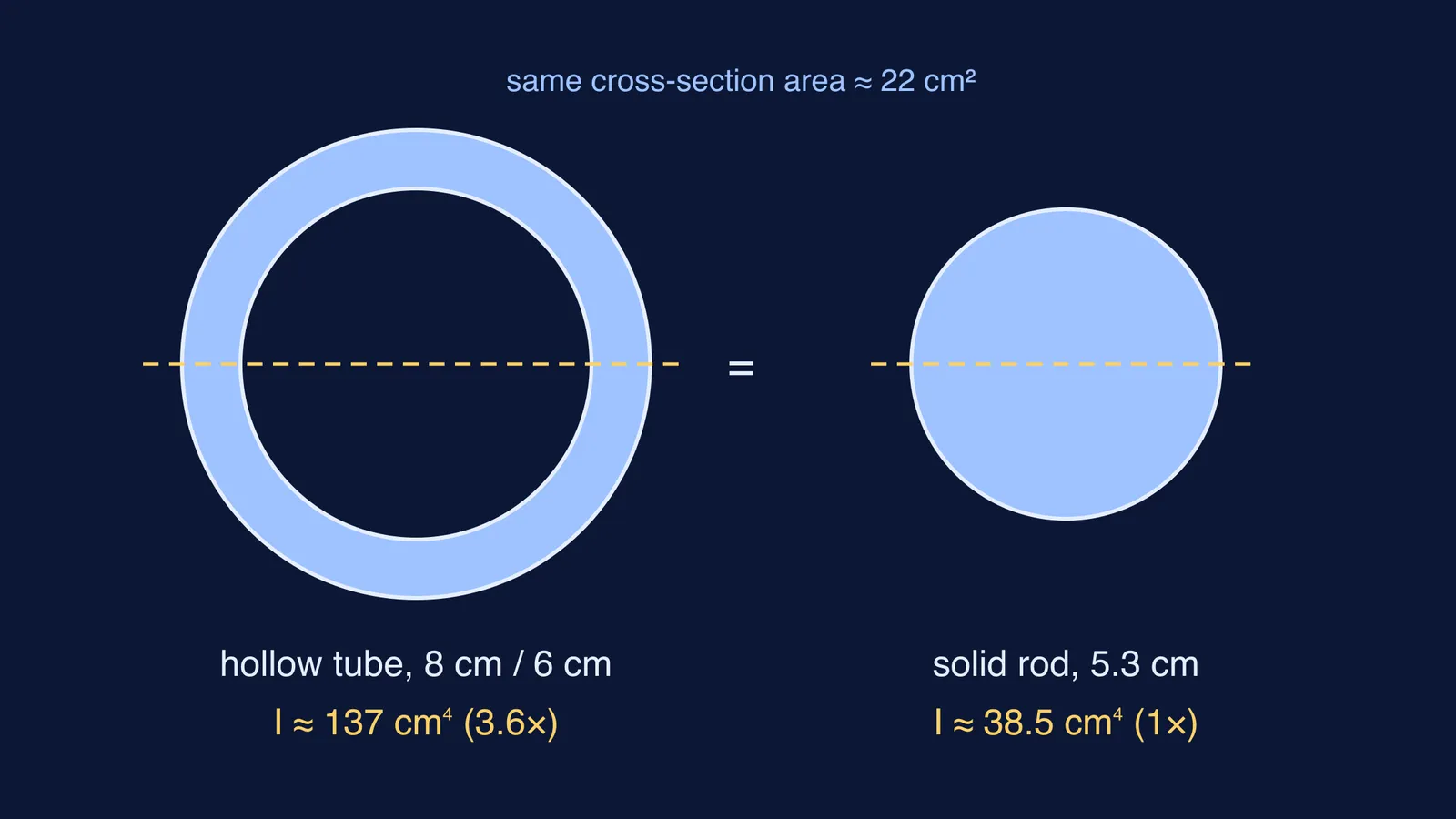
Take the same amount of material and shape it two ways. Bending stiffness depends on the second moment of area, I = π(D⁴ − d⁴)/64, where D is the outer diameter and d the inner one.
Tube: D = 8 cm, d = 6 cm. Area = π/4 × (64 − 36) ≈ 22 cm².
Solid rod, same area: D² = 28, so D ≈ 5.3 cm.
Tube: I = π/64 × (4096 − 1296) ≈ 137 cm⁴.
Rod: I = π/64 × 28² ≈ 38.5 cm⁴.
Same weight, about 3.6 times the bending stiffness. Divide I by the outer radius to get the section modulus: about 34 cm³ for the tube against 14.5 cm³ for the rod, so the tube carries roughly 2.4 times the bending moment before its outer fibres reach their limit. This assumes uniform material; real bamboo also puts its strongest fibres in that outer ring.
The Fermi Simulation Lab has interactive simulations for ideas that are easier to see than to read.
Does bamboo have weaknesses?
Yes, and good answers mention them. A 2022 study in Materials Today: Proceedings compiled published tension tests on three bamboo species from Sarawak, Malaysia, and found the reported average ultimate tensile strength "was less than half of the characteristic yield strength of steel". It also found nodes significantly weaker than the stretches between them, against earlier claims that nodes are mechanically helpful. Poles also vary: Mannan's team note there is "no accepted methodology for standardizing a species of bamboo for a particular structural purpose". Bamboo wins on strength for its weight, not on strength alone.
How do you write this up in an exam answer?
If a question asks why bamboo, bones or bicycle frames are hollow, use this plan:
Name the load: bending, not just pulling or squashing.
Say where the stress is: largest at the outer surface, near zero along the middle (the neutral axis).
Link shape to stress: a tube keeps material where stress is high, so it gains stiffness without extra weight.
Add the biology: fibre-rich tissue near the outer wall, with nodes that help stop the tube flattening.
If one step is a gap for you, the Fermi Concept Library has a lesson for every concept in physics, chemistry, biology, mathematics and computing. Next time you pass a pandal going up, look for the rings on each pole: plant structure doing an engineer's job.


