

On this page
Steel girders on bridges and building sites are often shaped like a capital I. You can explain that shape with a formula from your Class 11 physics textbook.
Why do beams have an I-shaped cross section?
The NCERT Class 11 Physics chapter Mechanical Properties of Solids gives the sag of a bar of length l, breadth b and depth d, supported near its ends and loaded at the centre by a weight W, as δ = Wl³/(4bd³Y), where Y is Young's modulus.
The sag is proportional to d to the minus three but to b only to the minus one, so NCERT concludes that increasing the depth is more effective than increasing the breadth. The same chapter says the I-section provides a large load-bearing surface and enough depth to prevent bending, and that it reduces the weight of the beam without sacrificing strength.
If Y feels shaky, start with our explainer on Young's modulus and elasticity.
What does the neutral axis have to do with it?
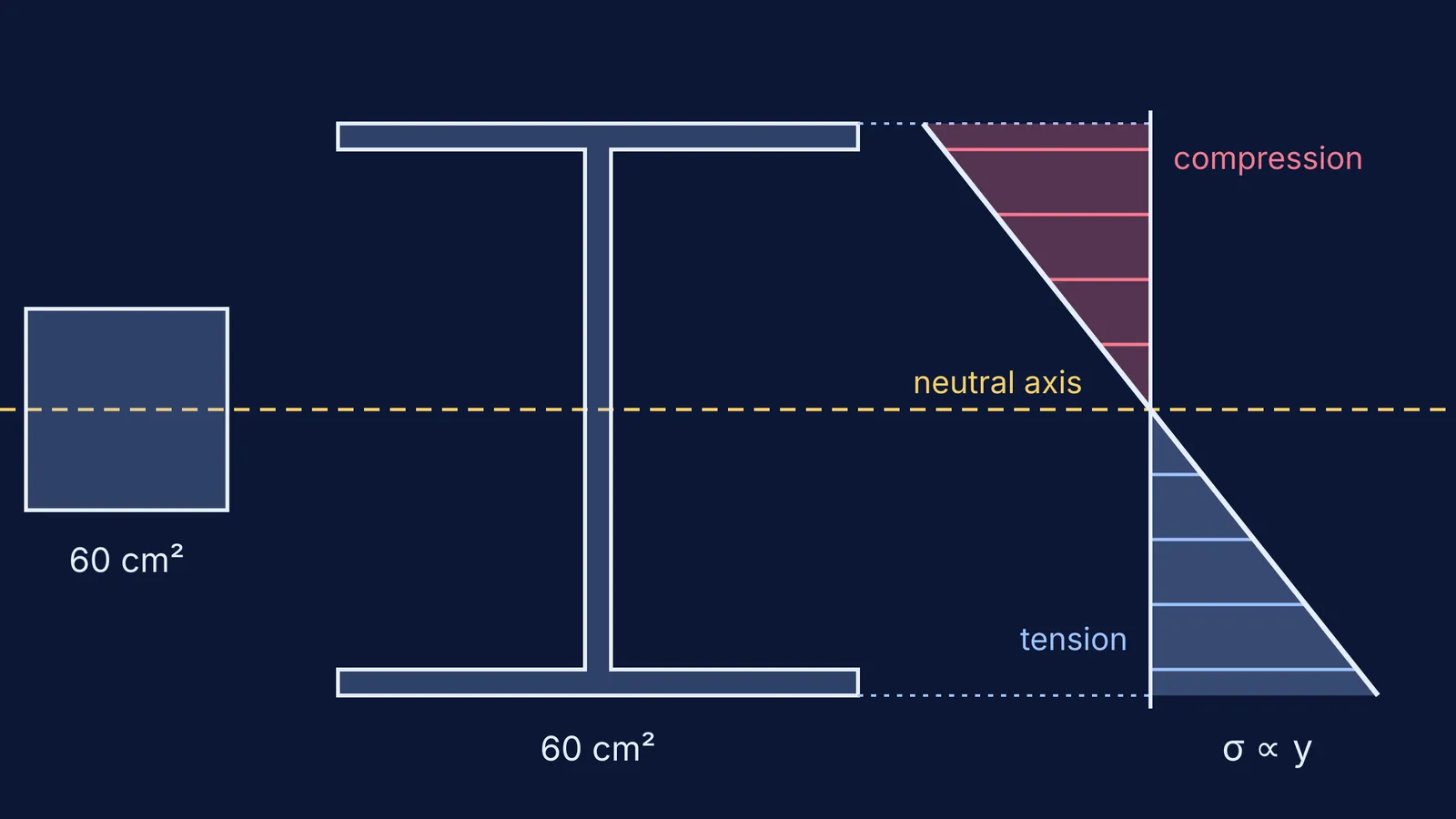
When a beam sags, its top is squashed and its bottom is stretched. MIT's Stresses in Beams notes by David Roylance explain that the stress increases linearly from zero at the neutral axis to a maximum at the outer surfaces. The same notes show that the neutral axis passes through the centroid of the cross-section.
So material near the centre line carries little stress. How much a beam resists bending is measured by the second moment of area, I, which adds up every small piece of area multiplied by the square of its distance from the neutral axis.
For a rectangle of width b and height h, I = bh³/12, as derived in the same MIT notes and in the University of Alberta's statics text. Roylance writes that beams are often made with wide flanges at the upper and lower surfaces to increase I. Substituting I = bd³/12 into NCERT's formula gives δ = Wl³/(48YI): double I and the sag halves.
How much stiffer is an I-beam? A worked example
Take 60 cm² (6000 mm²) of steel and shape it three ways. Every value of I below uses the rectangle formula from the MIT beam notes, adding and subtracting rectangles.
Square bar, side about 77.5 mm: I = 6000²/12 = 3,000,000 mm⁴.
Flat plank, 200 mm wide and 30 mm deep: I = 200 × 30³/12 = 450,000 mm⁴.
I-section, 220 mm deep, two flanges 200 mm × 10 mm and a web 10 mm × 200 mm: I = (200 × 220³ − 190 × 200³)/12 = 50,800,000 mm⁴.
Since sag is proportional to 1/I, the I-section sags about one-seventeenth as much as the square bar and about one-113th as much as the flat plank for the same steel.
Now check where that stiffness comes from with the parallel axis theorem. Each flange contributes 200 × 10³/12 + 2000 × 105² ≈ 22,070,000 mm⁴. The two flanges hold two-thirds of the area but give about 87% of I. If the parallel axis step is rusty, revise it in our post on moment of inertia axis theorems.
A solid square bar as stiff as this I-section needs side⁴ = 12 × 50,800,000, so a side of about 157 mm and an area of about 24,700 mm². That is roughly four times the steel for the same stiffness.
Why not just use a tall, thin plank?
A tall plank is stiff on paper, but NCERT warns that a deep bar can bend sideways unless the load is exactly at the right place, which is difficult to arrange on a bridge with moving traffic. This is called buckling. To avoid it, the textbook describes the I-section as a common compromise: the flanges give the beam width at the top and bottom, and the web keeps enough depth. Try it with paper in our folded paper beam experiment.
How do you write this in an exam answer?
For a short answer, cover four points:
State the formula: δ = Wl³/(4bd³Y), so sag depends on d³.
Say why depth matters: bending stress is zero at the neutral axis and largest at the outer surfaces.
Name the shape's advantage: flanges put material far from the neutral axis, the thin web saves weight.
Add the limit: a very deep, thin bar buckles, so the I-section is a compromise.
For JEE, a common question type is a ratio: two beams of the same material, different b and d, find the ratio of sags. Write δ ∝ 1/(bd³) and cancel everything else before you touch numbers.
Want more practice? The Fermi Problem Library has worked problems with a step-by-step solver that explains the reasoning rather than printing an answer, and the Fermi Concept Library gives every concept in physics its own lesson and its place in the map.


