

On this page
Why does a folded paper bridge hold more weight than a flat sheet?
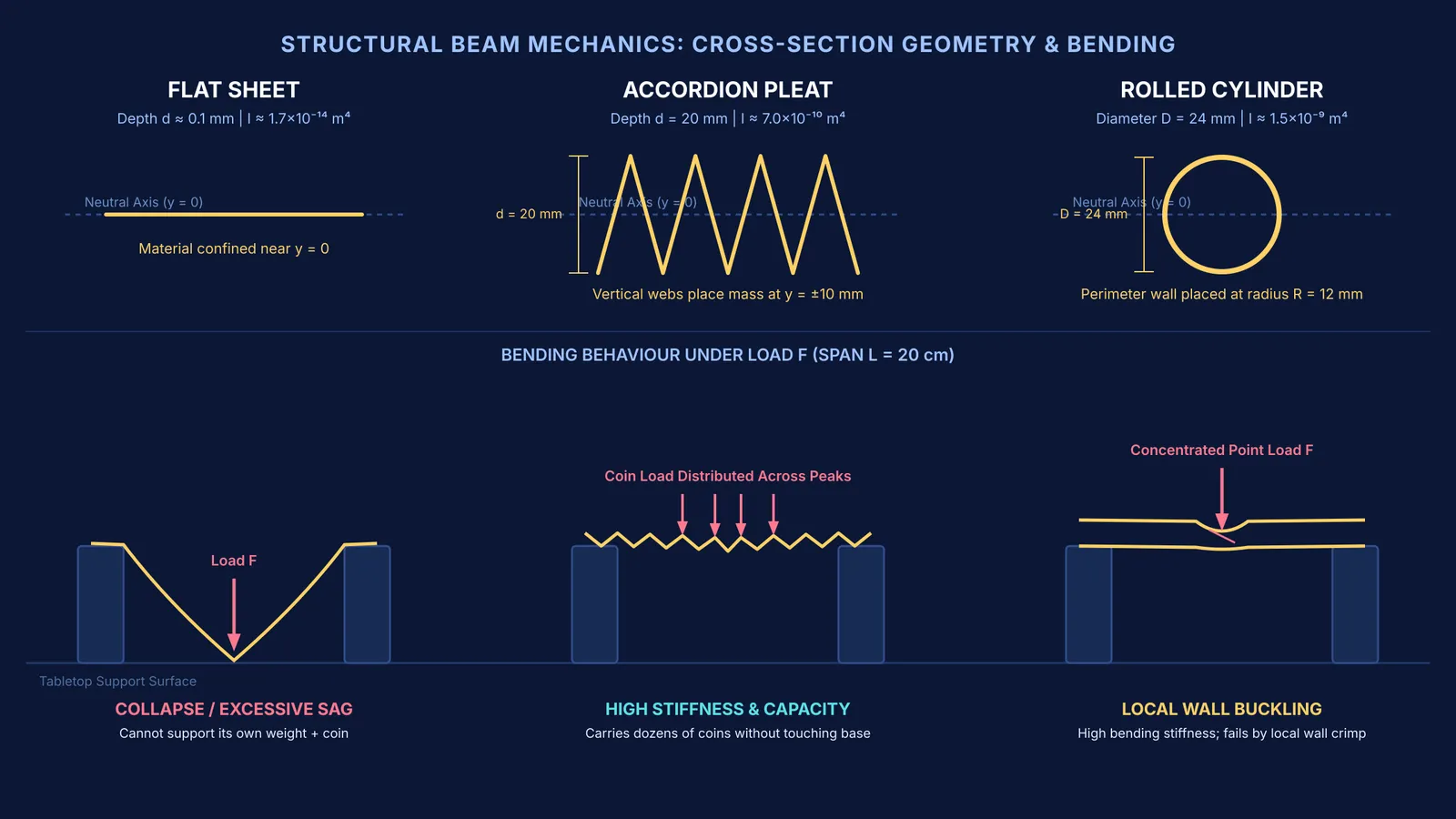
When testing structural stiffness on a tabletop, place a standard sheet of printer paper flat across two books spanning a 20 cm gap. Lacking vertical depth, the flat sheet sags under its own weight and collapses before holding a single coin. Now fold an identical sheet into accordion pleats 20 mm high and rest it across the same 20 cm span. The pleated bridge carries dozens of coins without touching the surface, illustrating the deflection principles analyzed in NCERT Class 11 Physics.
Both bridges contain identical mass and span the same gap. According to the NCERT Class 11 Physics text on the elastic behaviour of solids, the central depression δ of a beam of length l, breadth b, depth d, and Young's modulus Y under central load W is:
δ = (W l³) / (4 b d³ Y)
Because depth d is cubed in the denominator, doubling d cuts sag eightfold. In a flat sheet, effective depth is merely the paper thickness (about 0.1 mm). Folding the sheet into 20 mm pleats multiplies effective depth by two hundred times, slashing theoretical sag before buckling intervenes. Explore how Young's modulus governs stress and strain to see why elasticity stays constant while shape adds stiffness.
How does cross-sectional geometry create structural stiffness?
When a downward load bends a beam, the top compresses while the bottom stretches in tension. Along the centerline lies the neutral axis, where longitudinal stress equals zero. The bending stress σ at vertical distance y follows the flexure formula:
σ = (M y) / I
Here M is bending moment and I is the second moment of area (∫ y² dA). Because distance y is squared, material far from the neutral axis resists bending far more than material near the center. In the American Journal of Physics, Lawrence N. Virgin demonstrated how altering cross-sectional geometry transforms stiffness while keeping material volume unchanged.
For a flat strip of width b and thickness t, the second moment of area is I = (b t³) / 12. For paper roughly 0.1 mm thick, t³ is 10⁻¹² m³, leaving I near 10⁻¹⁴ m⁴. Folding or rolling redistributes that cross section to distances where y reaches 10 mm or more. As shown in Virgin's structural stiffness research, moving material away from the neutral axis increases I by orders of magnitude, providing rigidity without adding mass.
Flat, folded, or rolled: which paper shape holds the most coins?
Applying the mechanics of structural stiffness and beam geometry explains how different paper cross sections behave:
Flat sheet: With an effective depth of 0.1 mm, its second moment of area is negligible; it buckles under minimal load before supporting a coin.
Rolled tube: Rolling the sheet into a taped cylinder moves material far from the neutral axis. While this tubular shape provides high bending stiffness, localized point loads crush the thin wall, causing sudden creasing.
Accordion pleat: Folding the sheet into sharp triangular ridges 15 to 20 mm high creates vertical webs that maximize the second moment of area and spread coin weight across multiple peaks.
Civil engineers apply this principle directly. In the NCERT mechanical properties text, steel bridge girders use an I-shaped cross section: wide flanges handle tension and compression far from the neutral axis, while a thin web prevents shear. The same geometry makes corrugated cardboard boxes stackable and stiffens corrugated steel roofing against heavy rain.
How can you test paper beam strength using the Predict-Observe-Explain cycle?
Most learners predict that beams made from identical paper will hold equal weight, or that rolled tubes must beat folded shapes. Testing these shapes becomes active inquiry through the Predict-Observe-Explain (POE) framework established by Richard White and Richard Gunstone in their 1992 book *Probing Understanding*. In Science Education, Gunstone and White showed that writing down a prediction with its justification creates cognitive conflict when results contradict intuition, prompting students to replace naive guesses with physical reasoning. Read more on how active engagement reshapes classroom learning.
To run the bridge test:
Prepare setups: Support three identical sheets of A4 paper across books spaced 20 cm apart.
Predict: Write down your predicted ranking (flat, folded, rolled) and physical reasoning.
Observe: Leave beam 1 flat, fold beam 2 into accordion pleats 20 mm high, and roll beam 3 into a taped cylinder. Add coins one by one into a central paper cup until each beam collapses.
Explain: Reconcile observations with the second moment of area and local buckling.
Bridging tabletop experiments with interactive simulations
A paper bridge gives a direct feel for structural mechanics, but paper creases weaken under repeated load. Exploring why interactive simulations support active inquiry shows that pairing hands-on tests with digital models helps students build lasting intuition.
To explore the concepts beyond tabletop paper:
For visualizing internal stresses and testing beam geometries under dynamic loads, students can experiment in the Fermi Simulation Lab, which provides interactive simulations for the ideas that are easier to see than to read.
When working through numerical beam bending or rotational moment problems, the Fermi Problem Library offers worked problems with a step-by-step solver that explains the reasoning rather than printing an answer.


