

On this page
Bamboo looks like a tree and is used like timber, but botanically it is a grass. That one fact explains its two famous habits: shoots that can add more than a metre a day, and flowering that some species delay for decades, then do all at once before dying.
Is bamboo a grass or a tree?
Bamboo is a grass. Bamboos make up Bambusoideae, a subfamily of Poaceae, the grass family, with 115 genera and about 1,450 species (Wysocki and colleagues, BMC Evolutionary Biology, 2015).
The stem, called a culm, is built from segments (internodes) joined at nodes, the rings you can see on any bamboo pole. Its hardness comes from cell walls packed with lignin and cellulose: a 2022 study found that a single growing internode of moso bamboo laid down about 28 mg of lignin and 44 mg of cellulose per gram of dry weight every day (Chen and colleagues, The Plant Cell, 2022).
To see how a grass stem looks under the microscope, read our guide to dicot stem vs monocot stem sections, or how Agnes Arber studied the form of monocots and grasses.
Why does bamboo grow so fast?
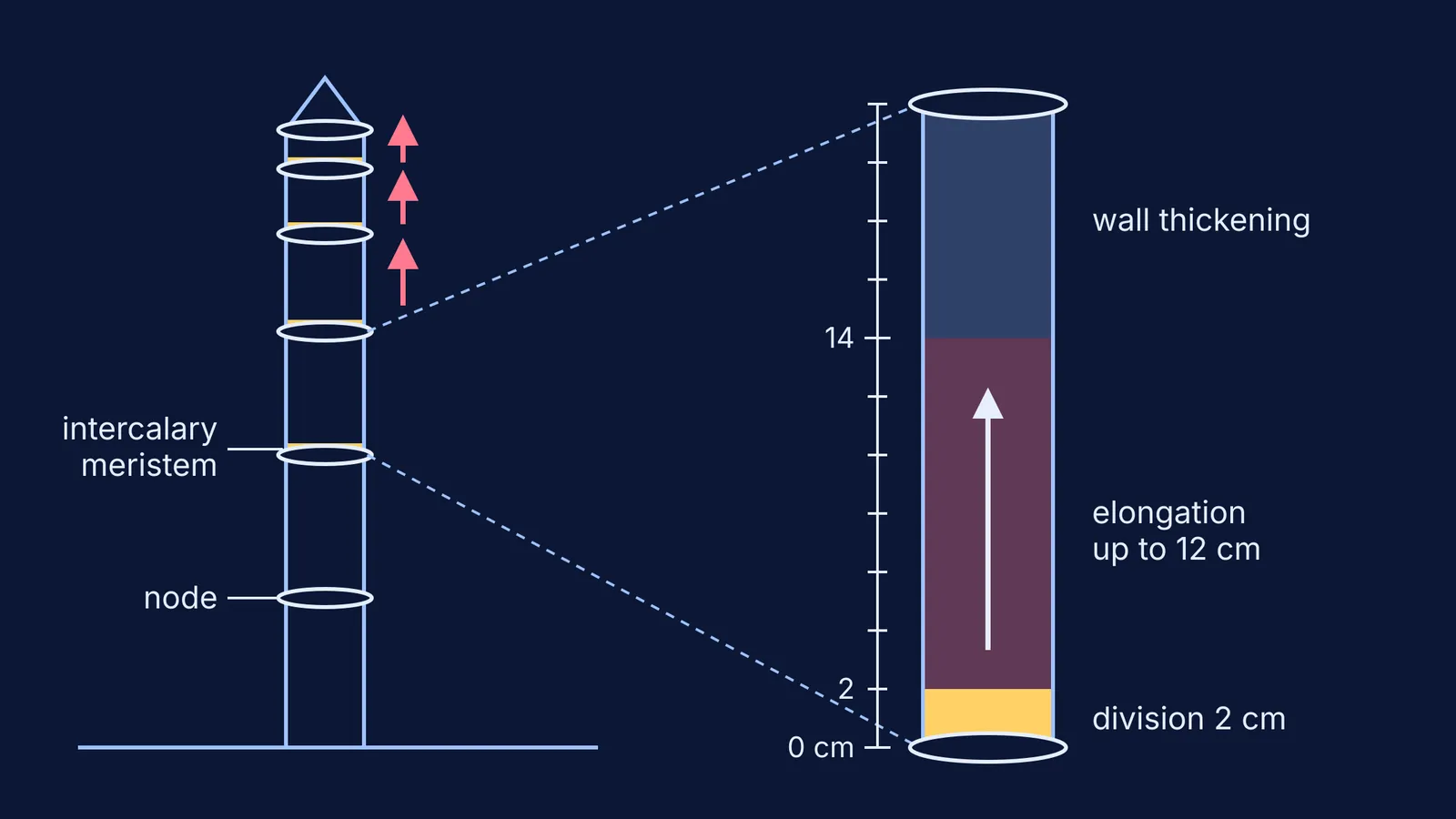
Because it grows in many places at once. Most stems lengthen mainly from a growing tip. Grasses also have intercalary meristems, which a 2025 PNAS paper describes as specialised developmental zones that drive rapid stem elongation in monocots (Qin and colleagues, PNAS, 2025). In that study, the team sampled bamboo's meristem tissue from the segment just above the node.
So each internode pushes itself up from its own base, and several do it at once, like a telescope sliding open.
The numbers come from the Plant Cell study, which examined more than 12,750 internodes from more than 510 culms in 17 moso bamboo populations (Chen and colleagues, 2022):
Moso bamboo (*Phyllostachys edulis*) grows up to 114.5 cm in a day.
A growing internode has a cell division zone about 2 cm long at its base, an elongation zone up to 12 cm long above it, and mature tissue above that where walls thicken.
At its fastest, internode 18 grew 11.8 cm in a day and produced about 570 million cells daily.
That internode finished its rapid growth at 29 cm, after 23 days.
Division happens in a 2 cm band, but elongation runs over up to 12 cm: most of the length comes from cells stretching.
Worked example: how many segments grow at once?
Use the two Plant Cell numbers above (Chen and colleagues, 2022) as a back-of-the-envelope check.
Whole shoot at peak: 114.5 cm per day.
One internode at peak: 11.8 cm per day.
114.5 ÷ 11.8 ≈ 9.7.
So a shoot at record pace needs roughly ten internodes elongating at once, if each ran at internode 18's top speed. Internodes vary, so treat this as rough, but it shows why the growth has to be shared across many segments rather than coming from one tip.
Why does bamboo flower so rarely, and all at once?
Many woody bamboos stay leafy and vegetative for decades, then flower together and die. A 2020 review notes that recorded bamboo flowering cycles range from 3 to 150 years, and that many species stay vegetative "for decades, or even a century, followed by mass synchronous flowering and subsequent death" (Zheng and colleagues, Frontiers in Plant Science, 2020).
The same review credits the ecologist Daniel H. Janzen with the predator escape hypothesis, set out in his 1976 paper Why bamboos wait so long to flower. The idea: if every clump seeds in the same year, seed-eaters cannot eat everything, so more seeds survive.
India has a vivid example. In the northeast, the bamboo *Melocanna baccifera* (muli) is monocarpic, flowers gregariously and has a cycle of 40 to 50 years, which a recent study set at 48 years (Koshy and colleagues, PLOS One, 2022). Locally the flowering and its aftermath are called mautam, or "bamboo death": rats feast on the fruits and, breeding quickly, multiply. The team recorded 456.67 kg of fruit from one clump, and most clumps died within five months of fruiting ending.
How do you explain bamboo's growth in an exam answer?
Use this five-point checklist:
Classify: bamboo is a grass, subfamily Bambusoideae of Poaceae.
Name the meristem: intercalary meristems, near the base of each internode just above a node.
Separate division from elongation: a short division zone feeds a longer zone where cells stretch.
Give one sourced number: moso bamboo, up to 114.5 cm per day (Chen and colleagues, 2022).
Add flowering if asked: monocarpic, gregarious, long cycles, with *Melocanna baccifera* and mautam as the Indian example.
The common slips: calling bamboo a tree, or saying it grows only from its tip. If meristem types still blur together, the Fermi Concept Library has every concept in biology, each with its own lesson and its place in the map, so you can see how one idea connects to the next.
Next time you pass a bamboo pole, count the nodes: each ring once held its own growth zone.


