On this page
If you like biology, want to work in a hospital and are not set on MBBS, cardiac care technology is worth a close look. It is a hands-on allied health course: in the curriculum we looked at, you are in the ECG room by your second year and learning the cath lab by your third.
What does a cardiac care technologist actually do?
A cardiac technologist runs the tests and equipment that cardiologists rely on, and works in three main places.
The ECG room. You record the heart's electrical activity. The practical syllabus at MGM Institute of Health Sciences covers the steps to perform an ECG, positioning patients for different conditions, taking a history, looking after the machine and spotting common recording errors.
The echo lab. Echocardiography uses ultrasound to image the heart. The same syllabus teaches probe and scanner settings, the windows and views used in echocardiography, and how echo reports are written.
The cath lab. In the final academic year, students take cardiac catheterisation and paediatric interventions. The curriculum says graduates should become "an integral member of the cardiac catheterization and electrophysiology laboratory teams", performing procedures "at the direction of a qualified physician".
You work alongside cardiologists, not instead of them, and much of the job is careful routine: preparing the patient, setting up equipment and recording clean data.
If you want to see how the waves on an ECG line up with what the heart is doing, read our guide on matching ECG waves to cardiac cycle events.
Is cardiac care technology a recognised profession in India?
Yes. The National Commission for Allied and Healthcare Professions Act, 2021 (No. 14 of 2021, assented on 28 March 2021) set up a national commission, the NCAHP, to regulate allied health education and practice. Its Schedule names Cardiovascular Technologists, Perfusionists and Electrocardiogram (ECG) or Echocardiogram (ECHO) Technologists under one heading, "Cardio-vascular, Neuroscience and Pulmonary Technology Professional".
Course rules are still being standardised. In July 2026 the Ministry of Health reported that NCAHP has notified 16 competency-based curricula, all mandatory from the 2026–27 academic year. Cardiovascular technology is not on that list. Check NCAHP's current notices, and ask your college how it will adapt if a national curriculum is issued.
How is the course structured, year by year?
Course names vary, so read the syllabus, not just the title. Here is one university's plan, the MGM B.Sc. Cardiac Care Technology curriculum.
Eligibility: a Class 12 pass with Physics, Chemistry and Biology, with a minimum 45% aggregate at this institute.
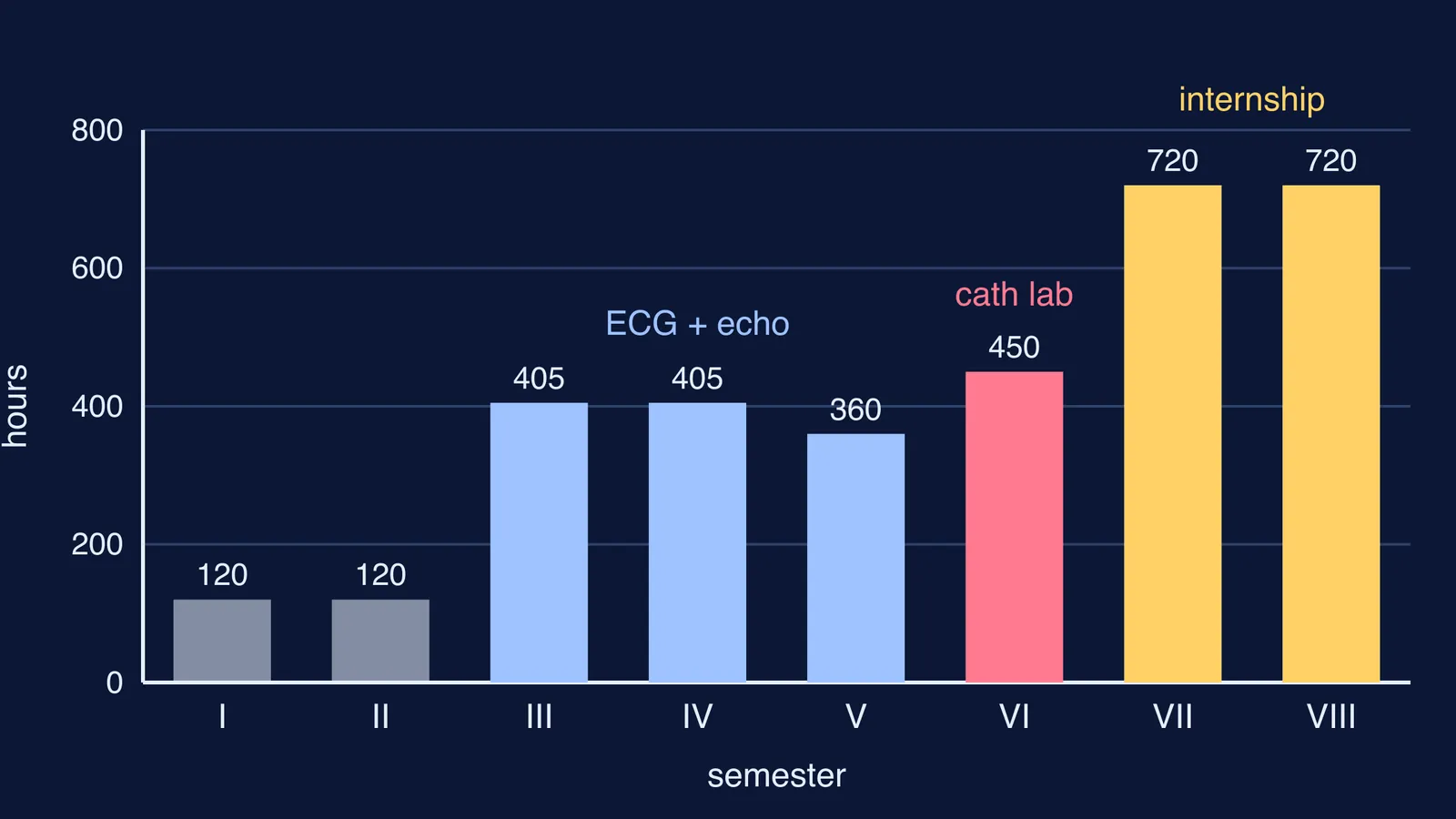
Year 1: anatomy, physiology, biochemistry, microbiology, pathology and community clinical visits.
Semester III: basic ECG and basic echo, plus 405 hours of supervised clinical posting.
Semester IV: cardiovascular diseases and cardiac instrumentation, with another 405 clinical hours.
Semester V: advanced ECG, advanced echo and invasive cardiology, with 360 clinical hours.
Semester VI: cardiac catheterisation and paediatric interventions, with 450 clinical hours.
Year 4: a full internship of 1,440 hours.
That adds up to 1,620 hours of clinical posting before the internship begins, and 3,060 hours once the internship is added. That suits you if you learn by doing.
The theory builds on Class 11 and 12 biology. If the cardiac cycle feels shaky, start with our cardiac cycle pressure graph walkthrough. The Fermi Concept Library has a lesson on each biology and physics concept, so you can fill gaps such as the Doppler effect before echo classes begin.
What is the scope after a cardiac care technology course?
Demand follows disease. The World Health Organization) says cardiovascular diseases are the leading cause of death worldwide, with an estimated 19.8 million deaths in 2022, about 32% of all deaths. WHO adds that over three quarters of these deaths happen in low- and middle-income countries.
The Act's Schedule points to the main job titles: cardiovascular technologist, ECG or echo technologist, and perfusionist (MGM teaches perfusion as a separate degree). Salaries and openings vary by city and hospital, so ask working technologists and the placement cell for current figures rather than trusting a brochure. To compare paths, see our guide to allied health science courses after 12th PCB.
What should you ask a college before you join?
Can I see the full semester-wise syllabus, with clinical posting hours?
Which hospital do students rotate in, and does it have its own cath lab and echo machines?
How many students share one ECG machine or echo machine during practicals?
Who supervises clinical postings: a cardiologist, a senior technologist or both?
Is the internship paid or unpaid, and where is it done?
How will the course follow NCAHP rules as they are notified?
Where did last year's graduates go to work?
If a college cannot answer questions 1 and 2 clearly, look elsewhere. If you are not sure where to start with the Class 12 biology behind all this, Fermi's AI tutor can work out what you already know and build a plan for the session, so you begin with your real gaps.