On this page
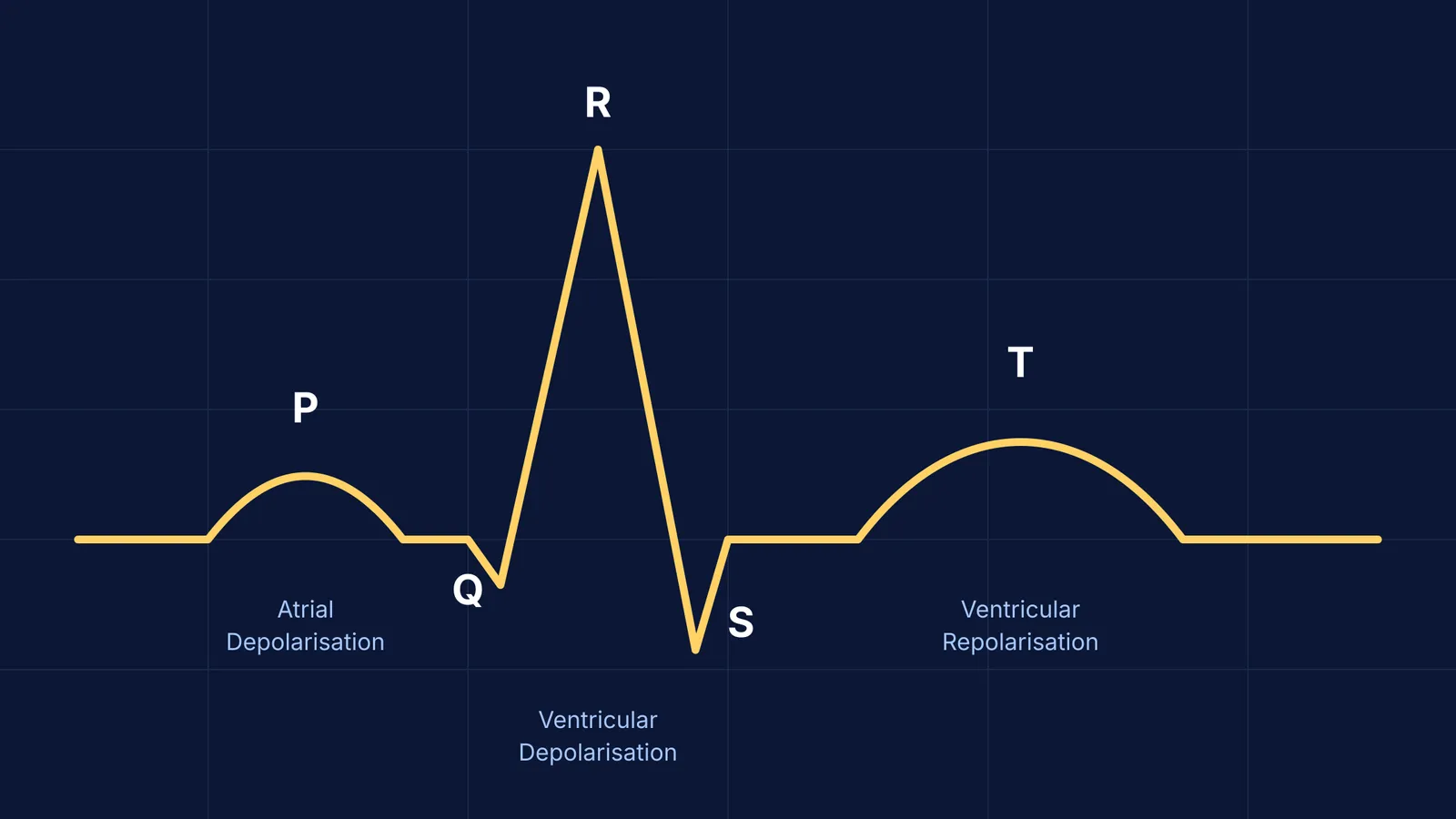
An electrocardiogram (ECG) records the electrical activity of the heart over a cycle that takes about 0.8 seconds. Memorising the sequence of letters is one thing, but visualising how those electrical signals control the mechanical pumping of blood is much harder.
When you sit down with Fermi's AI tutor, you can move past rote memorisation by asking it to connect the graph directly to the biology.
What do the P, QRS and T waves mean?
A standard ECG trace consists of three main components that correspond to electrical events in the heart, as detailed in the NCERT Class 11 Biology textbook.
P-Wave: This small upward bump represents the electrical depolarisation of the atria, which leads to the contraction of both atria.
QRS Complex: This sharp peak marks the depolarisation of the ventricles, which triggers ventricular contraction (systole).
T-Wave: This wider bump represents the repolarisation of the ventricles, as they return to a normal, relaxed state.
To learn this deeply, do not just memorise the list. Instead, look at a cardiac cycle pressure graph and predict exactly when the valves will snap open and shut.
How can I ask the AI tutor to test my knowledge?
When you use the Fermi Concept Library to revise the circulatory system, you are in charge of the session. Rather than asking for a summary you could easily read in a book, give the tutor a script that forces you to practice active recall.
How long do the cardiac cycle events last?
A healthy resting heart beats about 72 times per minute, dividing the 0.8-second cycle into distinct phases (NCERT Biology).
Atrial Systole: The atria contract, increasing the flow of blood into the ventricles by about 30%.
Ventricular Systole: The ventricles contract. The tricuspid and bicuspid valves close—creating the first heart sound, "lub"—and blood is pumped out into the arteries.
Joint Diastole: All four chambers relax. The semilunar valves close to create the second heart sound, "dub", and blood flows passively from the veins back into the heart.
Testing yourself on these specific events builds confidence. If you ever struggle to remember the sequence, ask the AI for more what-if questions to ask an AI tutor so you can test your intuition before you check the textbook.
What causes the QRS complex?
When you look at an ECG trace, the QRS complex is a tall, sharp spike, while the P-wave is just a small ripple. This size difference reflects the anatomy of the heart (NCERT Biology).
The P-wave represents the electrical excitation or depolarisation of the atria. By contrast, the QRS complex represents the depolarisation of the ventricles. The walls of ventricles are much thicker than that of the atria, as they pump blood out into the circulatory pathways.
How does the heart generate its own electrical signal?
Unlike skeletal muscles that require a signal from the brain to move, the heart is myogenic, meaning it generates its own electrical impulses.
The cycle begins at the Sino-atrial Node (SAN), a specialised patch of tissue in the right atrium that acts as the heart's natural pacemaker (NCERT Biology). The SAN generates an action potential that stimulates both atria to contract.
This action potential is then conducted to the ventricular side by the Atrio-ventricular Node (AVN) and AV bundle, transmitting it through the entire ventricular musculature to trigger their contraction.
How do you calculate cardiac output from the cycle?
Because each cycle is highly predictable, doctors and examiners can use these numbers to measure heart function.
During a single 0.8-second cycle, each ventricle pumps out approximately 70 millilitres of blood, a value known as the stroke volume (NCERT Biology). To find the total cardiac output, you simply multiply this stroke volume by the heart rate (the number of cycles per minute).
For a healthy adult with a heart rate of 72 beats per minute, the cardiac output is 70 mL multiplied by 72, which equals approximately 5,040 mL, or roughly 5 litres of blood per minute. This means that your entire blood volume circulates through your heart every single minute.