

On this page
Students preparing for competitive physics exams like the JEE often fall into the trap of blocked practice. Blocked practice means solving dozens of problems on a single topic, such as projectile motion or thermodynamics, in one sitting.
During blocked practice, your brain goes on autopilot. You stop thinking about the underlying physics and start blindly plugging numbers into a memorized formula. While you might feel highly productive getting correct answers, this repetition creates a dangerous illusion of competence.
A 2021 study published in *npj Science of Learning* found that undergraduate physics students who used interleaved practice—mixing up different types of problems—showed up to a 125% median improvement on surprise transfer tests compared to those who used blocked practice [10.1038/s41539-021-00110-x]. When you mix topics or change parameters, you force yourself to retrieve the correct strategy from memory, which is exactly what you must do during an actual exam.
What happens when you change one variable at a time?
To truly grasp a physical concept, you must test its boundaries. In education science, this is known as parameter variation.
When you ask, "What if we double the mass of the block?", you force your brain to trace the exact mathematical relationship between mass and the final outcome. If the answer is that the outcome does not change—such as the acceleration of a falling object in a perfect vacuum—you uncover a fundamental rule of the universe.
Parameter variation prevents you from relying on algebraic reflexes. It builds a robust mental model by isolating how one specific force or condition impacts the entire system. After understanding the core research behind parameter variation, you can use an interactive platform like Fermi's AI tutor to visually test these physical relationships without getting bogged down in repetitive calculations.
What if questions to understand physics deeply?
To master a physics topic, you have to stop asking your tutor to solve the problem for you. Instead, you should push the boundaries of the problem you just finished. Use these specific "what if" scenarios to break a concept down.
The Extreme Limit: "What if the friction coefficient approaches zero, or becomes infinitely large?" This teaches you the boundary conditions of the equation.
The Inverse Scenario: "What if the charge on this particle is negative instead of positive?" This forces you to visualize vector directions and fields rather than just calculating magnitudes.
The Proportionality Test: "What if the distance between these two planets is halved?" This builds intuition for inverse-square laws, showing you how rapid changes occur over small distances.
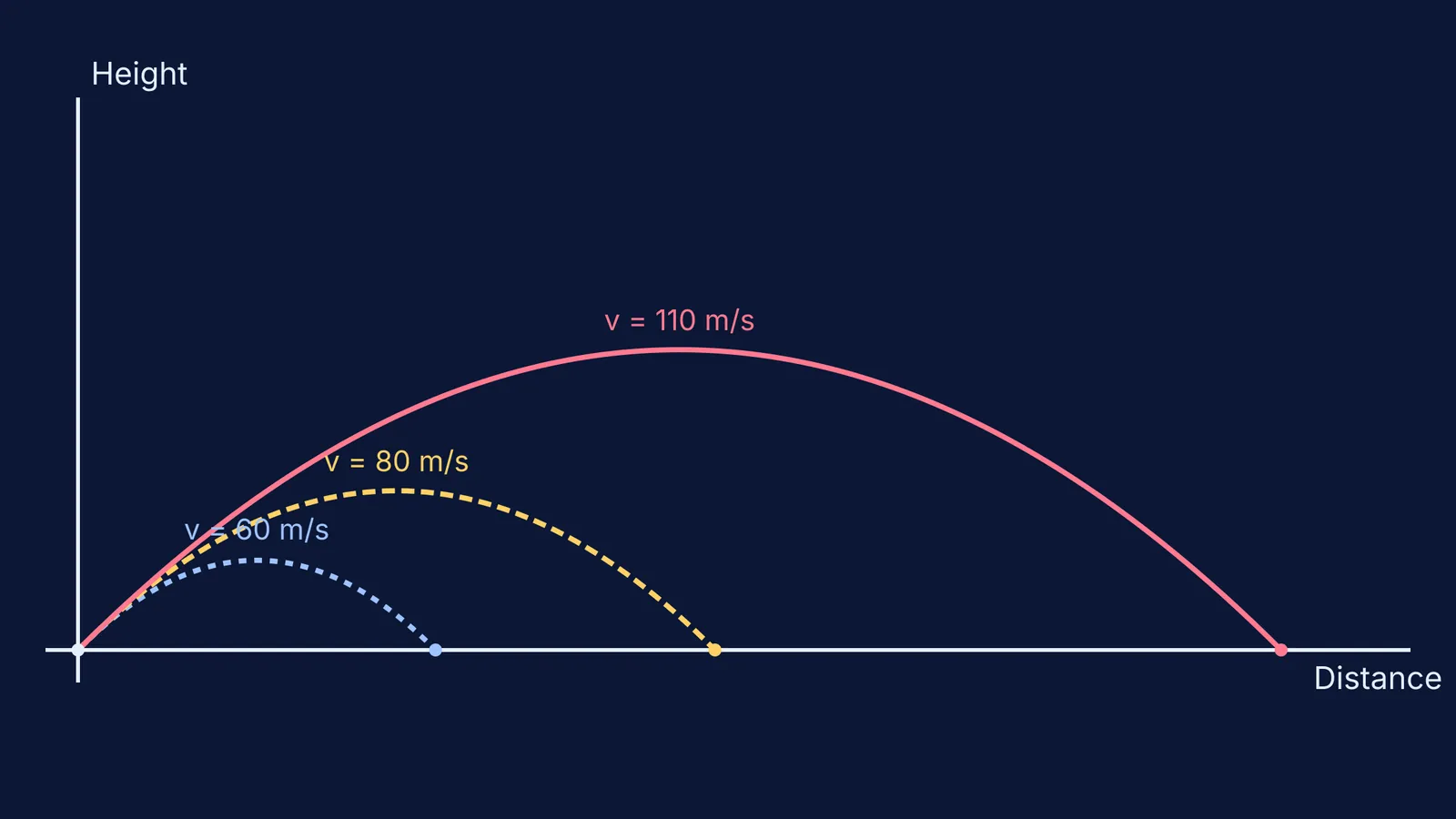
The Assumption Check: "What if we do not ignore air resistance in this trajectory?" This highlights the idealizations used in classical mechanics and prepares you for more complex, real-world problems.
Each of these questions isolates a single variable. When you observe how the system responds to that specific change, you learn exactly what role the variable plays in the governing equation.
How to use this prompt script with your AI tutor?
When you finish a practice problem, do not move immediately to the next one in the textbook. Use this simple framework to squeeze every drop of learning out of the question you just successfully answered.
Isolate: Pick one quantity in the problem you just solved (for example, the angle of the ramp, or the initial velocity of the car).
Predict: Before opening your chat window, make a concrete prediction. Will the final velocity increase, decrease, or stay exactly the same? Why?
Prompt the AI: Type the following to your AI tutor: "I just solved this problem where the ramp was at thirty degrees. What if the angle was sixty degrees? Walk me through how the final velocity changes conceptually, but do not solve the math for me."
By shifting your study habit from grinding through hundreds of identical equations to actively testing problem boundaries, you will build the genuine intuition required to succeed in high-stakes exams.


