On this page
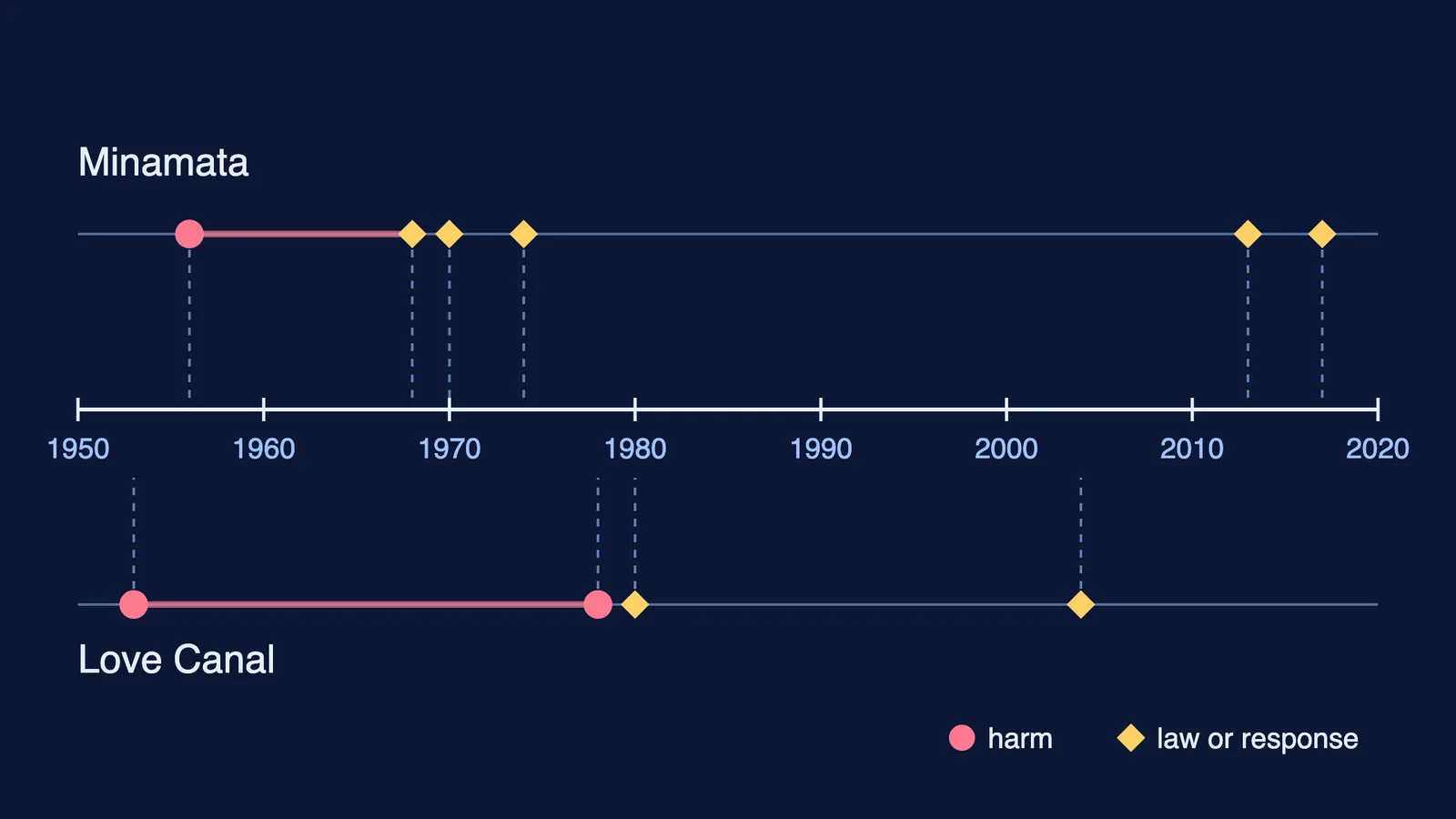
In 1956, doctors in Minamata City, on the Yatsushiro Sea coast of Kumamoto Prefecture, reported a patient with nervous-system symptoms nobody could explain, according to Japan's Ministry of the Environment. In 1978, chemicals from an old dump were leaching into the backyards and basements of homes and a school at Love Canal, New York (US EPA). Unlike the sudden gas leak at Bhopal, both were slow, hidden for years, and both changed the law.
What is Minamata disease?
Minamata disease is poisoning of the nervous system, mainly the central nervous system (the brain and spinal cord), by methylmercury, an organic compound of mercury (Ministry of the Environment, Japan). Its main signs are loss of feeling in the hands and feet, poor coordination, a narrowed field of vision, and hearing and balance problems. Fetal Minamata disease harmed babies whose mothers were exposed in pregnancy.
Kumamoto University reported in November 1956 that the illness was a heavy-metal poisoning carried by fish and shellfish (Ministry of the Environment). The government's official finding came only in 1968: methylmercury, formed as a by-product of making acetaldehyde at the Chisso factory in Minamata and at Showa Denko on the Agano River in Niigata, had gone out with the factory wastewater, built up in fish and shellfish, and poisoned people who ate a lot of them.
By March 2001, 2,955 people had been certified as Minamata disease patients, 2,265 on the Yatsushiro Sea coast and 690 in the Agano River basin (Ministry of the Environment).
Why does mercury build up in fish?
The World Health Organization explains the chain. Bacteria in water turn mercury into methylmercury. Methylmercury bioaccumulates, meaning an organism ends up holding a higher concentration than its surroundings. Large predatory fish are more likely to carry high levels, because they eat many smaller fish. WHO says people are exposed to methylmercury mainly by eating fish and shellfish, and that mercury is a particular threat to a child developing in the womb.
That is how a factory pipe poisoned families who never went near it. The same idea of a pollutant travelling far from its source runs through how DDT and freons harm the environment. If bioaccumulation or organometallic compounds are new to you, the Fermi Concept Library gives each concept in chemistry and biology its own lesson.
What happened at Love Canal?
Eckardt C. Beck, then head of EPA Region 2, described the case in the EPA Journal in 1979 (US EPA). In the 1920s an unfinished canal in Niagara Falls became a municipal and industrial chemical dump. In 1953 the Hooker Chemical Company covered it with earth and sold it to the city for one dollar. In the late 1950s, about 100 homes and a school were built on the site.
After record rainfall, rotting drums leached chemicals into backyards and basements. Beck cites a 1978 New York Times report of 82 compounds, 11 of them suspected carcinogens, rising through the soil; benzene was among the most common. On 7 August 1978, President Carter approved emergency aid, the first ever given for something other than a natural disaster, and 221 families moved or agreed to move (US EPA).
How did each case change pollution law?
In 1970 Japan's Water Pollution Control Law began controlling the discharge of toxic substances such as mercury and cadmium in all Japanese waters (Ministry of the Environment). In 1974 the Pollution-related Health Damage Compensation Law let certified sufferers of pollution-related disease receive compensation charged to the responsible company, without having to sue and prove the cause themselves.
The US EPA had no legal authority to clean up hazardous waste sites until 11 December 1980, when President Carter signed the Comprehensive Environmental Response, Compensation and Liability Act, known as Superfund (US EPA). It gave the EPA authority to clean up abandoned hazardous waste sites, made responsible parties liable, and set up a trust fund paid for partly by taxes on petroleum and chemical feedstocks. Love Canal was deleted from the National Priorities List in 2004.
The Minamata Convention on Mercury was adopted in Kumamoto on 10 October 2013 and came into force on 16 August 2017; India signed it in 2014 and ratified it on 18 June 2018 (UN Treaty Collection).
How can you analyse any pollution case?
Ask four questions, answered here for both cases:
Source: what substance, from which process? Methylmercury from acetaldehyde production; mixed chemical waste including benzene.
Pathway: how did it reach people? Through fish in the food chain; through soil and water into basements.
Delay: how long until official action? 1956 to 1968; covered 1953, emergency 1978, law 1980.
Remedy: who paid? The responsible companies, through Japan's compensation system; responsible parties and a trust fund, under Superfund.
Try them on Bhopal, or on a river near you after reading how BOD shows whether water is clean or polluted. If a ppm or concentration sum trips you up, the Fermi Problem Library has worked problems with a step-by-step solver that explains the reasoning.
This is history and chemistry, not medical advice; if you are worried about mercury exposure, talk to a doctor.