On this page
On the night of 2-3 December 1984, a tank at the Union Carbide pesticide plant in Bhopal released methyl isocyanate over the sleeping city. The chemistry fits on one line of a Class 11 notebook. What made it, in the words of the French ministry's ARIA accident report No. 7022, the worst disaster in the history of the chemical industry was a chain of safety systems that were switched off, drained or taken apart.
What gas leaked in Bhopal?
The gas was methyl isocyanate, or MIC, formula CH3NCO (NIOSH Pocket Guide). The plant made it on site from phosgene and reacted it with α-naphthol to make Sevin, a carbamate insecticide (ARIA report). Phosgene also turns up in our post on why chloroform is stored in dark bottles.
Three properties explain that night:
MIC boils at about 39 °C, so a warm tank turns it to vapour fast (PubChem).
Its vapour is about twice as heavy as air, so the cloud stays near the ground (PubChem).
NIOSH puts its "immediately dangerous to life or health" level at 0.12 ppm and lists water as incompatible with it (NIOSH).
How did water set off a runaway reaction?
On the evening of 2 December, about 500 litres of water entered tank 610, which held 42 tonnes of MIC (ARIA report). How it got in is still disputed: the report records both the pipe-washing theory and Union Carbide's claim that water was fed in directly near the tank, by sabotage or a hose connected to the wrong inlet.
MIC reacts with water to give 1,3-dimethylurea and carbon dioxide, and the reaction releases heat:
2 CH3NCO + H2O → (CH3NH)2CO + CO2
That heat started a worse reaction. Three MIC molecules joined into a ring, 1,3,5-trimethyl isocyanurate, which ARIA calls "highly exothermic". Iron catalysed it: chloroform, at 12-16% instead of 0.5% after the last distillation run, had corroded steel valves and released iron salts. The temperature rose to as much as 200 °C and the pressure from 0.14 to 3.8 bar; a rupture disc broke and the safety valve, set at 2.76 bar, opened.
This is a runaway. Hotter liquid reacts faster, and a faster reaction releases more heat. Rate climbs steeply with temperature, the idea behind our post on finding activation energy from half-lives at two temperatures. Cooling is the brake, and at Bhopal the brake was off.
Worked example: how much MIC could 500 litres of water use up?
500 litres of water is about 500 kg, or 500 ÷ 18 ≈ 27.8 kmol.
The equation uses 2 mol of MIC per mol of water: 55.6 kmol.
MIC's molar mass is 57.1 g/mol (NIOSH), so that is 55.6 × 57.1 ≈ 3,170 kg, about 3.2 tonnes.
That is under 8% of the 42 tonnes. The water was not the fuel; it was the match. Its reaction's heat started the trimerisation, whose heat boiled off the rest, and about 40 tonnes left the tank (ARIA report).
Which safety systems were off at Bhopal?
The ARIA report lists what was not working:
Refrigeration: the tanks were designed to be kept at 0 °C, but storage had not been refrigerated for at least six months.
Nitrogen pressure, which keeps contaminants out, had been off since 21 October.
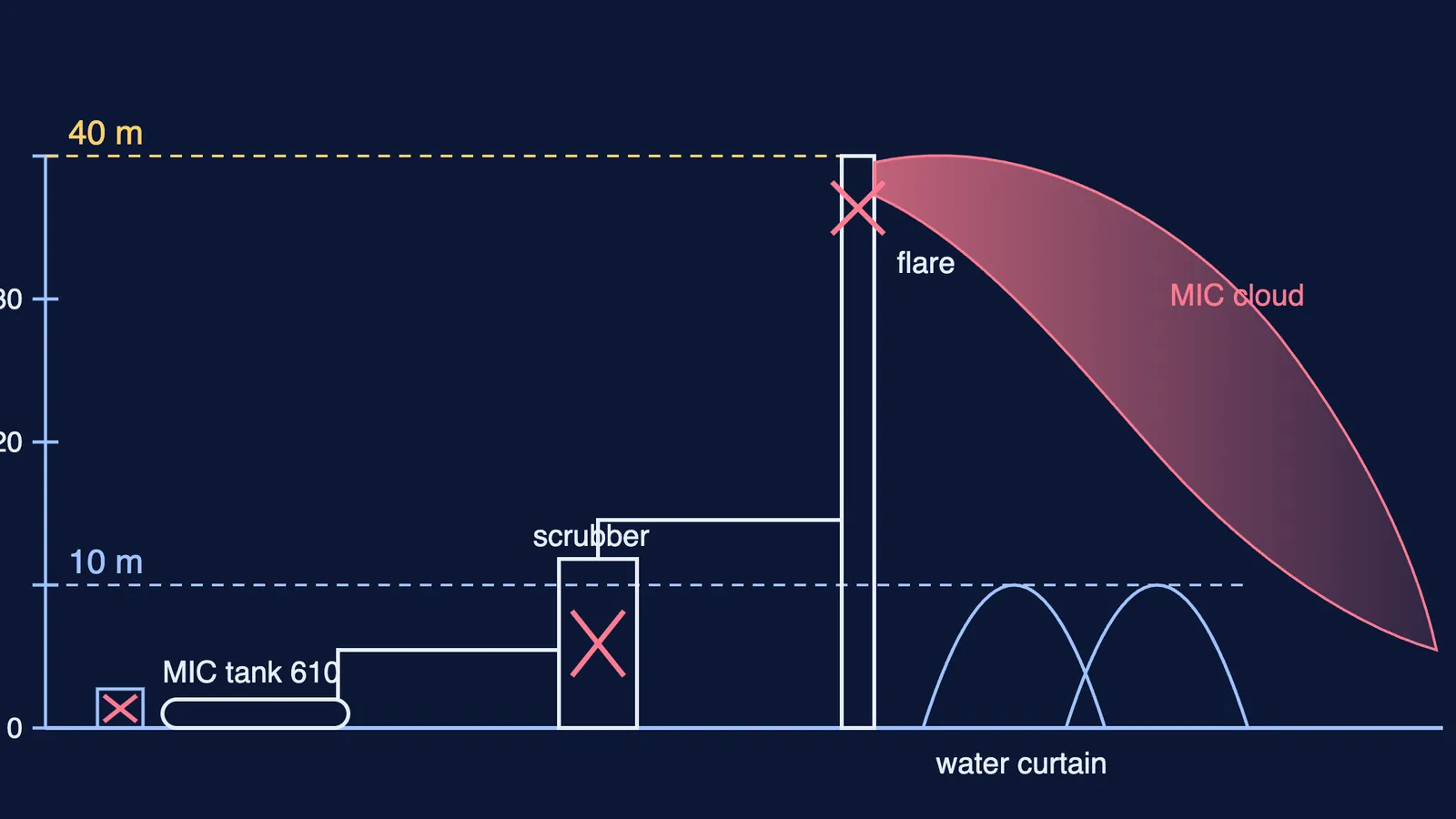
The soda in the scrubber had not been checked or circulated properly since 23 October, and the scrubber was undersized anyway: it could have neutralised no more than 3.5 of the 40 tonnes released.
The flare tower had been taken apart for maintenance a few days earlier.
Temperature, pressure and level indicators were defective, and high-temperature alarms had been disconnected.
The spare tank 619, meant to stay empty, held 1 tonne.
Water curtains reached only 10 m; the gas came out at 40 m.
Edward Broughton's 2005 review in Environmental Health gives slightly different details: a 30-ton refrigeration unit drained of coolant for use elsewhere, the scrubber turned off three weeks earlier and the flare out of action for three months. The sources agree on the point that matters: every layer had failed at once.
How many people died in the Bhopal gas tragedy?
The latest official count, confirmed by the Madhya Pradesh government, is 3,787 deaths, 2,259 of them immediate, and over 500,000 people poisoned (ARIA report). Other estimates run much higher: Broughton's review reports 15,000 to 20,000 premature deaths over the following two decades.
A barrier check you can use on any reaction
ARIA adds that MIC was an intermediate that need not have been stored in bulk: another route to Sevin used the same raw materials and a less toxic intermediate, at higher cost. Ask four questions of any hazardous reaction, from a factory to your school lab:
What releases energy? At Bhopal: hydrolysis, then trimerisation.
What keeps it slow? Cooling to 0 °C and keeping water out.
What catches an escape? Scrubber, flare, water curtain.
Can less of the hazard be kept on hand? A smaller MIC stock, or a different route.
Our post on chemistry lab safety rules and the accident each one prevents applies the same thinking at bench scale.
If hydrolysis, exothermic reactions or the Arrhenius idea still feel shaky, the Fermi Concept Library has a lesson for each chemistry concept, and the Fermi Problem Library works problems like the stoichiometry above step by step, explaining the reasoning.