On this page
If you have opened a chemistry lab cupboard, you have probably seen chloroform in a brown glass bottle with the cap screwed tight. That is not decoration. Chloroform (CHCl₃) slowly reacts with oxygen when light falls on it, and one product is phosgene, a poisonous gas. It is a classic "give reasons" fact in school chemistry and a regular in exam revision for CBSE, JEE Main and NEET-UG, so it is worth knowing properly: the reaction, the job of the bottle, and the job of the ethanol.
Why is chloroform stored in dark coloured bottles?
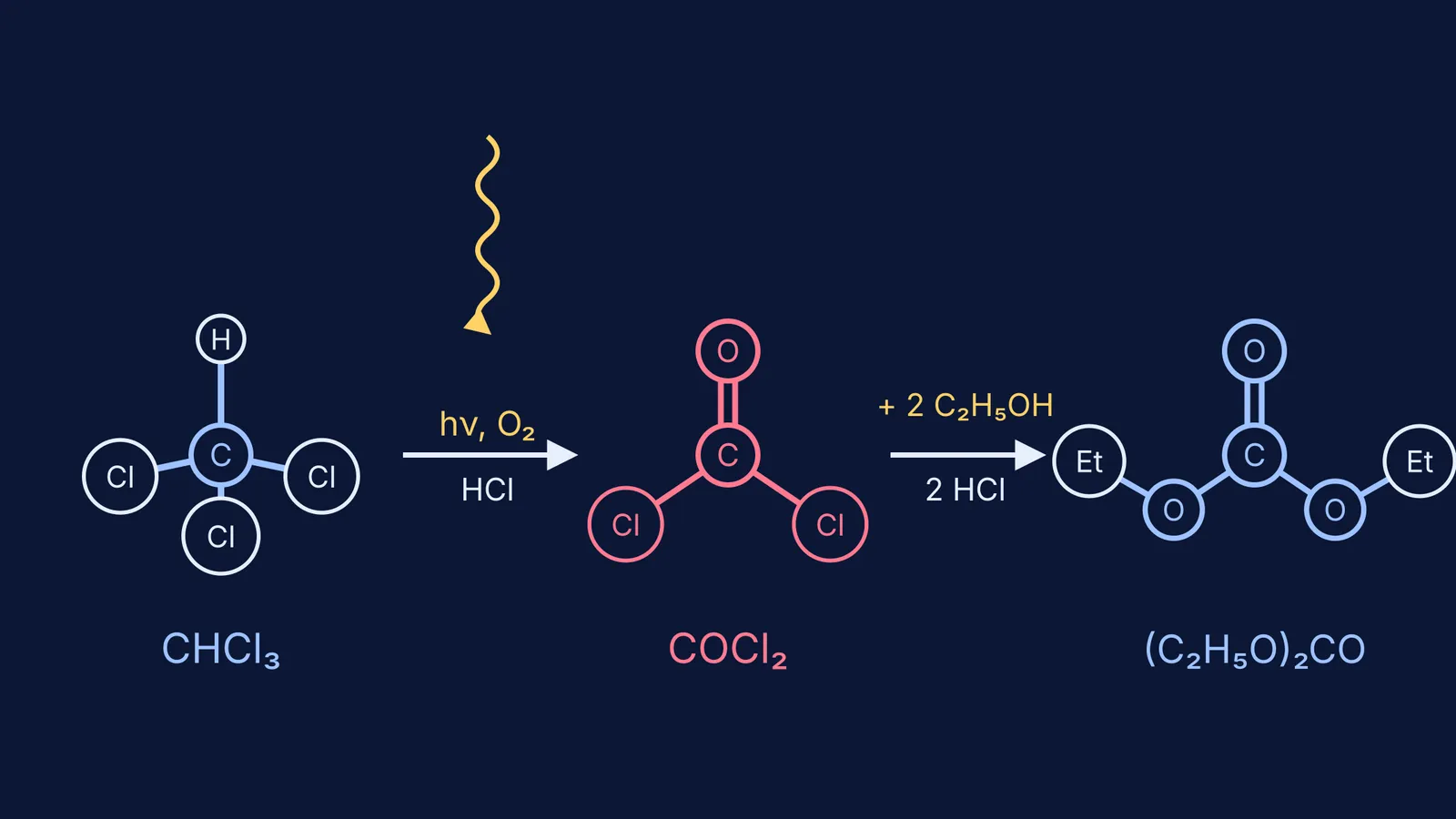
In UV light and air, chloroform is slowly oxidised to phosgene (carbonyl chloride, COCl₂) and hydrogen chloride, as the chloroform entry on Wikipedia summarises:
2CHCl₃ + O₂ → 2COCl₂ + 2HCl (in light)
A laboratory safety procedure from Western Carolina University says chloroform degrades in the presence of heat, UV light, air and certain metal catalysts to give phosgene, "a highly toxic gas/liquid, with a characteristic odor of cut hay/grass". The US CDC fact sheet on phosgene adds that it can damage the skin, eyes, nose, throat and lungs.
The bottle deals with the light. The glass maker Beatson Clark says its amber glass protects the contents from ultraviolet light below a wavelength of about 450 nanometres. Less UV reaching the liquid means less light energy to drive the reaction. The cap deals with the air: the same Western Carolina procedure says to keep chloroform containers closed as much as possible and store them away from light.
What does the 1% ethanol in chloroform do?
A dark bottle slows the reaction but cannot promise to stop it, so manufacturers add a stabiliser. A University of Michigan lab protocol lists the common ones: ethanol at about 1%, or amylene (pentene) at about 100 ppm.
Ethanol works because it reacts with any phosgene that does form and turns it into diethyl carbonate, a relatively harmless ester (Wikipedia: chloroform):
COCl₂ + 2C₂H₅OH → (C₂H₅O)₂CO + 2HCl
You can see this in real bottle paperwork. One supplier's specification for chloroform stabilised with ethanol lists ethanol at 0.5-0.8% and phosgene at no more than 0.0005%.
The choice of stabiliser matters. A 2007 study by Kristof Maudens, Sarah Wille and Willy Lambert at Ghent University, published in the Journal of Chromatography B, reported that phosgene traces left by failing stabilisation can seriously compromise the extraction and measurement of anthracycline drugs, and that of the three kinds of chloroform (unstabilised, alcohol-stabilised and hydrocarbon-stabilised), only the ethanol-stabilised type minimises these errors. The Michigan protocol gives the practical result: ethanol-stabilised chloroform typically has a shelf life of 5 years, against less than 12 months for amylene-stabilised chloroform.
How do you write this answer in an exam?
For a "give reasons" or short-answer question, a complete answer covers three things: the cause, the equation and the remedy. Here is a model answer you can adapt:
Chloroform is slowly oxidised by air in the presence of light to phosgene (carbonyl chloride), a poisonous gas.
2CHCl₃ + O₂ → 2COCl₂ + 2HCl (light).
So it is stored in closed, dark coloured bottles, which keep out light and air.
About 1% ethanol is added, which converts any phosgene formed into diethyl carbonate, a relatively harmless ester: COCl₂ + 2C₂H₅OH → (C₂H₅O)₂CO + 2HCl.
Slips to check before you move on:
Writing COCl or CCl₂O carelessly instead of COCl₂ (one C, one O, two Cl).
Dropping the HCl, which leaves the equation unbalanced.
Saying ethanol "blocks light". It does not; it reacts with phosgene.
Calling the product ethyl chloride. It is an ester, diethyl carbonate.
If you keep losing marks on steps like these, the Fermi Problem Library has worked problems with a step-by-step solver that explains the reasoning rather than printing an answer.
Where else does this idea show up?
Chloroform is not the only chemical that light breaks down. Read how light decomposes silver chloride for a second example you can quote in the same kind of answer. To see light breaking bonds in a chlorine reaction step by step, go through free-radical chlorination of methane. Chloroform also comes back as a reagent in the carbylamine test for primary amines.
To place this fact among the other haloalkane ideas you need, the Fermi Concept Library covers every concept in physics, chemistry, biology, mathematics and computing, each with its own lesson and its place in the map.
Next time you see a brown bottle on the lab shelf, run the four steps above in your head: light, air, phosgene, ethanol.