

On this page
Leave a white powder on a sunny windowsill and it slowly turns grey. That is silver chloride breaking apart, and the same chemistry made black and white photographs.
What happens when silver chloride is left in sunlight?
In NCERT's Class 10 science chapter on chemical reactions, Activity 1.8 shows that white silver chloride turns grey in sunlight. The book gives the equation as 2AgCl(s) → 2Ag(s) + Cl2(g), with "sunlight" written over the arrow, and adds that silver bromide behaves the same way: 2AgBr(s) → 2Ag(s) + Br2(g).
The Royal Society of Chemistry's version of the experiment, making a photographic print with silver chloride, puts it simply: the formation of metallic silver causes the darkening of the areas exposed to light.
Photolytic decomposition is a reaction in which light supplies the energy that splits one compound into simpler substances. NCERT groups it with two other energy sources, noting that decomposition reactions need energy "either in the form of heat, light or electricity" (NCERT chapter). Heating nitrates and carbonates is the heat version of the same idea, covered in our post on what happens when nitrates and carbonates are heated.
How much light energy does it take to split AgCl?
This is the step the textbook skips, and it links your chemistry to Class 12 physics. A crystal can only absorb a photon if the photon carries at least a minimum energy, set by the crystal's absorption edge.
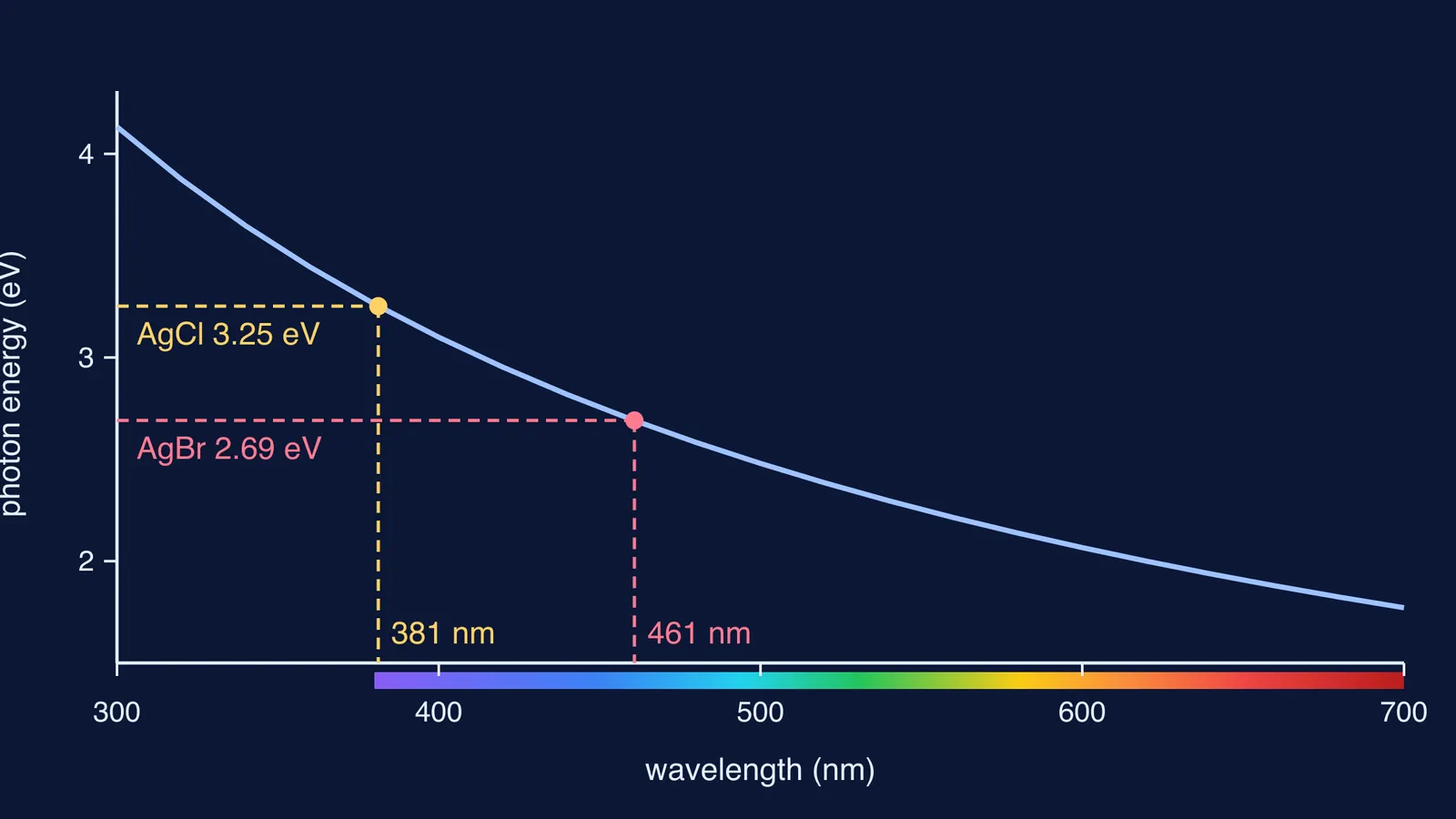
In a 1966 study in Physical Review, Joesten and Brown measured the absorption threshold of pure silver chloride at 3.252 eV and pure silver bromide at 2.691 eV, at 4.2 kelvin. Treat the room-temperature cut-offs worked out below as approximate.
Now turn energy into wavelength. NIST lists the Planck constant as 6.62607015 × 10^-34 J s, the speed of light as 299 792 458 m/s and the elementary charge as 1.602176634 × 10^-19 C, all exact. Put together, they give a shortcut worth memorising: E (in eV) = 1239.84 ÷ λ (in nm).
AgCl: λ = 1239.84 ÷ 3.252 = about 381 nm. Only light at the violet edge of what we can see, and ultraviolet, has enough energy.
AgBr: λ = 1239.84 ÷ 2.691 = about 461 nm. Blue light is now enough.
Red light at 650 nm: E = 1239.84 ÷ 650 = 1.91 eV. That is below both thresholds, so red light should not start either reaction in the pure crystals.
The numbers also help explain the colours. Silver chloride is white because it absorbs almost no visible light. Silver bromide is a pale yellow solid because it absorbs some blue light, the same light that has enough energy to split it.
If photon energy or E = hc/λ still feels shaky, the Fermi Concept Library gives each concept in physics and chemistry its own lesson, so you can fix the physics before going back to the chemistry.
Why did black and white photography use silver bromide?
NCERT says it directly: "The above reactions are used in black and white photography" (NCERT chapter). In film, the halide ion absorbs a photon and loses an electron (X− + hν → X + e−), and that electron reduces a silver ion to a silver atom, as the silver bromide entry summarises. A few silver atoms per grain form an invisible "latent image" that the developer later amplifies into a visible dark patch. R. W. Gurney and N. F. Mott set out the theory in a 1938 paper on the photolysis of silver bromide.
The photon-energy idea shows up in the darkroom too. For direct lighting, Ilford's data sheet for its Multigrade RC Cooltone paper recommends a light brown 902 safelight filter with a 15 W bulb, at least 1.2 m away, for no more than 4 minutes. The same sheet's spectrogram shows the paper responding up to green light, beyond the pure silver bromide cut-off, but its sensitivity falls away at longer wavelengths. Long-wavelength light carries less energy per photon than blue, which is why a light brown or red safelight is gentler on the paper, though not harmless forever. For where silver-based photography began, see our post on Fox Talbot's calotype and negative photography.
How do you write this reaction in a board exam?
Use this checklist for a 2- or 3-mark answer:
Write the observation: white silver chloride turns grey in sunlight.
Write the balanced equation with states: 2AgCl(s) → 2Ag(s) + Cl2(g), with "sunlight" or hν over the arrow.
Name the type: decomposition, specifically photolytic (light) decomposition.
Name the grey product: silver metal, not silver oxide.
Give the use: black and white photography, with silver bromide as the second example.
Common mistakes: leaving out the 2 in front of AgCl, writing Cl instead of Cl2, and calling it a displacement reaction. If a question asks how you made the silver chloride in the first place, that is a precipitation reaction with silver nitrate, explained in our guide to telling chloride, bromide and iodide apart with silver nitrate.
For more practice on reaction types and photon-energy numericals, the Fermi Problem Library has worked problems with a step-by-step solver that explains the reasoning rather than printing an answer.


