

On this page
In 1839, the world was stunned by the invention of the photograph. The French daguerreotype produced a sharp, stunningly detailed image on a metal plate. But it had a fatal flaw: each plate was a unique, one-off object. If you wanted ten copies of a portrait, the subject had to sit still for ten separate exposures.
Across the English Channel, the British scientist William Henry Fox Talbot was working on a different approach. He discovered a way to capture an image on paper and use it as a master template to print as many copies as he wished.
This breakthrough established the negative-positive system that dominated photography for the next century.
What is the calotype process?
William Henry Fox Talbot patented his photographic invention in February 1841. He called it the calotype, from the Greek word *kalos* meaning "beautiful".
The core of Talbot's process was the discovery of the latent image on 23 September 1840. Earlier experiments required paper to sit in the camera for hours until the image darkened visibly. Talbot found that a short exposure of just a few seconds or minutes left an invisible, "latent" image on the paper. This invisible record could be chemically developed later to reveal the picture.
To create a calotype negative, a photographer followed these chemical steps (detailed here):
Sensitising: High-quality writing paper was brushed with silver nitrate and then dipped in potassium iodide to precipitate silver iodide, a light-sensitive salt, within the paper. Just before use, it was brushed with a solution containing gallic acid and silver nitrate to make it highly sensitive to light.
Exposure: The paper was placed in a camera obscura. Where light from the scene hit the paper, it triggered a chemical change in the silver salts.
Development: The paper was removed in the dark and washed again in a gallic acid and silver nitrate solution. This acted as a developer, turning the exposed areas dark and making the invisible image visible.
Fixing: To stop the paper from continuing to darken when brought into the light, it was washed in a solution of hyposulfite of soda. This step, suggested by Talbot's friend Sir John Herschel, dissolved the unexposed silver salts and made the image permanent.
How does a negative make multiple positive prints?
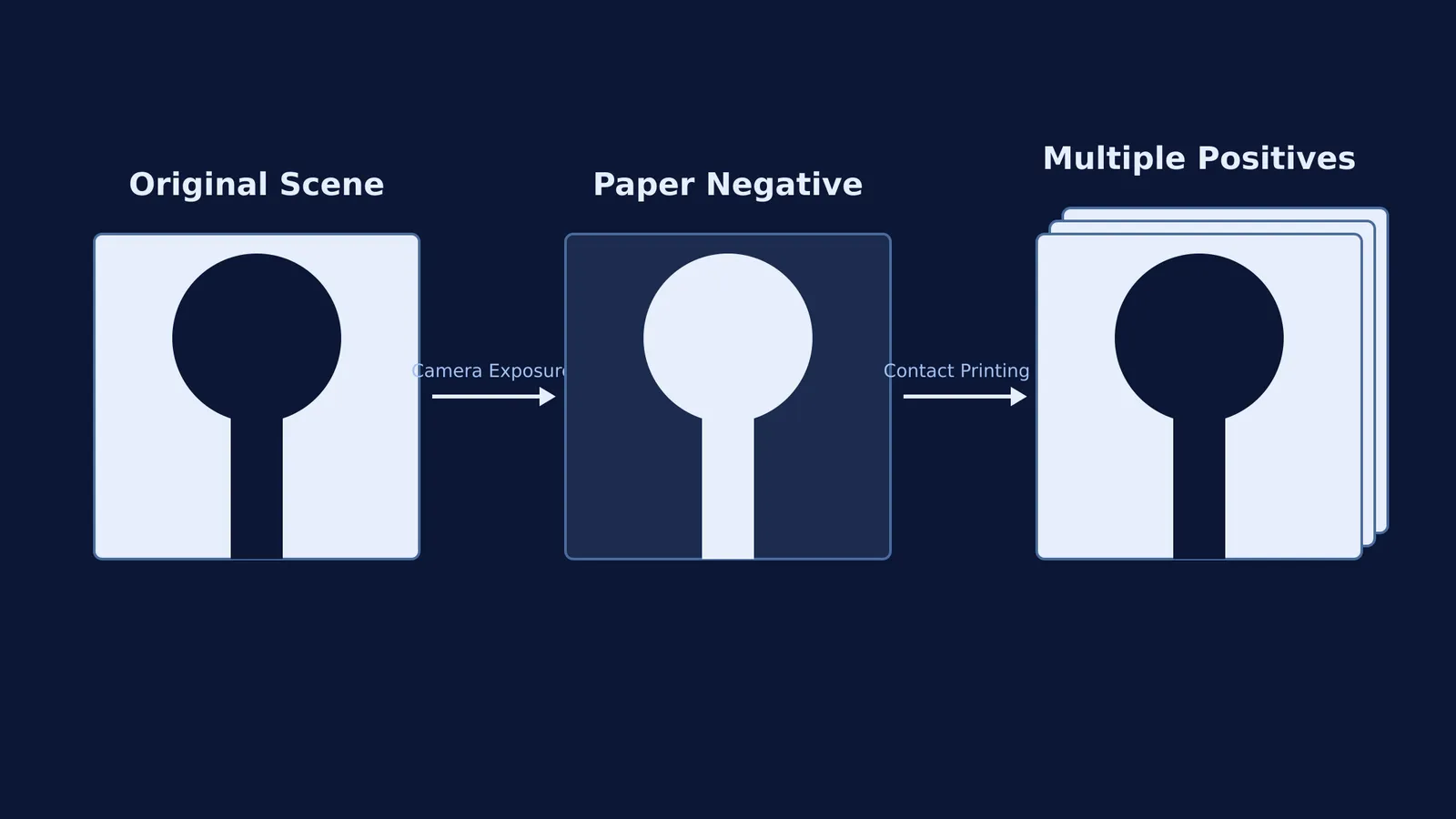
The paper that came out of Talbot's camera was a negative. The tones of the real world were reversed.
Because bright objects like the sky reflect a lot of light, they heavily exposed the silver salts, turning those areas dark on the paper. Dark objects like the trunk of a tree reflected very little light, leaving the silver salts unexposed. After the fixing bath washed the unexposed salts away, the dark tree appeared as the white of the blank paper.
If you find it hard to picture how light rays converge to form an inverted image inside a camera, the Fermi Simulation Lab provides interactive setups where you can move lenses and trace the light yourself.
To make a final photograph, Talbot simply took his paper negative, placed it tightly against a second sheet of sensitised paper, and laid them in the sun. This is called a contact print.
Now, the process reversed itself. The dark, heavily exposed sky of the negative blocked the sunlight, keeping the new paper underneath white. The white, unexposed tree of the negative let the sunlight pass straight through, turning the new paper dark.
By passing light through a negative, the original tones of nature were restored. Because the negative was never destroyed in this process, Talbot could repeat the contact printing step to make hundreds of identical positive prints from a single camera exposure.
The chemistry of the calotype in brief
If you are studying chemical reactions, the calotype process is an elegant real-world example of redox (reduction-oxidation):
Sensitising: Silver nitrate (AgNO₃) reacts with potassium iodide (KI) to precipitate silver iodide (AgI), a light-sensitive salt, within the paper.
Exposure (Reduction): Light photons provide the energy for an electron transfer, reducing transparent silver ions (Ag⁺) into opaque, metallic silver atoms (Ag) in tiny clusters (the latent image).
Development (Reduction): Gallic acid acts as a reducing agent, donating more electrons to reduce the remaining silver ions around the latent image, amplifying the dark patches.
Fixing: Sodium thiosulfate (Na₂S₂O₃, then known as hyposulfite of soda) forms a soluble complex with the unreacted silver iodide, allowing it to be safely washed out of the paper with water.
Understanding the chemical reactions that drive this process is a classic part of physical chemistry. You can map out these exact oxidation-reduction rules in the Fermi Concept Library, which connects individual reactions to the broader principles of chemistry.
Why did the calotype beat the daguerreotype?
In its early years, the calotype struggled to match the razor-sharp clarity of the daguerreotype. Because the calotype image was embedded in the fibrous texture of paper rather than a polished silver plate, the prints had a softer, slightly fuzzy quality.
However, the power of reproduction changed the medium forever. The ability to shoot one negative and distribute hundreds of positive prints made photography a tool for mass communication, journalism, and publishing.
More on light and optics:


