

On this page
Heating a salt is one of the most predictable questions in s-block chemistry. Three kinds of salt come up (nitrates, carbonates and bicarbonates), and the products depend on the metal's group, with lithium as the odd one out. Learn the pattern and the reason behind it, and you can write any of these equations without memorising each one.
What do group 1 and group 2 nitrates and carbonates give when heated?
Here is the full set, from Chemguide's pages on group 1 compounds and group 2 thermal stability. X stands for the metal.
Group 2 carbonates: XCO3 → XO + CO2, the metal oxide and carbon dioxide.
Group 2 nitrates: 2X(NO3)2 → 2XO + 4NO2 + O2, the oxide, brown nitrogen dioxide and oxygen.
Lithium carbonate: Li2CO3 → Li2O + CO2, the same pattern as group 2.
Lithium nitrate: 4LiNO3 → 2Li2O + 4NO2 + O2, again like group 2.
Sodium to caesium nitrates: 2XNO3 → 2XNO2 + O2. They stop at the nitrite and give no nitrogen dioxide.
Sodium to caesium carbonates: no decomposition at typical lab temperatures, though they will break down if heated more strongly.
Why does thermal stability increase down the group?
The explanation is polarisation. As Chemguide's group 2 page puts it, a small 2+ ion packs a lot of charge into a small volume, so its high charge density strongly distorts the nearby negative ion. When the cation pulls electron density towards itself, the bonds inside the carbonate or nitrate ion weaken, and less heat is needed to break it apart.
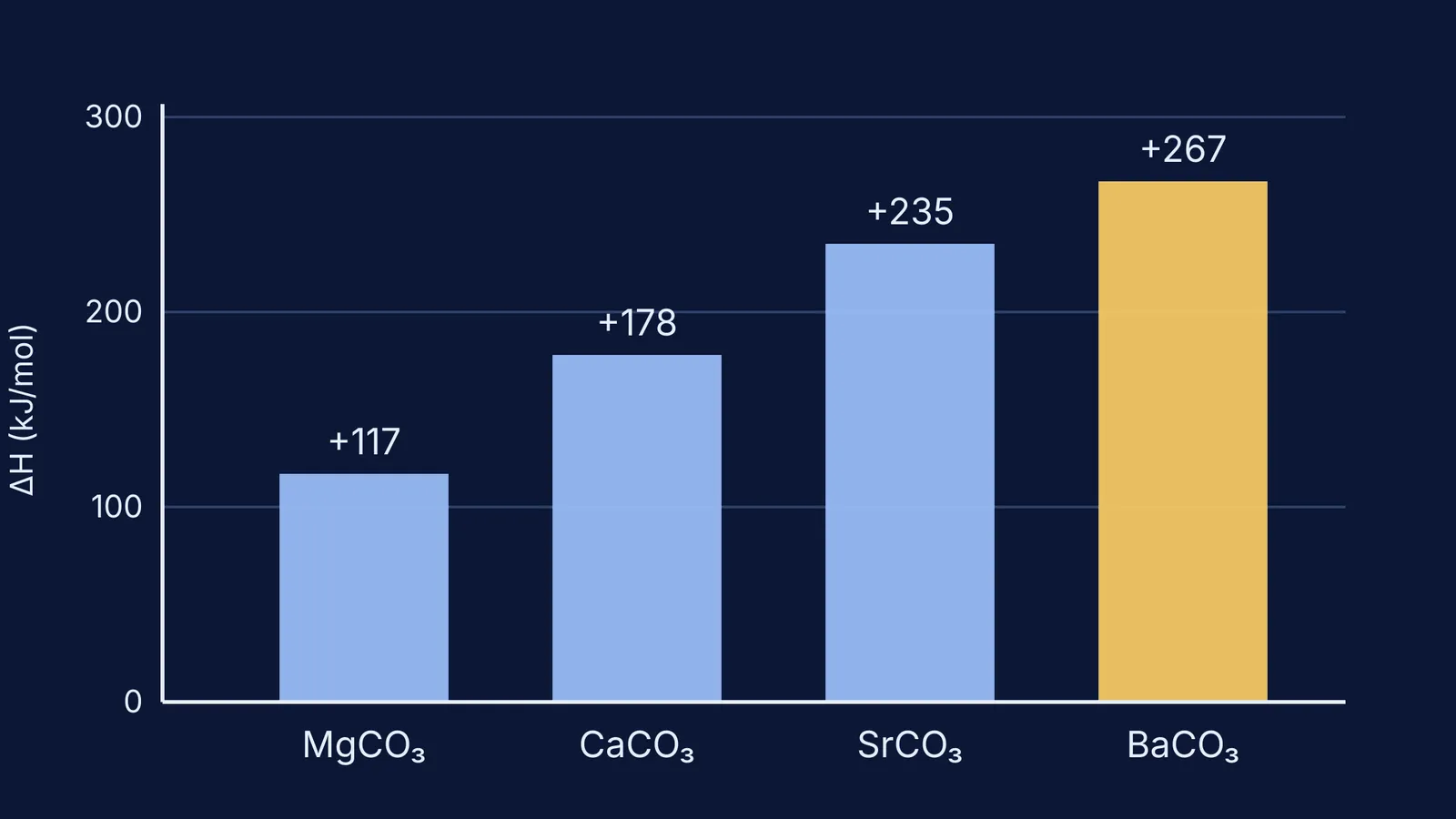
Down group 2 from Mg2+ to Ba2+, the same 2+ charge is spread over a bigger ion, so the distortion weakens and the salt becomes more stable. The enthalpy change for decomposing the carbonate is +117 kJ/mol for MgCO3, +178 for CaCO3, +235 for SrCO3 and +267 for BaCO3 (Chemguide). The chart at the top of this post plots these four values to scale.
Lithium fits the same logic. Li+ is the smallest group 1 ion, so it polarises anions far more than Na+ or K+, and its salts behave like magnesium's. The other group 1 ions are larger and carry only a 1+ charge, which is why their carbonates survive lab heating. Chemguide's group 1 page also notes that decomposition gets harder further down group 1.
How do you write and balance the equations?
Nitrate equations are where marks get lost. Here is calcium nitrate, step by step.
Write the products the rule predicts: Ca(NO3)2 → CaO + NO2 + O2.
Balance nitrogen: two N on the left, so write 2NO2. Now Ca(NO3)2 → CaO + 2NO2 + O2.
Count oxygen: 6 on the left, 1 + 4 + 2 = 7 on the right. One too many.
Use a half: Ca(NO3)2 → CaO + 2NO2 + ½O2. Both sides now have 6.
Double to clear the fraction: 2Ca(NO3)2 → 2CaO + 4NO2 + O2.
That matches the general group 2 equation. Sodium nitrate is shorter: NaNO3 → NaNO2 + ½O2, doubled to 2NaNO3 → 2NaNO2 + O2. For lithium nitrate, start from LiNO3 → ½Li2O + NO2 + ¼O2 and multiply by four.
What happens when bicarbonates are heated?
Sodium hydrogencarbonate (baking soda) is stable enough to exist as a solid but breaks down easily on heating: 2NaHCO3 → Na2CO3 + CO2 + H2O (Chemguide). It stops at the carbonate, because sodium carbonate is itself stable at lab temperatures.
Group 2 hydrogencarbonates are best known from hard water. Calcium and magnesium hydrogencarbonates decompose when the water is heated and the insoluble carbonate re-forms, which is why this hardness is called temporary (Lenntech). For calcium: Ca(HCO3)2 → CaCO3 + CO2 + H2O.
A two-minute self-test
Cover everything above and write the products and a balanced equation for each:
MgCO3
Ba(NO3)2
KNO3
Li2CO3
Mg(HCO3)2 in boiling water
Check each against the rule and the oxygen count. If one is wrong, note which step failed, not just the right answer. For the wider picture, including why lithium resembles magnesium, read our guide to s-block elements: trends, anomalies and key compounds. To make these reactions stick, try learning inorganic chemistry with retrieval, not rote lists. The gases they give off also turn up in salt analysis in the chemistry practical.
If your nitrate equations keep coming out unbalanced, the Fermi Problem Library has worked problems with a step-by-step solver that explains the reasoning rather than printing an answer. If polarisation is the part that hasn't clicked, start with its lesson in the Fermi Concept Library.


