On this page
Some kinetics questions give you two half-lives at two temperatures and ask for the activation energy. A common approach is to work out both rate constants in s⁻¹ first and then use the Arrhenius equation, which adds steps where a rounding slip or an inverted ratio can creep in. You can skip that detour. For a first-order reaction, the two half-lives already contain everything you need.
Why does the ratio of half-lives give the ratio of rate constants?
The NCERT Class 12 chapter Chemical Kinetics derives the first-order half-life as t½ = 0.693/k, which is ln 2/k. The same chapter points out that this half-life does not depend on the starting concentration. LibreTexts' page on first-order reactions/Kinetics/02%3A_Reaction_Rates/2.03%3A_First-Order_Reactions) says the same thing: the first-order half-life is a constant.
Rearrange it to k = ln 2/t½ and write it at both temperatures. When you divide one by the other, the ln 2 cancels:
k₂/k₁ = t½(T₁) / t½(T₂)
The ratio flips. The faster reaction (bigger k) has the shorter half-life, so the half-life measured at the lower temperature goes on top.
How do you find activation energy from half-lives at two temperatures?
NCERT derives the two-temperature form of the Arrhenius equation, ln(k₂/k₁) = (Ea/R)(1/T₁ − 1/T₂), and writes it in base-10 logs with 2.303R as equation 3.22 (NCERT Chemical Kinetics). Swap in the half-life ratio and you get one equation:
ln[t½(T₁) / t½(T₂)] = (Ea/R)(1/T₁ − 1/T₂)
Follow these steps in order:
Check that the reaction is first order. The question may say so, or call it radioactive-style decay or a pseudo-first-order reaction.
Convert both temperatures to kelvin.
Write the half-lives in the same unit. Because only their ratio matters, any unit works as long as both match. You do not need seconds.
Take the ratio with the low-temperature half-life on top.
Use R = 8.314 J mol⁻¹ K⁻¹. NIST lists its exact value as 8.314 462 618... J mol⁻¹ K⁻¹. Ea then comes out in J/mol, so divide by 1000 to get kJ/mol.
If your paper uses log instead of ln, multiply R by 2.303. Our explainer on why 2.303 appears in chemistry formulas shows where that factor comes from.
Worked example: N₂O₅ with real textbook numbers
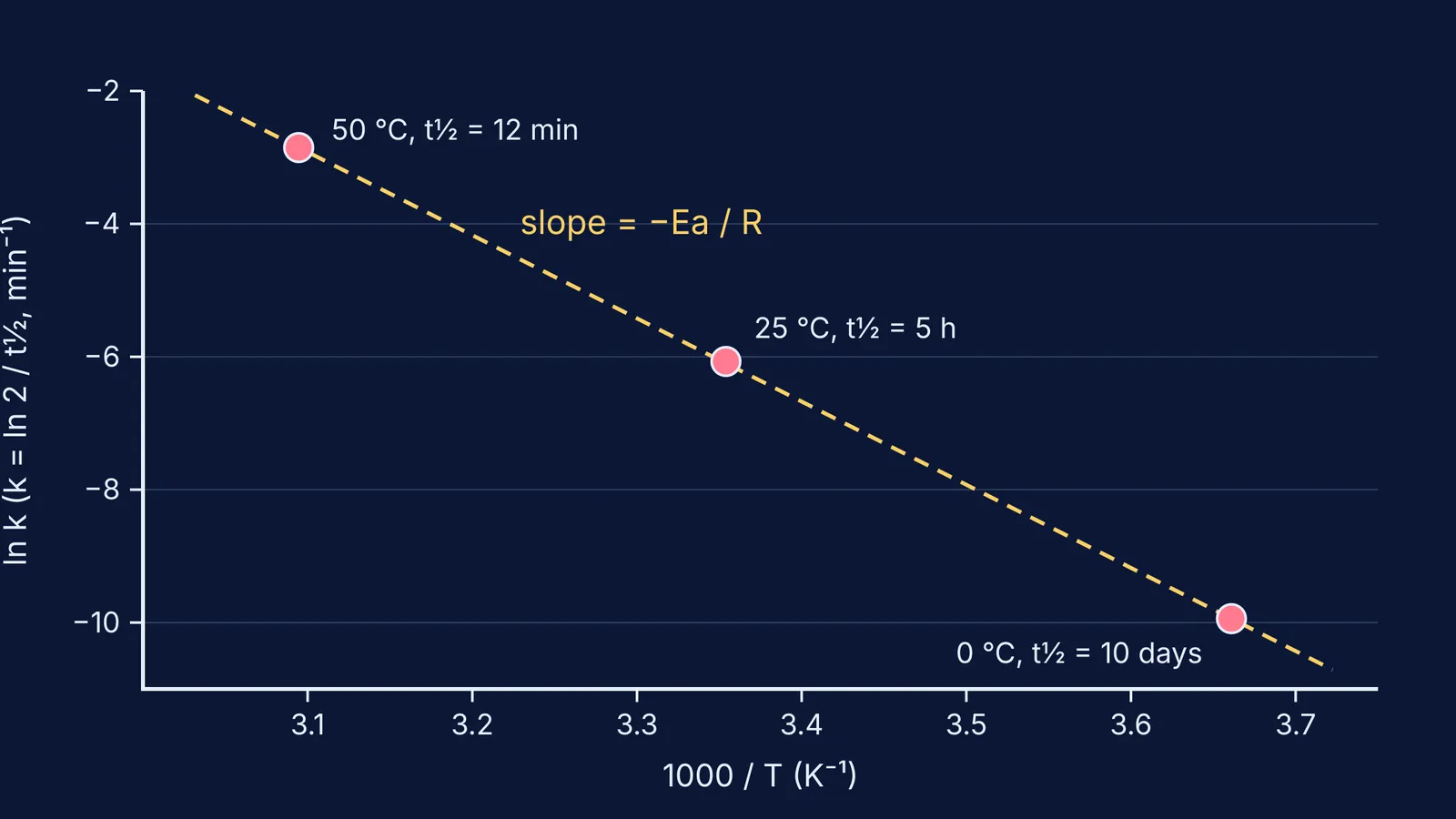
The NCERT chapter opens its section on temperature with a real case. When N₂O₅ decomposes, half of the original amount is gone in 12 min at 50 °C, 5 h at 25 °C and 10 days at 0 °C. The same chapter uses the decomposition of N₂O₅ as an example of a first-order reaction, so the shortcut applies.
Take the 25 °C and 50 °C values:
T₁ = 298.15 K, T₂ = 323.15 K.
Half-lives in minutes: 5 h is 300 min, and the other is 12 min.
Ratio: k₂/k₁ = 300/12 = 25, so ln 25 = 3.219.
1/T₁ − 1/T₂ = 0.0033540 − 0.0030945 = 0.0002595 K⁻¹.
Ea = 8.314 × 3.219 / 0.0002595 ≈ 103,000 J/mol, which is about 103 kJ/mol.
To check your answer, repeat the calculation with the 0 °C and 25 °C pair. The ratio is 14,400 min / 300 min = 48, and you get about 105 kJ/mol. The small difference is not surprising, since the textbook gives rounded times ("10 days", "5 h"). When two pairs of points give close answers, that is a good sign your method and arithmetic are sound. If you have three or more temperatures, plot them as in our guide on finding activation energy from an Arrhenius plot, where the slope is −Ea/R.
What if the reaction is not first order?
For other orders the half-life depends on the starting concentration. NCERT gives t½ = [R]₀/2k for a zero-order reaction (Chemical Kinetics, section 3.3.3). The half-life ratio still equals the inverse rate-constant ratio, but only if both runs start at the same concentration. If they do not, work out each k on its own first. Our post on half-life and initial concentration for any reaction order shows how that dependence changes from one order to the next.
If you want more practice, the Fermi Problem Library has worked problems with a step-by-step solver that explains the reasoning rather than printing an answer, which can help you spot where an inverted ratio crept in. If half-life or the Arrhenius factor itself still feels shaky, each has its own lesson in the Fermi Concept Library.