

On this page
Half-life is the kinetics quantity you can read straight off a concentration–time graph, and the way it changes with starting concentration tells you the order. NCERT defines half-life as the time in which the concentration of a reactant is reduced to one half of its initial concentration (NCERT Class 12 Chemistry, Unit 3, section 3.3.3). This guide gives you the one rule behind every order, a short method for finding n, and the three common cases side by side.
How does half-life depend on initial concentration for any order?
For a reaction with rate = k[A]ⁿ and n ≠ 1, integrating the rate law gives t½ = (2^(n−1) − 1) / ((n − 1) k [A]₀^(n−1)). That is the general half-life in this summary of integrated rate laws, rewritten without its shorthand g = 1 − n.
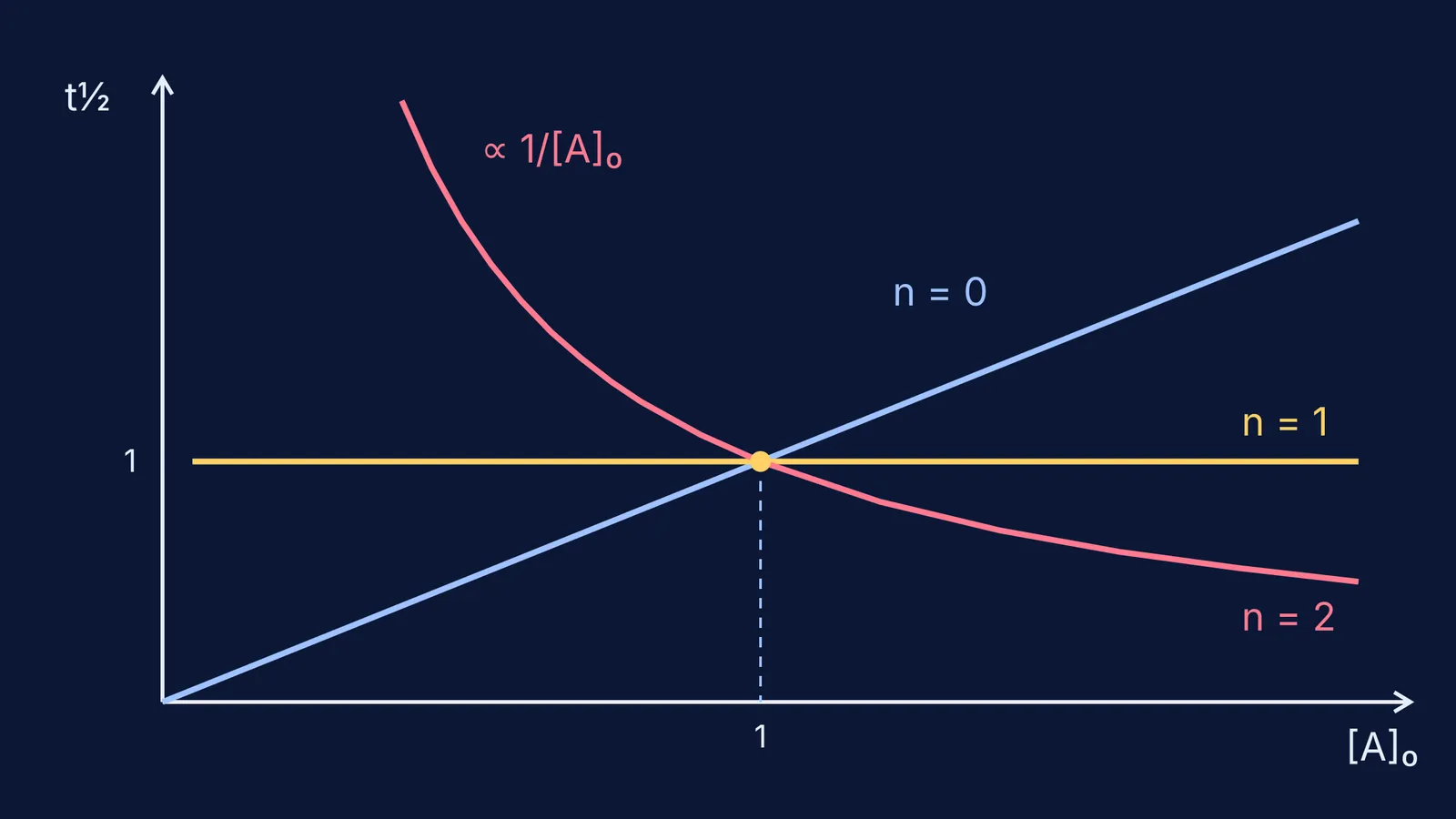
For a given reaction at a given temperature, everything in that expression except [A]₀ is a constant. So it reduces to one proportionality: t½ ∝ [A]₀^(1−n).
The exponent tells you everything:
n = 0: the exponent is +1, so doubling [A]₀ doubles t½.
n = 1: the exponent is 0, so t½ does not depend on [A]₀ at all.
n = 2: the exponent is −1, so doubling [A]₀ halves t½.
n = 3: the exponent is −2, so doubling [A]₀ cuts t½ to a quarter.
What are the zero, first and second-order half-life formulas?
NCERT derives the first two in section 3.3.3 of the Chemical Kinetics chapter. The LibreTexts physical chemistry page on the method of half-lives gives all three:
Zero order: t½ = [A]₀/2k. It grows in proportion to [A]₀.
First order: t½ = 0.693/k. It stays constant.
Second order: t½ = 1/(k[A]₀). It gets shorter as [A]₀ rises.
NCERT says it directly for zero order: t½ is directly proportional to the initial concentration and inversely proportional to the rate constant. The units of k change from order to order, and that is a second way to read the order. It is covered in reading reaction order from the units of k.
The same rule handles successive half-lives within one run. After one half-life the concentration is [A]₀/2, and that becomes the new starting point. Put it into t½ ∝ [A]₀^(1−n) and each half-life is 2^(n−1) times the one before. That is one half for zero order, the same for first order and double for second order. So the time to reach 25% of the reactant left is 1.5 t½, 2 t½ and 3 t½ for zero, first and second order.
How do you find the order from two half-lives?
Take two runs with starting concentrations a₁ and a₂ and measured half-lives t₁ and t₂. Write the proportionality for each run and divide one by the other: t₁/t₂ = (a₁/a₂)^(1−n). Take logs and rearrange:
n = 1 + log(t₁/t₂) / log(a₂/a₁)
Worked example 1. A reactant at 0.10 mol L⁻¹ has a half-life of 40 min. At 0.20 mol L⁻¹ the half-life is 20 min.
t₁/t₂ = 40/20 = 2.
a₂/a₁ = 0.20/0.10 = 2.
n = 1 + log 2 / log 2 = 2.
The reaction is second order. Check it against the list above: doubling [A]₀ halved t½, which matches n = 2.
Worked example 2. At 0.10 mol L⁻¹, t½ = 100 s. At 0.40 mol L⁻¹, t½ = 50 s.
t₁/t₂ = 100/50 = 2.
a₂/a₁ = 0.40/0.10 = 4.
n = 1 + 0.301/0.602 = 1.5.
A fractional answer is allowed. The NCERT chapter points out in section 3.2.4 that order is an experimental quantity and can be zero or even a fraction.
Which half-life mistakes cost marks?
Using 0.693/k for every order. That formula is for first order only.
Flipping one ratio but not the other. Keep t₁ and a₁ from the same run, and keep the order exactly as in the formula. One upside-down ratio turns a second-order answer into zero order.
Mixing up two runs with successive half-lives in one run. Two runs use the ratio formula. One run uses the 2^(n−1) step.
Dropping units. [A]₀/2k needs k in mol L⁻¹ s⁻¹, and 1/(k[A]₀) needs k in mol⁻¹ L s⁻¹ (NCERT Table 3.3).
Plotting when you don't need to. If a question gives two half-lives, the ratio method is faster. If it gives a full concentration–time table, the straight-line test in integrated rate law graphs is the better tool.
If your half-life answers keep going wrong at the same step, the Fermi Problem Library has worked problems with a step-by-step solver that explains the reasoning rather than just printing an answer. For the derivation behind each formula, the Fermi Concept Library gives every chemistry concept its own lesson.
If your data are rates rather than half-lives, try finding the order from initial rates next.


