On this page
If a question asks which water sample is cleaner, one with a BOD of 4 ppm or one with 18 ppm, the answer is the first. To see why, you need to know what BOD measures and how it connects to the oxygen fish breathe.
What is biochemical oxygen demand (BOD)?
The NCERT Class 12 Biology chapter Microbes in Human Welfare defines BOD as the amount of oxygen that would be consumed if all the organic matter in one litre of water were oxidised by bacteria.
The same chapter calls BOD an indirect measure of the organic matter in water: the greater the BOD of waste water, the more polluting it is. Bacteria feed on that organic matter and use up oxygen as they do.
The US Environmental Protection Agency's guide to dissolved oxygen and BOD lists sources of BOD such as leaves, animal manure, food-processing effluent and failing septic systems. It explains that the standard test measures the oxygen microorganisms use over a fixed period, usually 5 days at 20 °C.
What BOD value means clean water, and what means polluted?
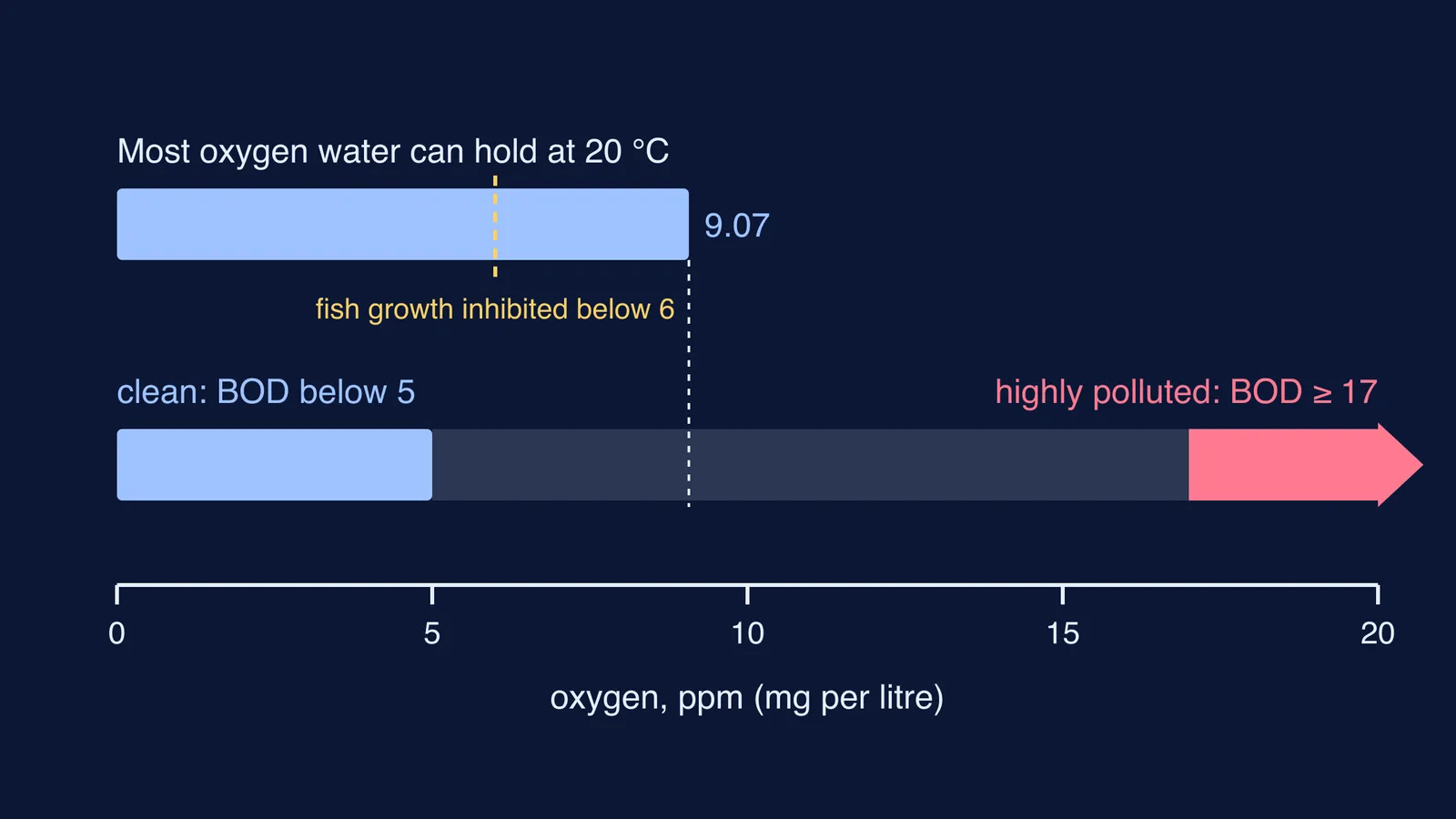
The older edition of NCERT Class 11 Chemistry (Part II, Environmental Chemistry, archived copy) states that clean water would have a BOD of less than 5 ppm, while highly polluted water could have a BOD of 17 ppm or more.
Those are the two numbers the NCERT text gives.
India's Central Pollution Control Board sets stricter limits for particular uses in its water quality criteria:
Drinking water source without conventional treatment (Class A): BOD 2 mg/L or less, dissolved oxygen 6 mg/L or more.
Outdoor bathing (Class B): BOD 3 mg/L or less, dissolved oxygen 5 mg/L or more.
Drinking water source after conventional treatment (Class C): BOD 3 mg/L or less, dissolved oxygen 4 mg/L or more.
Wildlife and fisheries (Class D): dissolved oxygen 4 mg/L or more.
How is BOD linked to dissolved oxygen?
Think of dissolved oxygen (DO) as the supply and BOD as the demand. Bacteria feeding on organic waste draw on the same small pool of oxygen that fish breathe.
That pool is tiny. The NCERT chemistry chapter (archived copy) notes that dissolved oxygen in cold water can reach about 10 ppm, while air holds about 200,000 ppm. It states that fish growth is inhibited when dissolved oxygen falls below 6 ppm. If too much organic matter is added, all the oxygen is used up, and anaerobic bacteria take over, producing foul-smelling chemicals.
The EPA guide puts the link in one line: the greater the BOD, the more rapidly oxygen is depleted in the stream. Its table shows water at 20 °C can hold at most 9.07 mg/L of oxygen, but at 30 °C only 7.54 mg/L (EPA). So the same pollution can do more harm in a hot Indian summer; we cover the temperature side in why warm water holds less oxygen, and what it means for fish.
Worked example: can the river pay its oxygen bill?
Take two samples at 30 °C, where water can hold at most 7.54 mg/L of oxygen (EPA table).
Sample A has a BOD of 3 mg/L, the CPCB bathing limit. Its demand is 3 ÷ 7.54, about 0.4 of the oxygen the water can hold, so oxygen from air and plants has a chance to keep up.
Sample B has a BOD of 18 mg/L, past the 17 ppm highly polluted mark in NCERT chemistry. Its demand is 18 ÷ 7.54, about 2.4 times what the water can hold.
Sample B could empty fully oxygenated water twice over. DO falls below 6 ppm, where NCERT says fish growth is inhibited, and the water can turn anaerobic and smelly.
This is a simplified budget. The EPA guide notes that real streams keep gaining oxygen from the air and from photosynthesis while respiration and decomposition remove it. The direction still holds: high BOD, low DO.
To see how treatment plants cut BOD before sewage reaches a river, read sewage treatment and BOD: the stages and the numbers. For the same oxygen crash caused by fertiliser, try how fertiliser runoff causes algal blooms.
How do you remember BOD and DO for exams?
Run through this checklist, drawn from NCERT chemistry and the EPA guide, before you answer:
High BOD means more organic waste; high DO means healthier water. They usually move in opposite directions.
Clean water: BOD below 5 ppm. Highly polluted: 17 ppm or more.
The standard test usually runs for 5 days at 20 °C.
Fish growth is inhibited when DO drops below 6 ppm.
Warmer water holds less oxygen, so heat and pollution add up.
If a link in this chain is shaky, such as aerobic and anaerobic bacteria or the solubility of gases, the Fermi Concept Library gives each concept in chemistry and biology its own lesson. For BOD and DO numericals, the Fermi Problem Library has worked problems with a step-by-step solver that explains the reasoning rather than printing an answer.