On this page
On a hot May afternoon, a school pond looks calm. By dawn, the fish may be at the surface, gulping air. The chemistry behind that scene is one line from your solutions chapter: gases get less soluble as temperature rises.
Why does warm water hold less oxygen?
Dissolving most gases in water releases heat, so it is an exothermic process, as the LibreTexts chemistry module on gas solubility/Equilibria/Solubilty/Temperature_Effects_on_the_Solubility_of_Gases) explains. Le Chatelier's principle does the rest: add heat, and the equilibrium shifts back toward oxygen leaving the water. In molecular terms, the added thermal energy overcomes the weak attractions between oxygen and water molecules, so more oxygen escapes.
Many solids behave the other way, as we explain in how temperature changes the solubility of solids. For gases, pressure matters too: Henry's law is why a fizzy drink goes flat once you open it.
How much less oxygen does warm water hold?
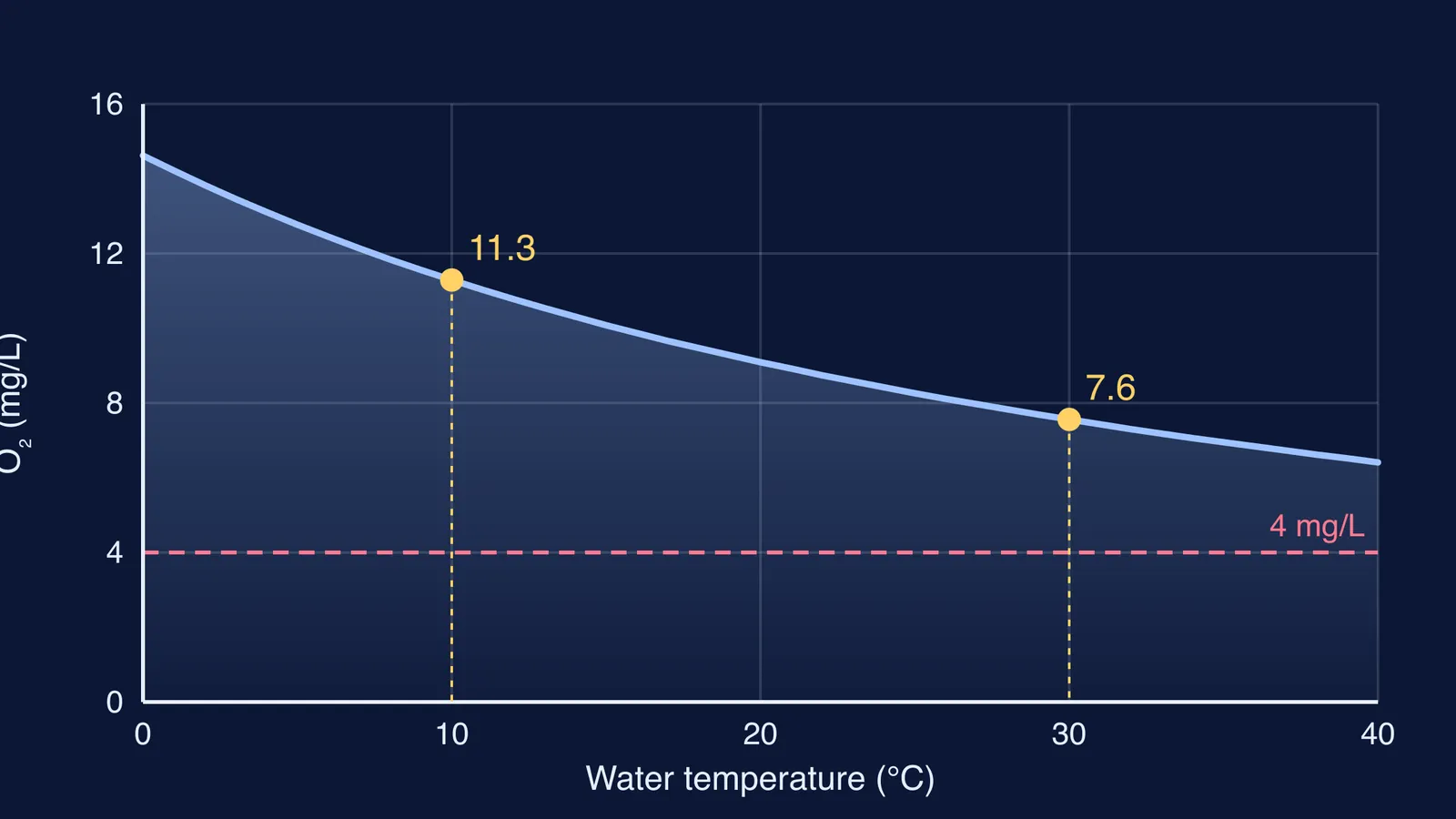
The US Geological Survey's DOTABLES calculator, which uses the Benson and Krause equations, gives these saturation values for fresh water at 760 mm Hg (sea-level pressure):
0°C: 14.62 mg/L
10°C: 11.29 mg/L
20°C: 9.09 mg/L
30°C: 7.56 mg/L
35°C: 6.95 mg/L
Fresh water at 30°C can hold about a third less oxygen than at 10°C (7.56 against 11.29 mg/L), according to the USGS DOTABLES table. These are ceilings for salt-free water fully mixed with air at sea level; real ponds often sit below them.
Claude E. Boyd, an aquaculture scientist at Auburn University, writing for the Global Seafood Alliance, notes that oxygen consumption "roughly doubles with a 10 degrees-C increase in temperature within the temperature tolerance of the species." So between 20°C and 30°C, the oxygen ceiling falls by about 17% while a fish's demand roughly doubles.
Why do pond fish die in summer, often at dawn?
By day, algae and water plants add oxygen through photosynthesis. At night they stop, but they keep respiring, along with fish and bacteria. The US EPA's CADDIS guide to dissolved oxygen says oxygen levels are usually lowest just before dawn, and that kills can happen "abruptly in early morning, usually between 0200 hrs and sunrise."
How low is too low? India's Central Pollution Control Board sets a minimum of 4 mg/L of dissolved oxygen for water used for wildlife and fisheries (Class D) in its water quality criteria. In his article on fish oxygen needs, Boyd notes that warm-water fish usually survive at levels as low as 1.0 mg/L, but surviving is not thriving: as a general rule, he says, oxygen in fish culture systems should not fall below 50 percent of saturation. For the living side of this story, see our guide to the parts of a pond ecosystem.
How can a school measure dissolved oxygen?
Schools usually use one of two tools, both described in the EPA's volunteer monitoring manual on dissolved oxygen:
Winkler titration kit. You fill a bottle completely, "fix" the oxygen with reagents, then add a titrant drop by drop until the colour changes. The amount of titrant used gives the oxygen. One kit runs 50 to 100 tests.
Dissolved oxygen meter. A probe measures oxygen and temperature quickly, but a meter costs far more than a kit and must be calibrated before each run.
A one-day plan for a class project
Pick one spot in the school pond or tank, with a teacher present.
Sink the bottle just under the surface, let it fill, and cap it underwater.
If you see an air bubble under the stopper, pour it out and try again.
Add the kit's fixing reagents straight away, then titrate.
Note the water temperature at the same spot.
Repeat at about 6 a.m., noon and 4 p.m., then work out percent saturation for each reading.
Worked example: is the pond in trouble?
Percent saturation is the oxygen in the water divided by the most it can hold at that temperature, as the EPA manual defines it. Suppose that at 6 a.m. the water is 30°C and your kit reads 3.0 mg/L. The USGS table gives a ceiling of 7.56 mg/L at 30°C, so 3.0 ÷ 7.56 = 0.40, or about 40% saturation. That is below Boyd's 50% guideline and below the CPCB's 4 mg/L for fisheries.
Now suppose the same pond reads 7.0 mg/L at 4 p.m., at 33°C. The ceiling there is 7.18 mg/L, so the pond is at about 97%. The rise between the two readings is a day of photosynthesis; the drop back by the next dawn is the night's respiration.
If the percent-saturation step or a Henry's law sum trips you up, the Fermi Problem Library has worked problems with a step-by-step solver that explains the reasoning rather than printing an answer. To revise the ideas behind it, the Fermi Concept Library gives every concept in chemistry and biology its own lesson.