

On this page
If you have ever opened a bottle of soda and left it out on a warm day, you know it quickly loses its fizz. The reason lies in the physical relationship between gas solubility, pressure, and temperature.
Why do fizzy drinks go flat?
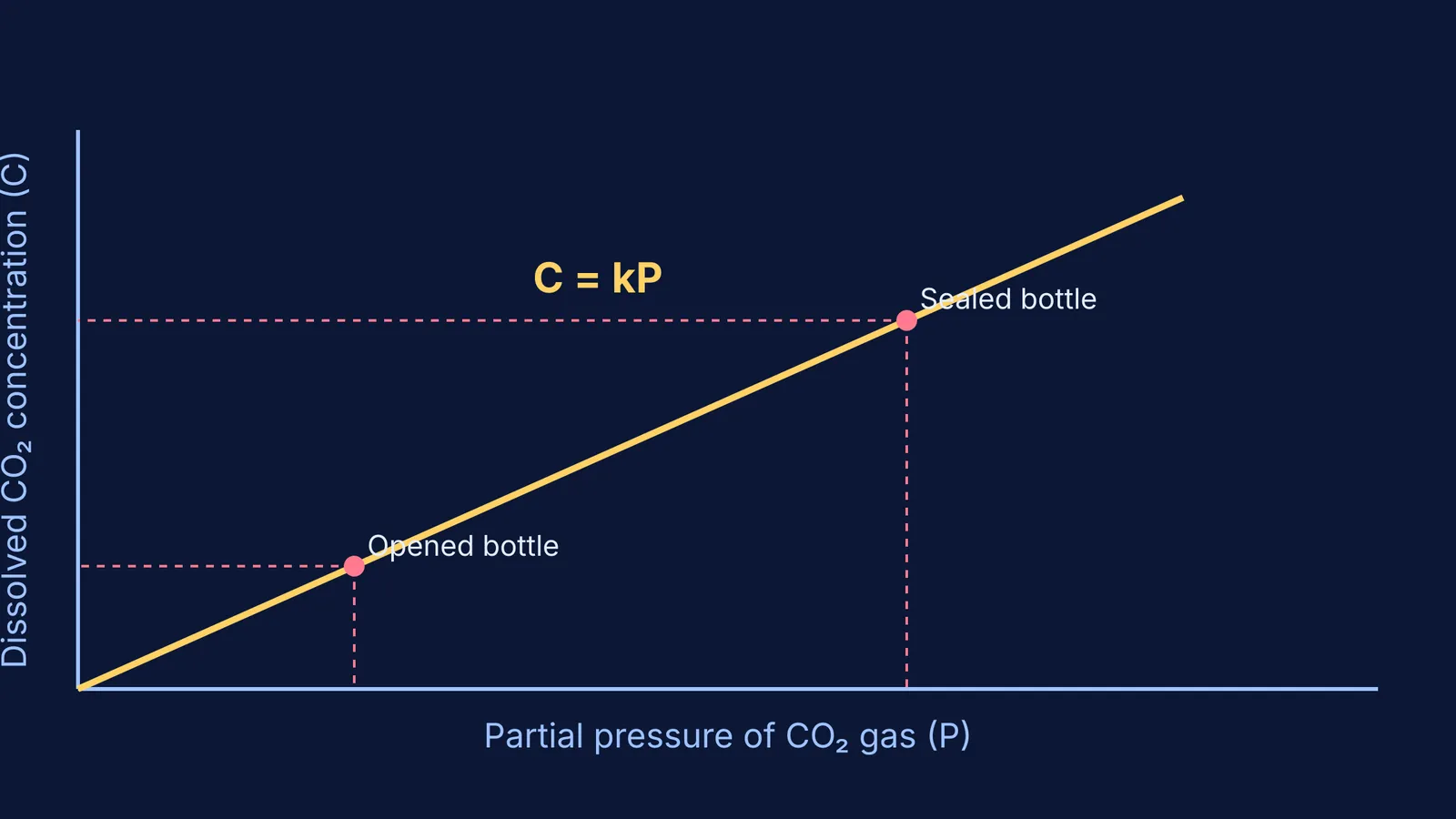
When carbonated beverages are bottled, they are sealed under a high pressure of carbon dioxide gas. According to OpenStax Chemistry, the quantity of an ideal gas that dissolves in a definite volume of liquid is directly proportional to the pressure of the gas. This principle is known as Henry's law.
When you twist the cap off a soda bottle, the high-pressure gas trapped in the space above the liquid escapes with a hiss. The partial pressure of carbon dioxide above the liquid immediately drops to match the surrounding atmosphere. Because the pressure is now drastically lower, the liquid can no longer hold as much dissolved gas, leaving the drink in a temporary state called supersaturation. The carbon dioxide comes out of the solution in the form of bubbles, and the drink eventually goes flat as it reaches a new, much lower equilibrium.
This sudden release of dissolved gas due to a drop in pressure is not just a kitchen phenomenon; it can have massive consequences in nature. For instance, the same OpenStax chapter explains that the water at the bottom of Lake Nyos is heavily saturated with carbon dioxide due to high pressure at depth. When a disturbance caused this deep water to rise to the surface where the pressure is much lower, tremendous quantities of dissolved carbon dioxide rapidly escaped into the air, causing a lethal natural disaster.
This sudden expansion and release of gas is a core thermodynamic concept, similar to what you might explore when learning about adiabatic vs isothermal: compress a gas and read the PV graph.
How does temperature affect solubility?
While Henry's law explains the role of pressure, temperature is just as important for keeping a drink fizzy. Gas solubility typically decreases as temperature increases. As the liquid warms up, the dissolved gas molecules gain kinetic energy, making it easier for them to overcome the attractive forces of the solvent and escape into the air.
This inverse relationship is why a warm soda loses its carbonation much faster than a cold one. In contrast, solid solutes like salt or sugar generally dissolve better in hot water than in cold water. You can test how solid compounds behave when they dissolve in water in a salt solubility simulation: saturation, Ksp and the common ion.
How does a Henry's law simulation explain why fizzy drinks go flat?
Reading about gas behaviour is one thing, but seeing it helps build intuition. In the Simulation Lab, you can adjust the pressure and temperature sliders in a closed system to watch how molecules move between the liquid and gas phases in real time.
When you lower the pressure in the simulation, you can see the dissolved gas particles rapidly leave the liquid phase and fill the space above it, mimicking the bubbles escaping from a freshly opened bottle of soda. Raising the temperature yields a similar result, visually confirming that heating a liquid provides the kinetic energy needed for gas molecules to break free. This interactive tool lets you experiment with variables safely and see the microscopic reasons behind everyday changes in gas solubility. You can apply the same interactive approach to other gas behaviours, such as testing Graham's law in a simulation: heavy vs light gas diffusion.
A practical test: the fizz experiment at home
You can observe these principles in your kitchen with a simple, two-step experiment to test pressure and temperature.
Setup: Take two identical unopened bottles of carbonated water or soda. Place one in the refrigerator and leave the other on the counter at room temperature for a few hours.
Observe: Open both bottles at the same time. The room-temperature bottle will likely hiss louder and foam more vigorously because the gas is less soluble at the higher temperature and rushes out as soon as the pressure drops.
Taste: Pour a glass from each bottle and leave them on the table for half an hour. The warm soda will taste noticeably flatter because the higher temperature drove the carbon dioxide out faster.
By connecting a simple household observation to Henry's law, you can easily predict how gases will behave under different conditions.


