

On this page
In a typical chemistry class, you calculate whether a system will shift forwards or backwards by comparing the reaction quotient Q vs K. You also learn that undissolved solids are left out of the equilibrium constant for heterogeneous equilibria. But the simple question of whether a solid will dissolve more easily in hot water comes down to thermodynamics and Le Chatelier's principle.
Why does the solubility of most solids increase with temperature?
When most solids dissolve, they absorb heat from the water. This is an endothermic process. You can think of heat as a reactant on the left side of the equilibrium equation:
Solid + Water + Heat ⇌ Dissolved Solution
According to Le Chatelier's principle/Equilibria/Le_Chateliers_Principle/Effect_Of_Temperature_On_Equilibrium_Composition), if you add a "stress" to a system at equilibrium, the system will shift to offset that stress. When you heat the water, you are adding more of the "reactant" (heat) to the system. The system consumes this extra heat by pushing the equilibrium forward, forcing more solid to dissolve.
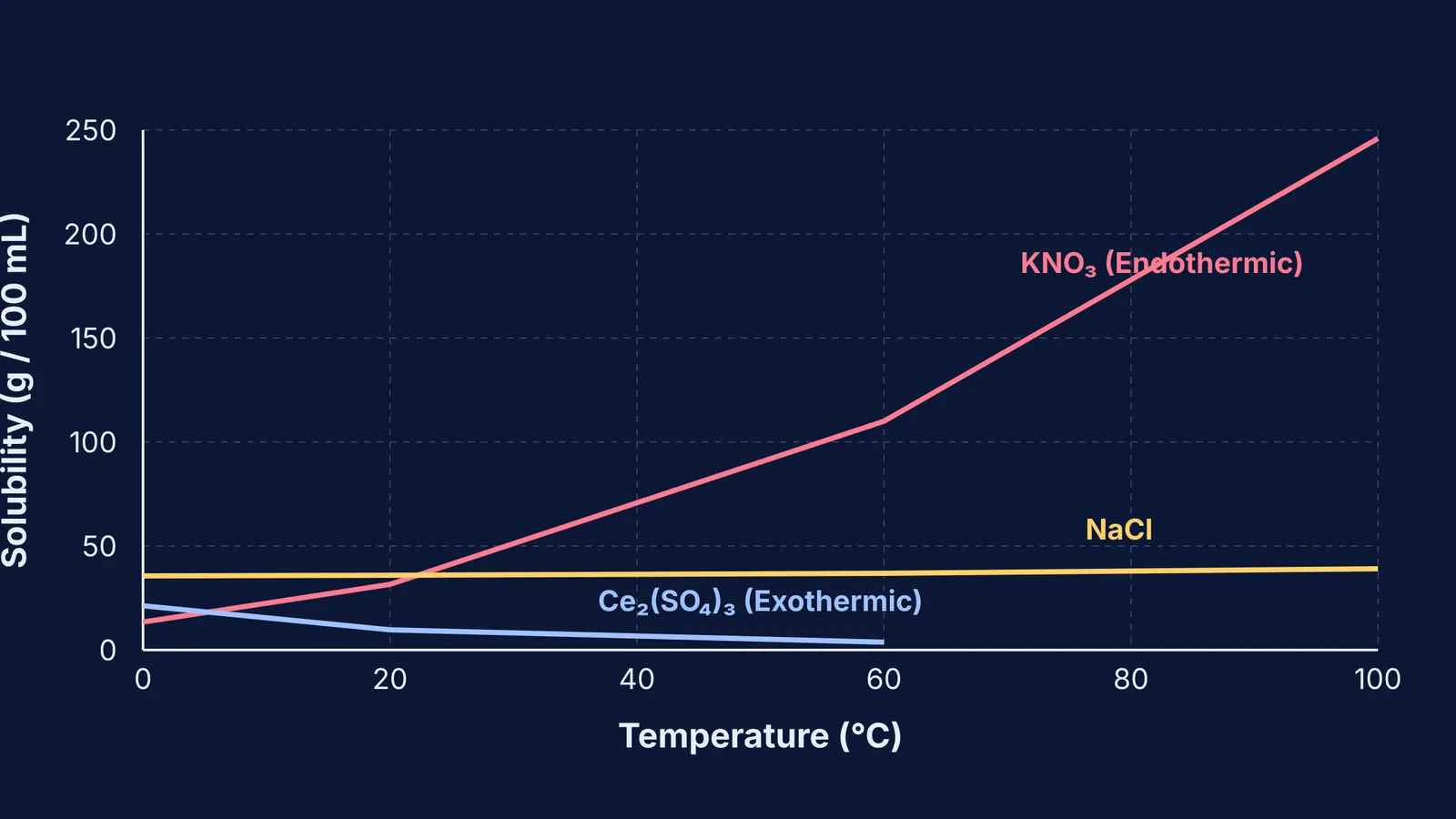
Potassium nitrate (KNO₃) is a classic example of an endothermic salt. At 0 °C, you can dissolve only 13.3 g of KNO₃ in 100 mL of water (Wikipedia solubility data). If you heat that same water to 100 °C, the equilibrium shifts so far forward that the solubility skyrockets to 246 g.
Do any solids become less soluble as water gets hotter?
Yes. While most salts dissolve endothermically, a few release heat when they dissolve. This is an exothermic process, where heat acts as a product on the right side of the equation:
Solid + Water ⇌ Dissolved Solution + Heat
If you add heat to a solution that already releases heat when forming, Le Chatelier's principle pushes the equilibrium backwards to counteract the change. The solid stops dissolving and begins to crystallise out of the hot water.
Cerium(III) sulfate (Ce₂(SO₄)₃) is a well-known example of this retrograde solubility. At 0 °C, you can dissolve 21.4 g of it in 100 mL of water (Wikipedia). But if you heat the water to 60 °C, the solubility drops to just 3.87 g. If you have a clear, saturated solution of cerium(III) sulfate at room temperature and put it on a stove, it will turn cloudy as the solid precipitates out.
How do you use solubility curves for exam problems?
In exams like JEE and NEET, you are often asked to calculate how much solid precipitates when a hot saturated solution cools down. You can find this by subtracting the mass the water can hold at the lower temperature from the mass it holds at the higher temperature (using data like the Wikipedia solubility table).
If you struggle with applying thermodynamic rules to new reactions, the Fermi Concept Library maps out Le Chatelier's principle and connects it to phase changes and solubility. And when you are stuck on a calculation like the one above, Fermi's AI tutor does not just print the final mass; it works out what you already know and builds a plan for the session, checking your understanding as it goes.
For more practice with equilibrium shifts and calculations, you can try solving worked problems step by step in the Fermi Problem Library.


