

On this page
When biologists want to explain how an entire ecosystem functions, they often look at a pond. In the NCERT Class 12 Biology curriculum, a pond is presented as the perfect model of a self-sustaining, shallow water body that demonstrates every basic function of an ecosystem in one manageable place.
A pond is complete because it handles productivity, decomposition, energy flow, and nutrient cycling without needing outside help. To understand how it manages this, we divide its structure into two main categories: the non-living (abiotic) and the living (biotic) parts.
What are the abiotic components of a pond ecosystem?
The abiotic components provide the physical setting and the raw chemical materials that life needs to survive. In a pond, these include the water, the soil, and the climatic conditions.
Water: This is the most obvious component, serving as the medium for all aquatic life. It holds dissolved organic and inorganic substances, including the oxygen that aquatic animals need to breathe and the carbon dioxide that plants use for photosynthesis.
Soil and Sediment: The mud at the bottom of the pond is rich in nutrients and serves as the foundation for rooted plants and bottom-dwellers. It acts as a reservoir for organic matter that settles from the water above.
Climatic Factors: Solar input (sunlight) is the primary energy source that drives the entire system. Other climatic factors, such as the cycle of temperature and day length, regulate the rate at which the pond functions.
Without these non-living factors, the biological machinery of the pond would have no energy to run on and no materials to build with, a concept central to Vladimir Vernadsky and the biosphere. The interplay of light, temperature, and dissolved minerals sets the stage for all biological activity.
What are the biotic components of a pond ecosystem?
The biotic components are the living organisms within the pond. They are classified by how they obtain their nutrition and energy. In any ecosystem, these living components form a continuous chain of dependency.
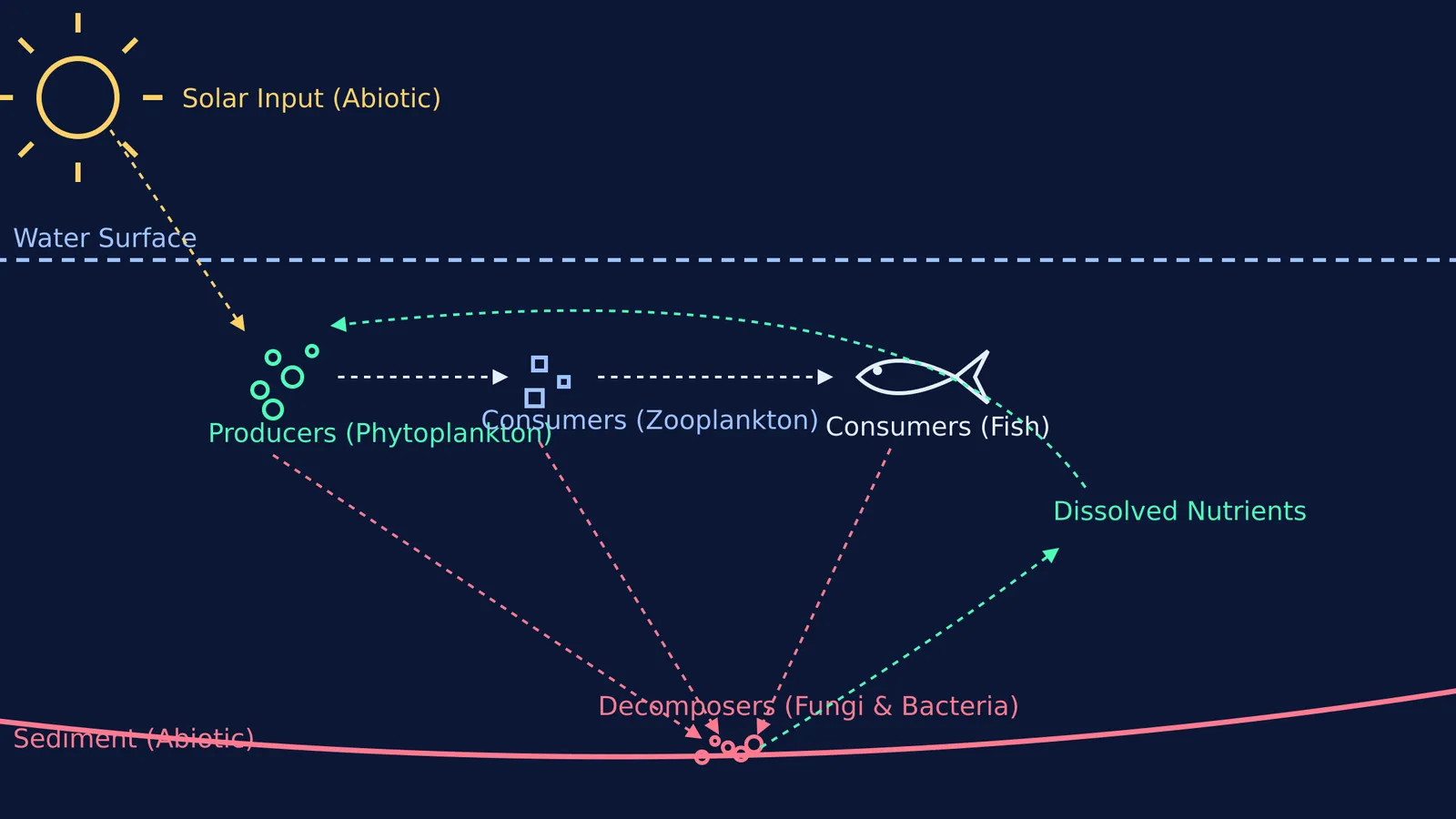
Producers (Autotrophs): These organisms convert inorganic materials into organic matter (food) using solar energy. In a pond, producers include phytoplankton (microscopic algae), larger algae, and various plants that grow on the margins, float on the surface, or remain submerged. They form the base of the aquatic food web.
Consumers (Heterotrophs): Consumers cannot make their own food and must eat producers or other consumers. A pond's consumers include zooplankton (which graze on phytoplankton), free-swimming animals like small and large fish, and bottom-dwelling (benthic) organisms.
Decomposers (Saprotrophs): Found abundantly at the muddy bottom, decomposers like fungi, bacteria, and flagellates break down dead organic matter. They return simple inorganic nutrients back to the soil and water so the producers can use them again, completing the cycle of matter.
If you are reviewing ecosystem dynamics for your exams and want to connect these ideas clearly, the Concept Library breaks down the biology step by step. If you are struggling with a specific ecological principle, Fermi's AI tutor can work out what you already know and build a plan for the session, so you sit down to a clear next step.
How do these components work together?
The real magic of a pond ecosystem is in the interactions between these biotic and abiotic elements. Energy enters through sunlight, is captured by producers, and then moves in a unidirectional flow through the consumers and finally to the decomposers.
At each step in this food chain, energy is lost. According to the 10% rule in ecology, only about 10% of the energy from one trophic level is transferred to the next, while the remaining 90% is largely lost as heat during metabolic processes. This rapid loss of energy explains why higher-level consumers, such as large predatory fish, are relatively few in number compared to the abundant phytoplankton.
Unlike energy, mineral nutrients are continuously recycled. When decomposers break down dead fish, plants, and other organic debris, they release nitrogen, phosphorus, and other essential nutrients back into the water and sediment. These materials are then taken up again by the algae and rooted plants, allowing the cycle of life to continue indefinitely.
Understanding these trophic levels and the flow of energy also helps explain why pollutants can concentrate as they move up the food chain, a process detailed in our guide to biological magnification. A pond might be a small body of water, but it perfectly mirrors the complex balance of the natural world, demonstrating how life sustains itself through constant exchange and adaptation.


