

On this page
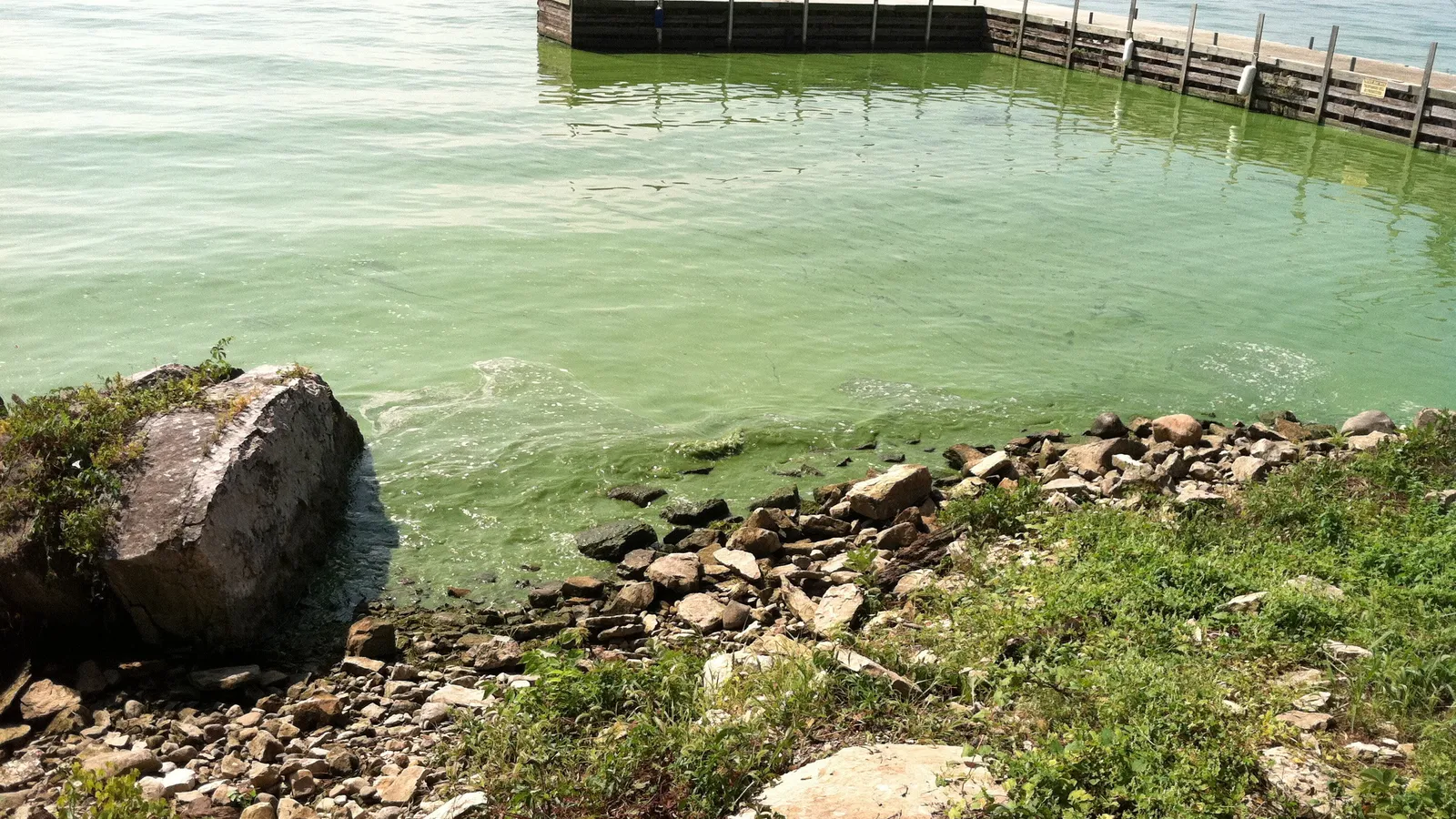
Spread fertiliser on a field, add heavy rain, and some of the nitrogen and phosphorus ends up in the nearest lake. What happens next is a chain you can predict step by step. Here it is from real lake experiments, then a virtual lake you can run to test fixes.
How does fertiliser runoff cause algal blooms?
Algae need light, carbon dioxide and nutrients; when one nutrient is in short supply, adding it is like taking off a brake. NOAA gives the chain in two lines: excess nutrients that run off land "can stimulate an overgrowth of algae, which then sinks and decomposes in the water", and "the decomposition process consumes oxygen" (NOAA Ocean Service).
The clearest evidence on which nutrient matters comes from whole-lake experiments in northwestern Ontario, Canada. D. W. Schindler's team added phosphorus, nitrogen and carbon to small lakes at rates similar to those in many polluted lakes (Schindler, Science, 1974). In one lake split into two basins, both got equal nitrate and sucrose, but only one also got phosphate. That basin "quickly became highly eutrophic", while the other stayed as it was before fertilising.
Eutrophication is the over-enrichment of water with nutrients, and Schindler's experiment showed that in these lakes phosphorus was the switch.
To see where that phosphorus sits before it reaches water, our carbon and phosphorus cycles explainer follows the atoms through rock, soil and living things.
Why do fish die at night after an algal bloom?
A bloom makes oxygen in daylight through photosynthesis, but every alga, bacterium and fish respires around the clock. A University of Florida extension guide explains that dissolved oxygen rises in daylight, declines at night and is lowest just before daybreak, and that cloudy weather markedly cuts oxygen production (Francis-Floyd and Pouder, UF/IFAS). The same guide recommends 5 mg/L or more for fish health, says most species are distressed at 2 to 4 mg/L, and says deaths usually occur below 2 mg/L. Larger fish are usually affected before smaller ones.
NOAA uses the same line for the sea: water with 2 milligrams of oxygen per litre or lower is hypoxic, the condition people call a dead zone (NOAA Ocean Service). A 2008 review reported dead zones in more than 400 coastal systems covering more than 245,000 square kilometres, linked to coastal eutrophication fuelled by river runoff of fertilisers and the burning of fossil fuels (Diaz and Rosenberg, Science, 2008).
How do you build a virtual lake to test this?
You do not need code: a spreadsheet with one row per hour works. Track four quantities, each updated from the row above:
Phosphorus in the water: rises with runoff, falls as algae take it up, returns as dead algae rot.
Algae: grow in daylight in proportion to the phosphorus available, and die at a steady rate.
Dead matter: gains whatever algae die, loses whatever bacteria break down.
Dissolved oxygen: gains from photosynthesis (daytime only) and from the air at the surface; loses to respiration by algae and to decay of dead matter.
Before you press run, answer three questions. Predicting first turns a simulation from a cartoon into a test, as our look at what studies found on simulations versus static diagrams explains.
When does oxygen first touch the 2 mg/L hypoxia line (NOAA): at noon, at midnight or just before dawn?
Does the oxygen crash come while algae are rising, or after they peak and start to die?
If runoff stops today, does oxygen recover tomorrow?
With these rules, the dawn low should sink day by day, with the deepest dip after the algae peak, when the most dead matter is rotting.
If you would rather move sliders than build columns, the Fermi Simulation Lab has interactive simulations for ideas that are easier to see than to read.
Which fixes for eutrophication work fastest?
Run each fix from the same polluted lake, one at a time.
Cut phosphorus at the source (less fertiliser, better timing, treated sewage). In one of Schindler's lakes, recovery "was almost immediate" when only the phosphate additions were stopped (Schindler, 1974). Real lakes can be slower: a review of 35 lakes with long-term records found that phosphorus released inside the lake delayed recovery, though in most a new, stable phosphorus level was reached after 10 to 15 years (Jeppesen and colleagues, Freshwater Biology, 2005).
Cut nitrogen only. Schindler's split-lake result suggests little change where phosphorus is the limiting nutrient. It is a tempting wrong guess, so test it.
Pump air into the water. Add an aeration term to your oxygen column: it lifts oxygen quickly and can prevent a fish kill, but the algae and the phosphorus are still there.
Your runs should show a trade-off: aeration is the emergency measure; cutting phosphorus is the cure, and in a real lake it can take years. A strong exam answer names both.
If terms like limiting nutrient still feel shaky, the Fermi Concept Library has a lesson for each concept in biology and chemistry. Then start your lake with one runoff pulse, predict the dawn oxygen on day 10, and run it.


