On this page
Carbon tetrachloride, freons and DDT come up together in Class 12 haloalkanes. All three were useful chlorine compounds, and all three lasted far longer in the environment than anyone planned. Here are the uses, the harms and the ozone mechanism, in a form you can write in an exam.
What is carbon tetrachloride used for, and why is it harmful?
According to the US Agency for Toxic Substances and Disease Registry, carbon tetrachloride (CCl4) was once used to make refrigeration fluid and aerosol propellants, and as a pesticide, a cleaning fluid and degreaser, in fire extinguishers and in spot removers. Because of its harmful effects, those uses are now banned and CCl4 is only used in some industrial applications.
The ATSDR says high exposure makes the liver enlarge and damages or destroys its cells, and also damages the kidneys. It adds that the US EPA classes CCl4 as a probable human carcinogen, based mostly on liver tumours in animals.
CCl4 also harms the ozone layer. NOAA's Twenty Questions and Answers About the Ozone Layer gives CCl4 an atmospheric lifetime of 30 years and an ozone depletion potential of 0.87, close to CFC-11's value of 1.
What are freons used for?
Freons are chlorofluorocarbons (CFCs), such as CFC-11 (CCl3F) and CFC-12 (CCl2F2). NOAA's assessment says CFCs were used in refrigeration, air conditioning, foam blowing, spray-can propellants and cleaning metal and electronic parts.
They are highly unreactive in the lower atmosphere, so they last a long time. In the same NOAA table, CFC-11 lasts 52 years in the atmosphere and CFC-12 lasts 102 years.
How do freons deplete the ozone layer?
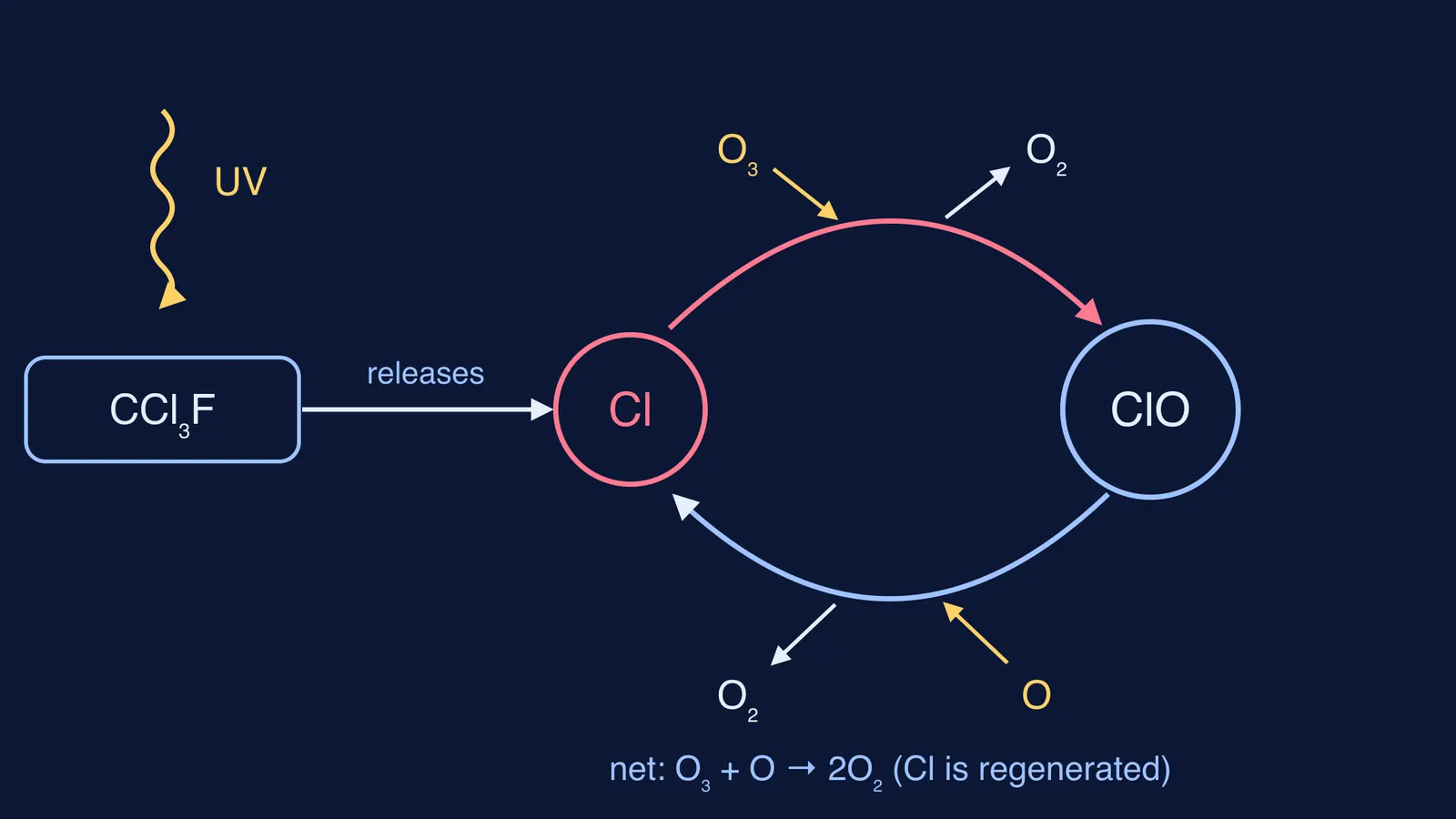
In 1974, Mario Molina and F. Sherwood Rowland proposed in Nature that chlorofluoromethanes are destroyed in the stratosphere and that the chlorine atoms released catalyse ozone destruction. NOAA describes the chain:
CFCs build up in the lower atmosphere and drift slowly upward. The US EPA says this can take as long as two to five years.
In the stratosphere, strong ultraviolet light breaks a C–Cl bond. For CFC-11: CCl3F + UV → CCl2F• + Cl•.
Propagation, part one: Cl• + O3 → ClO• + O2.
Propagation, part two: ClO• + O → Cl• + O2.
Net: O3 + O → 2O2. The chlorine atom comes out unchanged and starts again.
Because step 4 gives back the Cl atom, one chlorine atom can destroy over 100,000 ozone molecules before it is removed from the stratosphere, according to the US EPA.
Evidence from the atmosphere came in 1985, when Joseph Farman, Brian Gardiner and Jonathan Shanklin reported large losses of total ozone in Antarctica in Nature. The Montreal Protocol, signed in 1987, set out to phase out the production and consumption of ozone-depleting substances. The 2022 scientific assessment reported by WMO says nearly 99% of banned ozone-depleting substances have been phased out. If current policies stay in place, the ozone layer should return to 1980 values by around 2066 over Antarctica, 2045 over the Arctic and 2040 elsewhere.
Less ozone lets more UV-B reach the ground. See what UV-B does to DNA and your eyes.
Why was DDT banned, and is it still used?
DDT (dichlorodiphenyltrichloroethane) was the first modern synthetic insecticide, developed in the 1940s. The US EPA's history of DDT says it was used against malaria, typhus and other insect-borne diseases. The EPA says DDT is very persistent, builds up in fatty tissue and can travel long distances in the upper atmosphere.
Rachel Carson's 1962 book *Silent Spring* raised public concern over improper pesticide use, and in 1967 Derek Ratcliffe reported in Nature a decrease in eggshell weight in certain birds of prey. In 1972 the EPA cancelled DDT, citing harm to wildlife and potential risks to human health.
DDT is not banned everywhere. Under the Stockholm Convention, countries may still produce or use it for disease vector control, following WHO guidelines, when locally safe, effective and affordable alternatives are not available.
How should you write this in an exam?
For each compound, write one line on each of these four points:
Use: what made it attractive (CCl4: cleaning fluid and fire extinguishers; freons: refrigerants and aerosol propellants; DDT: insecticide against malaria mosquitoes).
Property behind the harm: CCl4 and freons are stable and volatile; DDT is stable and fat-soluble.
Harm: CCl4 damages the liver and kidneys and depletes ozone; freons deplete ozone; DDT persists, builds up in fatty tissue and harms wildlife.
Equation or evidence: the two propagation steps for ozone; the 1972 EPA cancellation for DDT.
For the ozone part, write all three stages of a chain reaction: initiation (UV splits C–Cl), propagation (the two Cl and ClO steps), and the net equation. Do not drop the ClO + O step: it is the step that shows the reaction is catalytic.
If haloalkanes still feel shaky, the Fermi Concept Library gives each chemistry concept its own lesson and shows where it fits in the map. When a mechanism question goes wrong, the Fermi Problem Library has worked problems with a step-by-step solver that explains the reasoning rather than printing an answer. For another case of light driving a reaction in a chlorine compound, see why chloroform is stored in dark bottles.