On this page
Life on land is shielded by a thin layer of gas most of us will never see. If you squashed all the ozone above you down to sea-level pressure, it would make a layer only about 3 millimetres thick on average, according to NOAA's Twenty Questions on the ozone layer. That layer decides how much of the Sun's most damaging light reaches your skin and eyes.
What does the ozone layer actually do?
Sunlight includes ultraviolet (UV) light, which WHO) splits into three bands by wavelength.
UV-C: 100–280 nm, the most energetic and most damaging
UV-B: 280–315 nm
UV-A: 315–400 nm
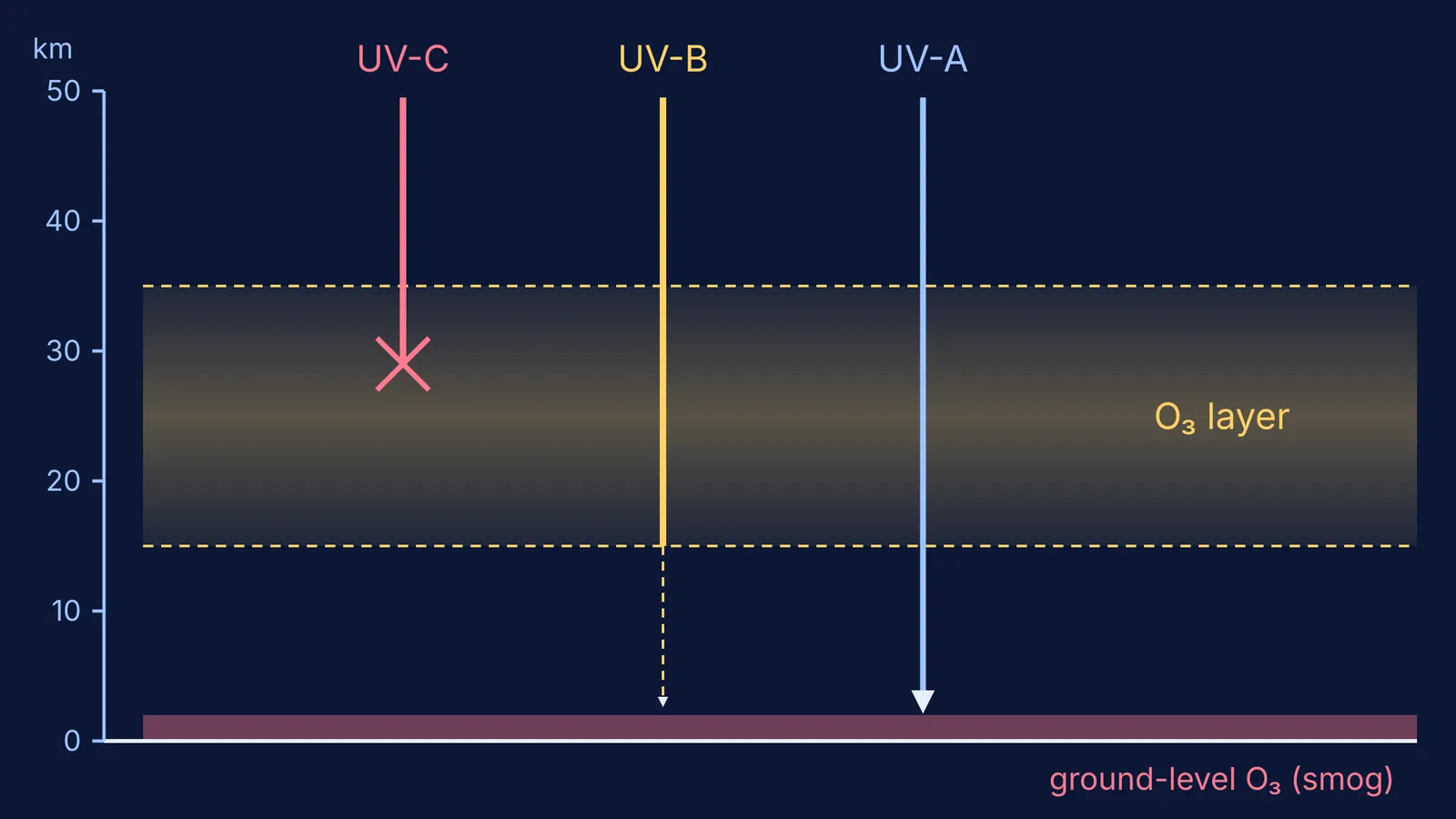
About 90% of atmospheric ozone is in the stratosphere, and the region with the most ozone, between about 15 and 35 km up, is what we call the ozone layer, according to NOAA's 2022 assessment. The same source says UV-C is entirely absorbed within the ozone layer and most UV-B is absorbed, while UV-A is only weakly absorbed. WHO puts it plainly: less ozone means more UV reaches the Earth's surface.
How does UV-B damage DNA and eyes?
Shorter wavelengths carry more energy per photon. Multiplying Planck's constant in eV by the speed of light gives the shortcut E = 1240/λ, with λ in nanometres. A 300 nm UV-B photon carries about 4.1 eV, while a 550 nm green photon carries about 2.3 eV. That extra energy is enough to drive chemical changes in molecules like DNA.
A review in the Journal of Nucleic Acids by Rastogi and colleagues (2010) describes how UV radiation, mainly UV-B, causes DNA lesions such as cyclobutane-pyrimidine dimers, where two neighbouring pyrimidine bases on the same strand become chemically linked. Cells have repair systems for this, including nucleotide excision repair, but damage that is not repaired can lead to mutations. The same idea is why UV water purifiers kill germs: they damage microbes' DNA on purpose.
WHO's UV fact sheet lists photokeratitis (inflammation of the cornea) as a short-term effect, and cataract, where the lens slowly turns cloudy, as a long-term one. WHO estimates that 15 million people worldwide are blind from cataracts, and that about 10% of those cases may be due to UV exposure.
How does ozone in the stratosphere absorb UV?
An ozone molecule (O3) absorbs a UV photon and splits into an oxygen molecule (O2) and a free oxygen atom (O). That atom soon joins another O2 to make O3 again, and the photon's energy ends up as heat in the stratosphere. Sydney Chapman worked out this cycle, which you can read about in how Chapman explained the ozone layer in 1930.
Why is ground-level ozone bad if the ozone layer is good?
Near the ground, ozone is not released directly. WHO-air-quality-and-health) explains that it forms when other gases react in sunlight, and that it is one of the major parts of photochemical smog. NOAA calls ozone near the surface in excess of natural amounts "bad ozone": it can reduce lung capacity, reduces crop yields and acts as a greenhouse gas.
Smog ozone does not repair the ozone layer. In India, the National Ambient Air Quality Standards, notified by the Central Pollution Control Board on 18 November 2009, cap ozone at 100 µg/m³ averaged over 8 hours and 180 µg/m³ over 1 hour.
Good ozone or bad ozone? A four-question check
Where is it? In the stratosphere (the ozone layer sits at about 15–35 km) it is the protective layer. In air at street level it is a pollutant.
What is the story about? UV, skin, eyes, DNA or CFCs point to the ozone layer. Smog, traffic, asthma or crops point to ground-level ozone.
What made it? UV splitting O2 high up makes layer ozone. Polluting gases reacting in sunlight make smog ozone.
What fixes it? For the layer, phasing out ozone-depleting chemicals. For smog, cutting vehicle and industrial emissions.
Worked example: "Ozone levels rose in Delhi on a sunny afternoon. Is that good news for UV protection?" Answer: no. That ozone is at ground level, so it is a pollutant, and sunlight helps form it.
For everyday life, WHO advises sun protection when the UV Index is 3 or above: limiting midday sun, seeking shade, a hat, UV-blocking sunglasses and sunscreen.
If any of these ideas feel shaky, the Fermi Concept Library has a lesson for each concept in physics, chemistry and biology, and shows where it sits in the map. To practise the numbers, the Fermi Problem Library has worked problems with a step-by-step solver that explains the reasoning.
Is the ozone layer recovering?
Yes, slowly. According to WMO, the 2022 assessment by the UN-backed Scientific Assessment Panel found that nearly 99% of banned ozone-depleting substances have been phased out. If current policies stay in place, the layer should return to 1980 values by about 2066 over the Antarctic, 2045 over the Arctic and 2040 for the rest of the world.