

On this page
If your purifier says "UV" on the label, a small lamp inside does the germ-killing. It does not filter germs out. It damages their genes so they cannot multiply, using Class 11 and 12 physics and biology.
What does a UV water purifier actually do?
Water flows past a lamp sealed in a clear quartz tube. Scotland's Drinking Water Quality Regulator, in its technical guidance on UV disinfection, says low-pressure mercury lamps, which produce 85% of their energy at 254 nm, are the most commonly used. It also notes that "unlike chlorine, UV does not have any residual disinfectant effect in the water." Nothing is added; the microbes stay in the water but can no longer reproduce.
Many home purifiers stack stages: a sediment filter, often an RO membrane for dissolved salts (see how an RO water purifier pushes against osmotic pressure), then the UV lamp for living microbes.
Where does UV-C sit on the electromagnetic spectrum?
The World Health Organization's Q&A on ultraviolet radiation defines the UV region as 100–400 nm: UVA (315–400 nm), UVB (280–315 nm) and UVC (100–280 nm). WHO calls UVC "the most damaging type of UV radiation", but the atmosphere filters all of it out. A purifier's 254 nm lamp is UV-C made on purpose. Our electromagnetic spectrum drawn to scale shows where that sits.
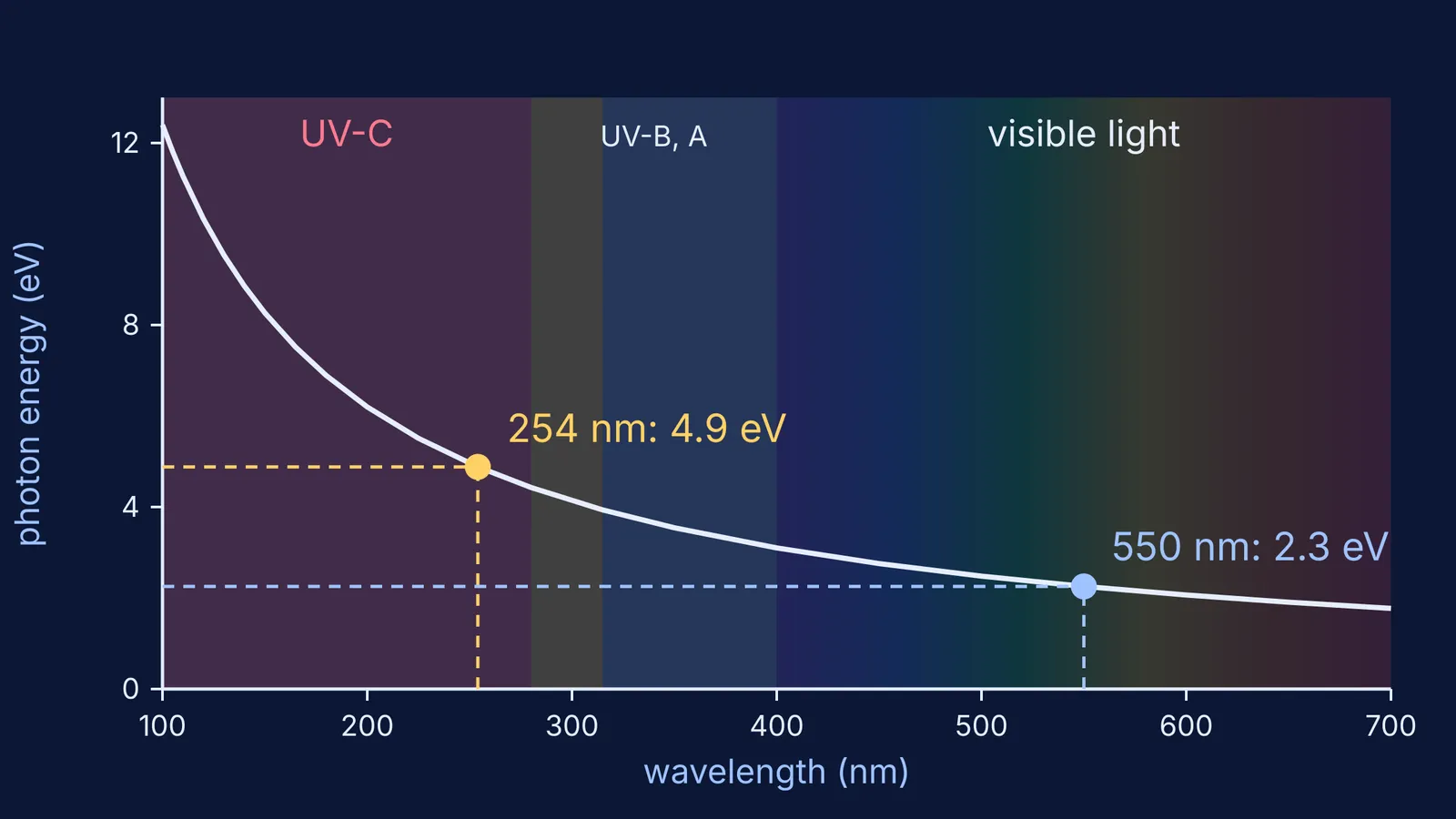
Why does a shorter wavelength do more damage? Each photon carries energy E = hc/λ.
Worked example. Use h = 6.626 × 10⁻³⁴ J s (NIST CODATA value) and c = 3.00 × 10⁸ m/s.
At 254 nm: E = (6.626 × 10⁻³⁴ × 3.00 × 10⁸) ÷ (254 × 10⁻⁹) ≈ 7.8 × 10⁻¹⁹ J, about 4.9 eV.
At 550 nm (green light): E ≈ 3.6 × 10⁻¹⁹ J, about 2.3 eV.
One UV-C photon carries a little over twice the energy of a green one.
In ordinary light, molecules absorb one photon at a time, so a brighter green bulb still cannot do what one UV-C photon does. If ideas like this are easier to see than to read, the Fermi Simulation Lab has interactive simulations built for that.
How does UV light damage a germ's DNA?
Australia's drinking water guidelines on UV disinfection put it in one line: "UV light inactivates microorganisms by damaging their nucleic acid, thereby preventing them from replicating and disrupting their ability to infect hosts." The useful band is 200–300 nm, with maximum effectiveness around 265 nm, so a 254 nm lamp sits close to the peak.
A review by Rastogi and colleagues in the Journal of Nucleic Acids (2010) lists the main UV lesions, starting with cyclobutane pyrimidine dimers: two neighbouring pyrimidine bases (thymine or cytosine) on one strand get joined by new bonds. That kink blocks normal copying. A bacterium that cannot copy its DNA cannot divide; a virus with damaged genes cannot copy itself. The review also describes repair systems, such as photoreactivation, that let cells undo some of this damage.
A literature review by Hijnen, Beerendonk and Medema in Water Research (2006) concluded that "UV is effective against all waterborne pathogens", including the protozoa Cryptosporidium and Giardia.
Why does cloudy water stop UV from working?
The Scottish UV guidance defines dose as lamp intensity multiplied by the time water spends in the reactor, in mW·s/cm². It warns that turbidity and suspended solids "could shield microbes from the radiation", and asks for turbidity below 1 NTU.
Worked example (made-up numbers). Say 10 mW/cm² reaches the far side of the chamber and each drop spends 3 s there.
Clear water: 10 × 3 = 30 mW·s/cm².
Cloudy water absorbing half the light: 5 × 3 = 15 mW·s/cm².
Cloudy water at double the flow: 5 × 1.5 = 7.5 mW·s/cm².
The same guidance cites US EPA figures of about 6 mW·s/cm² for 99% inactivation of Cryptosporidium and Giardia, but 100 mW·s/cm² for viruses, and notes that these doses are still being studied. Shade and speed eat the margin fast.
What should you check on a UV purifier at home?
These points come from the Scottish UV guidance unless marked.
Water should look clear before the UV stage; if it is cloudy, get the filters serviced.
Change the lamp on the maker's schedule. Typical lamp life is about 10 to 12 months, after which output is about 70% of a new lamp, even if it still glows.
Ask the technician to clean the quartz sleeve; hard water and iron leave deposits that block light.
Lamps can take up to ten minutes to warm up after being switched on, so after a power cut follow the manual before filling bottles.
Store purified water in clean, covered containers, because UV leaves no residual.
Never look at a bare UV-C lamp; WHO calls UVC the most damaging type of UV.
If you are unsure about your source water, have it tested by a certified lab.
Boiling attacks germs with heat instead; see what boiling water can and cannot remove. To revise the DNA structure behind all this, the Fermi Concept Library has a lesson for every concept in biology.


