

On this page
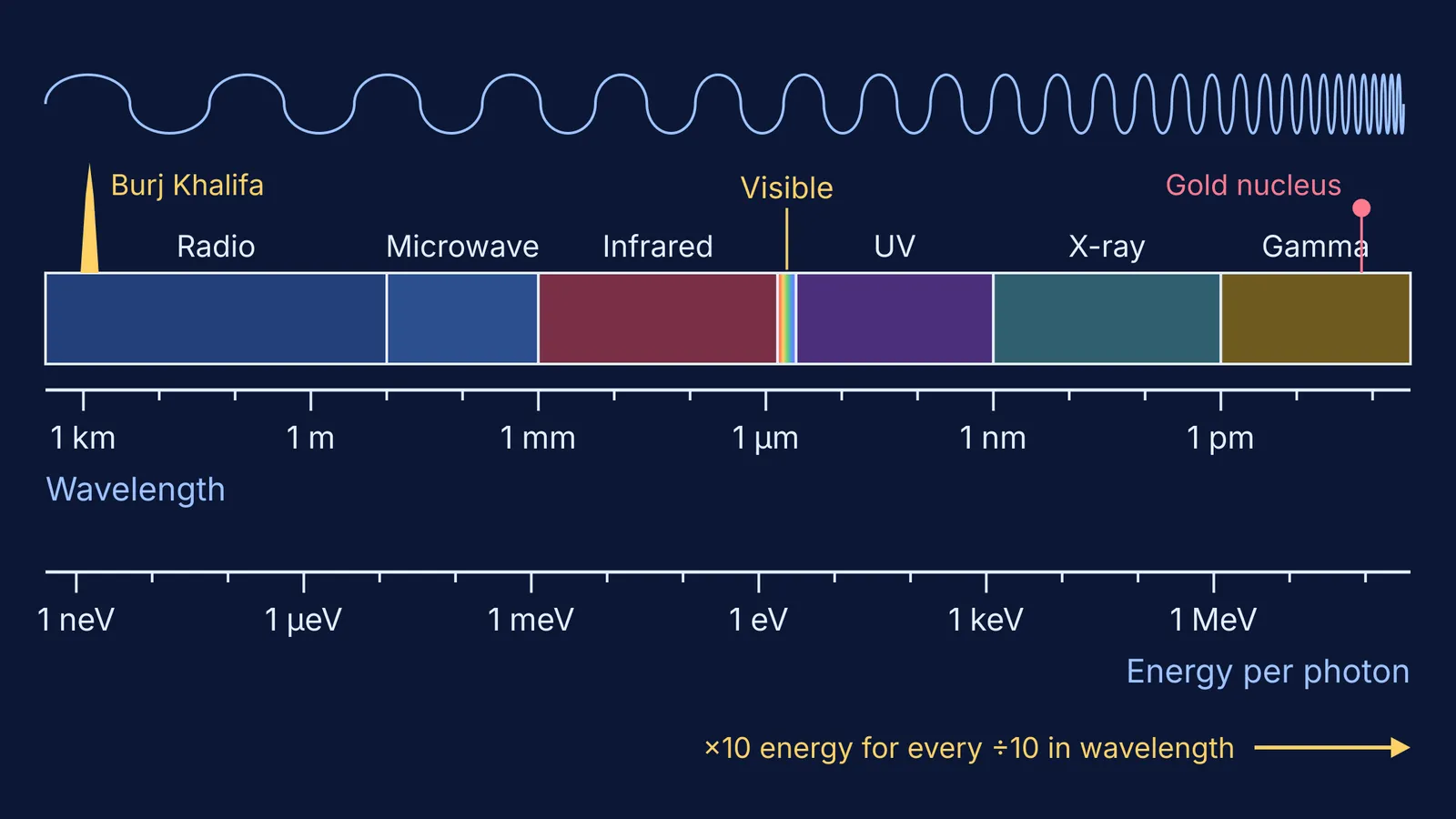
Most spectrum charts squeeze radio waves and gamma rays into one neat strip, which hides the main point: the range is huge. Put real objects beside the wavelengths and an energy beside each band, and the chart starts working for you in board, JEE Main and NEET-UG questions.
How big are electromagnetic waves compared to real objects?
The NCERT Class 12 physics chapter on electromagnetic waves lists these wavelength ranges in its Table 8.1, and points out that the boundaries between bands are not sharp:
Radio: longer than 0.1 m
Microwave: 0.1 m to 1 mm
Infrared: 1 mm to 700 nm
Visible light: 700 nm to 400 nm
Ultraviolet: 400 nm to 1 nm
X-rays: 1 nm to 10⁻³ nm
Gamma rays: shorter than 10⁻³ nm, which is 10⁻¹² m
Now compare them with things you can picture. The same NCERT chapter puts the AM radio band at 530 kHz to 1710 kHz. The speed of light is exactly 299,792,458 m/s by NIST's defined value, so a 530 kHz wave is about 566 m long. The Burj Khalifa is 828 m tall, according to the Council on Tall Buildings and Urban Habitat. One AM radio wave is about two-thirds of that tower.
FM radio (88 to 108 MHz) gives waves 2.8 m to 3.4 m long, and the 23.9 GHz wave in NCERT's Example 8.2, a microwave, is 1.26 cm long.
At the small end, NCERT's chapter on nuclei gives the radius of a nucleus as R = R₀A^(1/3), with R₀ = 1.2 fm. For gold (A = 197) that is about 7 fm, so a gold nucleus is about 14 fm, or 1.4 × 10⁻¹⁴ m, across. The NCERT waves chapter says gamma wavelengths go below 10⁻¹⁴ m, smaller than that nucleus.
How do you calculate the energy of one photon?
The energy of one photon is E = hf = hc/λ. The Planck constant h is exactly 6.62607015 × 10⁻³⁴ J s, according to NIST. One electronvolt is exactly 1.602176634 × 10⁻¹⁹ J, because NIST fixes the elementary charge at that value. Put these together and hc = 1239.84 eV nm, which gives the exam shortcut E (eV) ≈ 1240 / λ (nm). For more practice, see the 1240/λ photon-energy formula.
Predict first: a worked ladder from radio to gamma
Using the NCERT wavelengths above, cover the answers, write the power of ten you expect, then check with 1240 / λ.
AM radio, 566 m (5.66 × 10¹¹ nm): about 2.2 × 10⁻⁹ eV.
FM radio, 3.0 m at 100 MHz: about 4 × 10⁻⁷ eV.
Microwave, 1.26 cm from NCERT Example 8.2: about 1 × 10⁻⁴ eV.
Red light, 700 nm: 1.8 eV. Violet light, 400 nm: 3.1 eV.
Ultraviolet, 100 nm: 12.4 eV.
X-ray, 0.1 nm: 12,400 eV, or 12.4 keV.
Gamma ray, 10⁻³ nm: 1.24 × 10⁶ eV, or 1.24 MeV.
From that AM wave to that gamma ray, the wavelength shrinks by a factor of about 6 × 10¹⁴, and the energy per photon grows by the same factor. If you were off by powers of ten, check your units: metres not turned into nanometres, or kHz read as MHz.
Why does energy per photon matter more than wavelength?
NASA's introduction to the spectrum says gamma rays, X-rays and some ultraviolet are ionizing: they can knock electrons out of atoms. Why only some ultraviolet? In NCERT's atoms chapter, the energy of hydrogen's electron is E = −13.6/n² eV, so pulling it out of the ground state takes 13.6 eV. Using 1240 / 13.6, that matches a wavelength of about 91 nm, deep in the ultraviolet.
A microwave photon of about 10⁻⁴ eV is more than 100,000 times too weak to do that on its own; the NCERT waves chapter explains microwave ovens by energy passing into the motion of water molecules instead.
How to practise this in 15 minutes
Draw a line from 1 km to 10 fm with 17 equal steps, one per power of ten.
Shade the NCERT bands. Notice how thin the visible band is.
Mark two anchors: the 828 m tower and the 14 fm gold nucleus (NCERT nuclei chapter).
Under each step, write the energy per photon using the 1240 rule.
For any wavelength, name the band, then the power of ten in eV, and only then calculate.
If seeing a scale helps you more than reading about it, the Fermi Simulation Lab has interactive simulations for ideas that are easier to see than to read. Our post on simulations versus static diagrams covers when each one helps. If your powers of ten keep slipping in numericals, the Fermi Problem Library has worked problems with a step-by-step solver that explains the reasoning rather than printing an answer.
For the board-exam side of this chapter, read electromagnetic waves: the spectrum, E and B, and board questions next.


