On this page
In 1930 the British mathematical physicist Sydney Chapman worked out why there is a layer of ozone high above us. His answer, the Chapman cycle: ultraviolet sunlight both makes and breaks ozone, and the ozone layer is where the two balance. He set it out in "A Theory of Upper-Atmospheric Ozone" in the Memoirs of the Royal Meteorological Society (Le Moyne College teaching notes) and in a September 1930 paper, On ozone and atomic oxygen in the upper atmosphere.
Who was Sydney Chapman?
Chapman was born in Eccles, near Manchester, on 29 January 1888 and studied at Manchester and Cambridge (Wikipedia biography). He is also known for the Chapman–Enskog theory of gases and for work on Earth's magnetism, and he died in Boulder, Colorado, in 1970.
In 1913 Fabry and Buisson estimated that all the ozone overhead would make a layer about 3 mm thick at the surface, and from 1920 to 1925 Gordon Dobson made the first large set of ozone measurements (University of Washington lecture notes); here is how Gordon Dobson measured ozone with his spectrophotometer. What was missing was a mechanism.
What are the four reactions of the Chapman cycle?
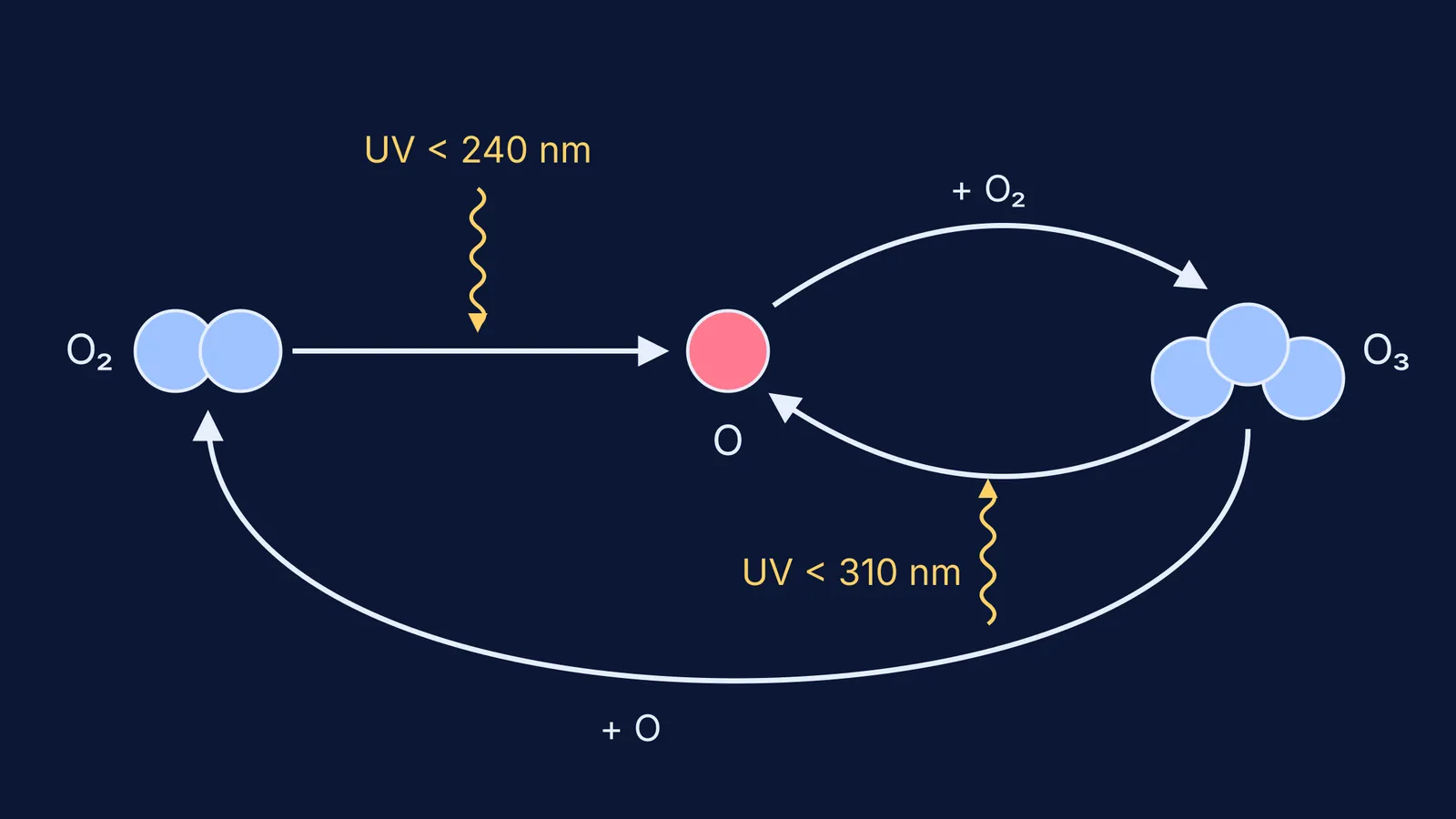
The textbook version of Chapman's mechanism has four steps (University of Washington lecture notes):
O₂ + UV light (wavelength below about 240 nm) → O + O. Slow.
O + O₂ + M → O₃ + M. Fast.
O₃ + UV light (wavelength below about 310 nm) → O₂ + O. Fast.
O + O₃ → 2 O₂. Slow.
M is a third molecule, such as N₂ or O₂, that conserves energy and momentum. Net effect: penetrating UV becomes heat with no net loss of ozone (ozone–oxygen cycle summary).
Steps 2 and 3 swap O and O₃ back and forth quickly, so chemists count them together as "odd oxygen" (University of Washington lecture notes). Only step 1 makes odd oxygen and only step 4 removes it, so the slow steps set how much ozone there is.
Why is the ozone layer in the stratosphere?
About 90% of Earth's ozone is in the stratosphere, which begins 10 to 15 km up and reaches about 50 km (NOAA and WMO, Twenty Questions, 2022). The richest band, about 15 to 35 km up, is the ozone layer. Even there ozone is rare: a few thousand ozone molecules per billion air molecules near the peak. All the atmosphere's ozone, brought down to the surface, would make a layer about 3 mm thick.
Chapman's picture explains the height. The UV that drives steps 1 and 3 gets stronger with altitude, because O₂ and O₃ above absorb it on the way down (University of Washington lecture notes). But higher air is thinner, with fewer O₂ molecules. The layer forms where there is enough of both. For the molecule itself, see ozone's resonance structure and why it is a strong oxidising agent.
Where did Chapman's theory fall short?
Chapman's chemistry alone predicts about twice as much ozone as is measured: roughly 790 Dobson Units (global average, March calculation) against about 300 observed (University of Washington lecture notes). Later work found the missing sinks: catalytic cycles in which a molecule X (OH, NO, Cl or Br) turns O + O₃ into 2 O₂ and comes out unchanged, ready to go again. The same notes link the nitrogen oxide cycle, which brought theory and measurement together, to the 1995 Nobel Prize.
Chlorine and bromine are the part humans changed: global stratospheric ozone fell from the 1970s to the late 1990s because human activities raised stratospheric chlorine and bromine (NOAA and WMO, Twenty Questions, 2022). Much of that chlorine story is in Thomas Midgley's leaded petrol and CFCs.
Worked example: can this photon split oxygen?
Chapman's wavelength limits make a neat Class 11-12 photon-energy problem. Use E (in eV) ≈ 1240 ÷ λ (in nm); multiply eV by 96.5 for kJ per mole of photons.
At 240 nm: E ≈ 1240 ÷ 240 ≈ 5.2 eV, or about 500 kJ/mol: the step 1 limit for O₂.
At 310 nm: E ≈ 1240 ÷ 310 = 4.0 eV, or about 386 kJ/mol: the step 3 limit for O₃, short of what O₂ needs.
Green light at 500 nm: E ≈ 1240 ÷ 500 ≈ 2.5 eV, under half what O₂ needs.
So a 280 nm photon (about 4.4 eV) cannot split O₂ but can be absorbed by O₃. The band between the two limits is where ozone does its shielding.
Before an exam, check yourself:
Shorter wavelength means more energy per photon, so "below 240 nm" means "above about 5.2 eV".
Step 2 needs no light, only a collision with M.
Only steps 1 and 4 change the total of odd oxygen.
If wavelength-to-energy conversions still trip you up, the Fermi Concept Library gives every concept in physics and chemistry its own lesson and its place in the map. For practice, the Fermi Problem Library has worked problems with a step-by-step solver that explains the reasoning rather than printing an answer.