

On this page
In 1924, British physicist Gordon Dobson built an instrument that transformed our understanding of the Earth's atmosphere. He invented the first ground-based spectrophotometer to measure the ozone layer, a device so effective that the standard measure of atmospheric ozone is still named after him (Wikipedia). His invention helped prove the importance of the ozone layer in absorbing harmful solar radiation and made global atmospheric monitoring possible.
Who was Gordon Dobson?
Gordon Miller Bourne Dobson (1889–1976) was a British physicist and meteorologist working at the University of Oxford. In the early 1920s, scientists were just beginning to understand the structure of the upper atmosphere, building upon the work of Fabry, Buisson and the 1913 measurement of the ozone layer.
By studying meteorites, Dobson had noticed that the temperature profile of the upper atmosphere was not constant, leading to the realisation that a specific region—the stratosphere—was being heated. He proposed that this heating was happening because ultraviolet radiation was being absorbed by ozone. Dobson designed and built the first instrument capable of accurately measuring this total ozone from the ground in 1924 (Wikipedia).
By studying how sunlight passed through the atmosphere, Dobson was able to map the ozone layer and prove its importance in absorbing harmful radiation. He also noted the connections between solar activity and weather, investigating how ultraviolet levels varied.
How does the Dobson spectrophotometer work?
Ozone molecules—which consist of three oxygen atoms—absorb ultraviolet (UV) light. While UVC radiation is entirely blocked by the ozone layer, longer-wave UVA light passes through almost completely. UVB light is partially absorbed.
The Dobson ozone spectrophotometer works by measuring the relative intensity of UVB radiation (at 305 nm) reaching the ground and comparing it to UVA radiation (at 325 nm) (Wikipedia). Since the amount of UVA remains relatively constant, the ratio between the two wavelengths reveals exactly how much ozone the sunlight passed through.
If all of the ozone were removed from the atmosphere, the amount of UVB radiation would equal the amount of UVA radiation on the ground. The ratio is determined by turning a dial on the instrument, which filters the light until the intensity of the two wavelengths is equal.
If you are studying atmospheric chemistry or optics for exams and find these interactions hard to picture, the Fermi Simulation Lab has interactive simulations for the ideas that are easier to see than to read.
Although they rely primarily on direct sunlight, Dobson spectrophotometers can also use light from the clear sky, the moon, or stars. The method is sometimes affected by aerosols and pollutants in the atmosphere, which can also absorb light at these wavelengths, but it remains a crucial technique.
What is a Dobson unit of ozone?
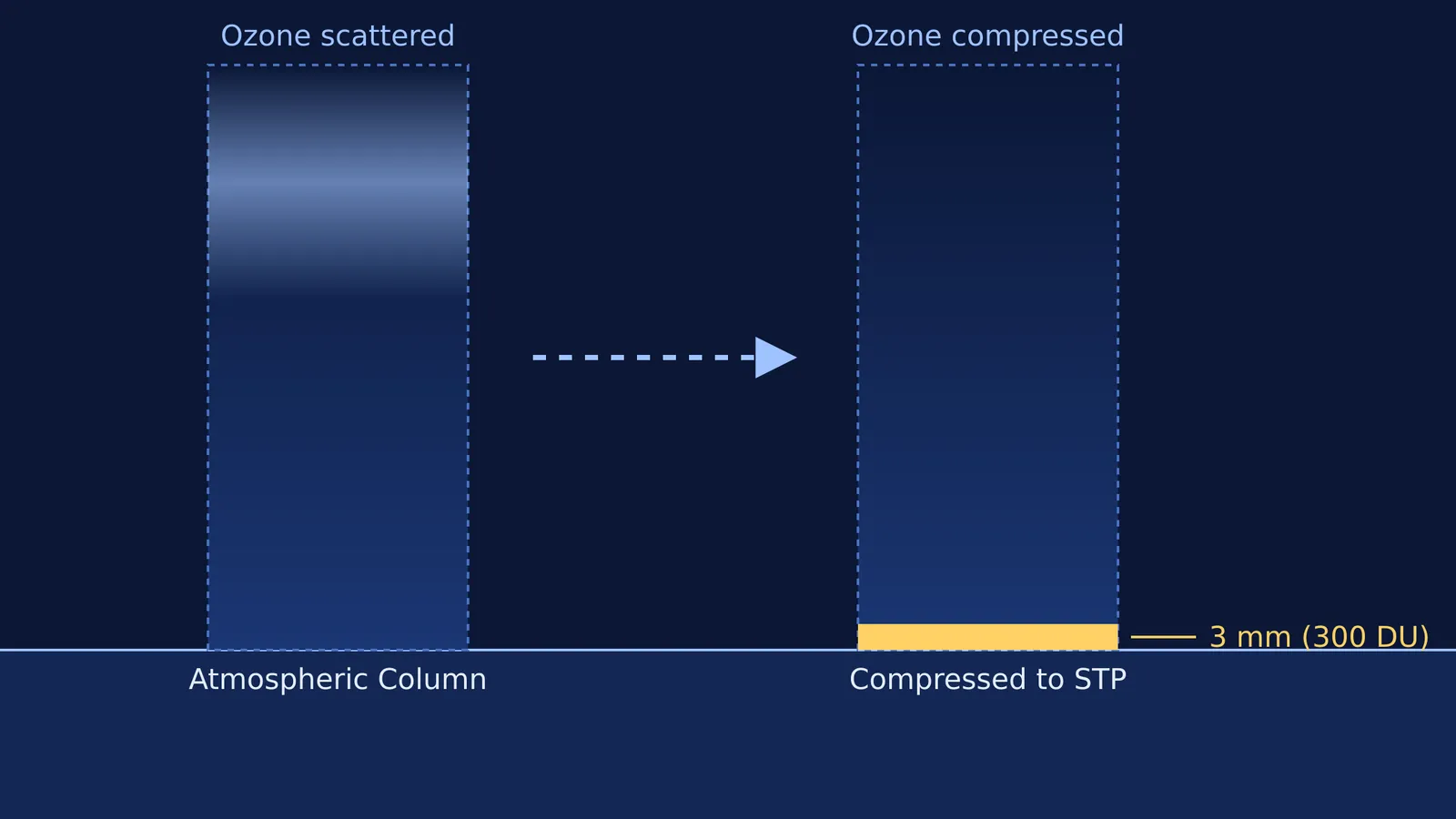
A Dobson unit (DU) is the standard measurement of the amount of a trace gas in a vertical column through the Earth's atmosphere.
One Dobson unit is defined as a layer of pure gas 10 micrometres (0.01 millimetres) thick at standard conditions for temperature and pressure (STP) (Wikipedia). The typical global column amount of atmospheric ozone is about 300 DU (Wikipedia). If all the scattered ozone in that column were compressed down to STP at the surface, it would form a layer of pure gas just 3 millimetres thick.
NASA uses a baseline value of 220 DU for ozone because values less than 220 DU were not found before 1979 over Antarctica. Readings below this level result from ozone loss driven by chlorine and bromine compounds.
How was the Antarctic ozone hole discovered?
Dobson's instruments formed the backbone of a global ozone-monitoring network. Decades later, they played a central role for Joseph Farman and the discovery of the Antarctic ozone hole. In 1984, Farman and his colleagues used data from Dobson spectrophotometers Nos. 31 and 51, stationed by the British Antarctic Survey, to document a massive seasonal loss of ozone over Antarctica (Nature).
Working through the numerical problems of spectroscopy and absorption can be challenging. For students who need help, the Fermi Problem Library has worked problems with a step-by-step solver that explains the reasoning rather than printing an answer.
Today, even with advanced satellite measurements, modernised Dobson spectrophotometers remain in use to calibrate data worldwide. About 120 instruments were made, and roughly 50 are still operating today, proving the lasting impact of Gordon Dobson's invention (Wikipedia).


