

On this page
What is the structure of ozone?
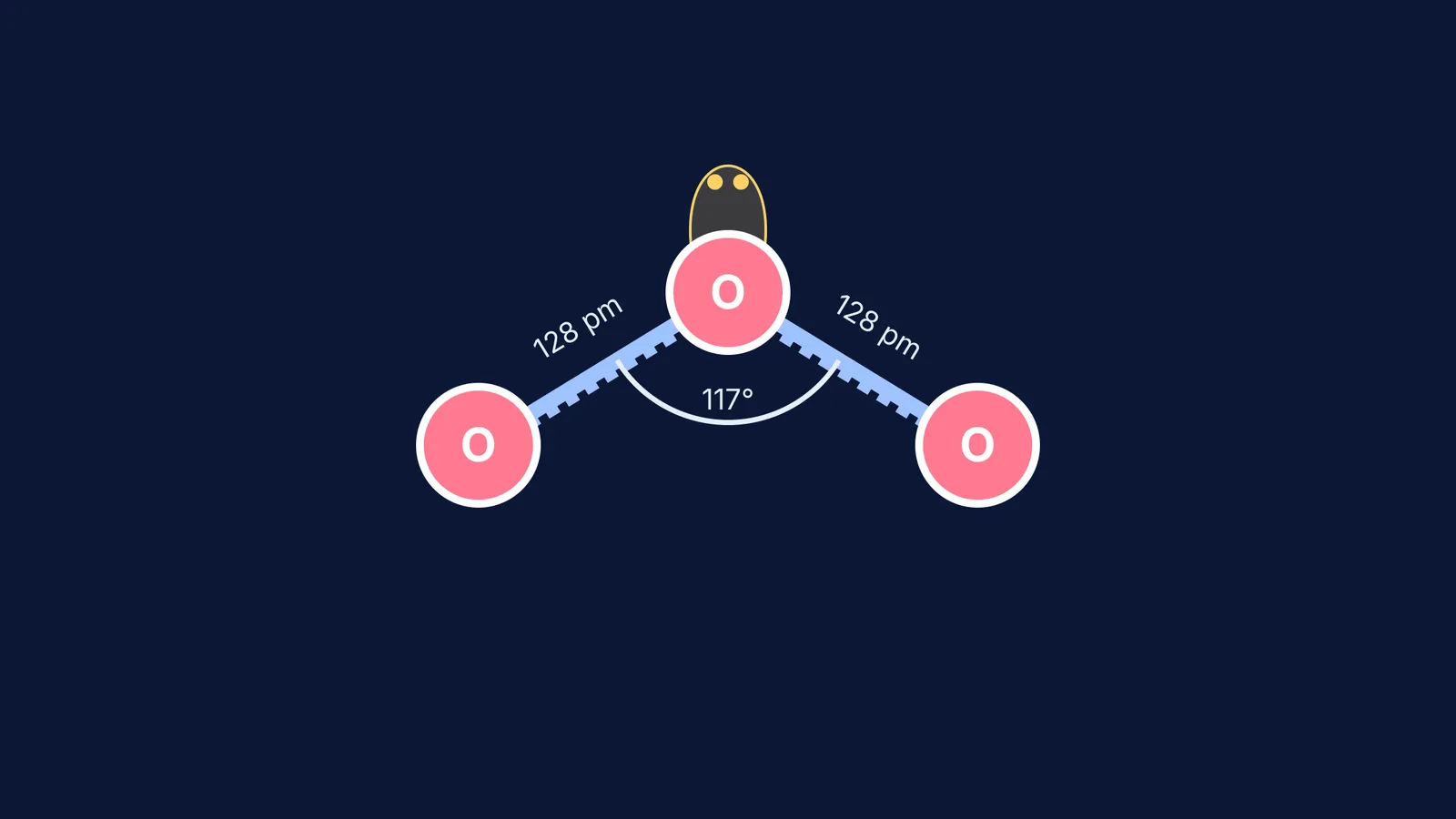
Ozone (O₃) is an allotrope of oxygen composed of three oxygen atoms. According to the NCERT Class 12 Chemistry textbook, the ozone molecule has an angular or V-shaped structure with a bond angle of approximately 117°.
Because the true structure is a resonance hybrid of two main canonical forms, the pi electrons are delocalised across the entire molecule. This means both oxygen-oxygen bond lengths in ozone are identical at 128 pm. This bond length sits comfortably between a standard O–O single bond and an O=O double bond, giving each bond a partial double-bond character. You can read more about how this works in our guide to finding the average bond order from resonance: nitrate, ozone and oxyanions.
The central oxygen atom is sp² hybridised and holds one lone pair of electrons. The repulsion between this lone pair and the two bonded oxygen atoms pushes the bonds closer together, reducing the angle from an ideal 120° (which you would expect for a trigonal planar electron geometry) down to 117°. Furthermore, calculating the formal charges across the molecule reveals that the central oxygen atom carries a formal charge of +1, while the terminal oxygen atoms share an overall formal charge of -1.
Why is ozone a strong oxidising agent?
Ozone is a thermodynamically unstable molecule when compared to normal diatomic oxygen (O₂). The NCERT Class 12 Chemistry syllabus explains that its formation from O₂ is an endothermic process. It requires energy to form, which is why a silent electric discharge is used in laboratory preparations. The discharge must be "silent" (sparkless) to prevent the generation of excess heat, which would immediately cause the newly formed ozone to decompose back into oxygen.
Its instability is driven by thermodynamics. The decomposition of ozone into oxygen results in the release of heat (a negative change in enthalpy, ΔH) and an increase in disorder (a positive change in entropy, ΔS). These two factors combine to make the Gibbs free energy change (ΔG) highly negative, driving the spontaneous breakdown into a stable molecule of oxygen gas and a highly reactive atom of nascent oxygen:
O₃ → O₂ + [O]
It is this nascent oxygen [O] that eagerly accepts electrons from other substances. This makes ozone a powerful oxidising agent that can strip electrons from metals, non-metals and other compounds much more aggressively than ordinary oxygen gas.
How does ozone react with KI, PbS and NO?
The chemistry syllabus highlights three classic redox reactions that demonstrate ozone's exceptional oxidising power:
1. Oxidising lead sulphide (PbS) When ozone passes over black lead sulphide, it rapidly oxidises it to white lead sulphate. This distinct and immediate colour change makes it a highly useful qualitative test for the presence of ozone in a mixture.
PbS(s) + 4O₃(g) → PbSO₄(s) + 4O₂(g)
2. Oxidising potassium iodide (KI) Ozone oxidises an aqueous solution of potassium iodide to produce free iodine.
2KI(aq) + H₂O(l) + O₃(g) → 2KOH(aq) + I₂(s) + O₂(g)
The liberated iodine (I₂) can be titrated against a standard solution of sodium thiosulphate using a starch indicator to determine the exact concentration of ozone.
3. Oxidising nitric oxide (NO) Ozone reacts instantly with nitric oxide to form nitrogen dioxide and oxygen gas.
NO(g) + O₃(g) → NO₂(g) + O₂(g)
Nitrogen oxides emitted from the exhaust systems of supersonic jet aeroplanes deplete the ozone layer in the upper atmosphere through this exact reaction. Because nitric oxide is a free radical, it aggressively attacks stratospheric ozone, a phenomenon famously studied by Mario Molina and the chemistry that warned of the ozone hole.
A three-step framework for balancing ozone reactions
Balancing ozone redox equations by trial and error can be frustrating. Instead, you can use the nascent oxygen method. Here is how it works for the oxidation of lead sulphide (PbS):
Write the ozone decomposition step. Every ozone molecule gives one stable oxygen molecule and one reactive nascent oxygen atom:
O₃ → O₂ + [O]
Write the target oxidation step. Lead sulphide (PbS) oxidises to lead sulphate (PbSO₄). This requires four oxygen atoms:
PbS + 4[O] → PbSO₄
Multiply and add. To get the four nascent oxygen atoms needed, multiply the first equation by four, then add the two equations together:
4O₃ → 4O₂ + 4[O] PbS + 4[O] → PbSO₄ Net equation: PbS + 4O₃ → PbSO₄ + 4O₂
This method works just as well for converting nitrites to nitrates or oxidising halogens. If you are struggling with the underlying chemistry, the Fermi Concept Library covers every concept in physics, chemistry, biology, mathematics and computing. For ideas that are easier to see than read, you can explore molecular structures in the Fermi Simulation Lab.


