On this page
Thomas Midgley Jr., an American engineer and chemist, made two inventions that solved real engineering problems and later did harm on a planetary scale. His story shows why you ask two questions about any new substance: is it safe to handle, and where does it end up?
What did Thomas Midgley invent?
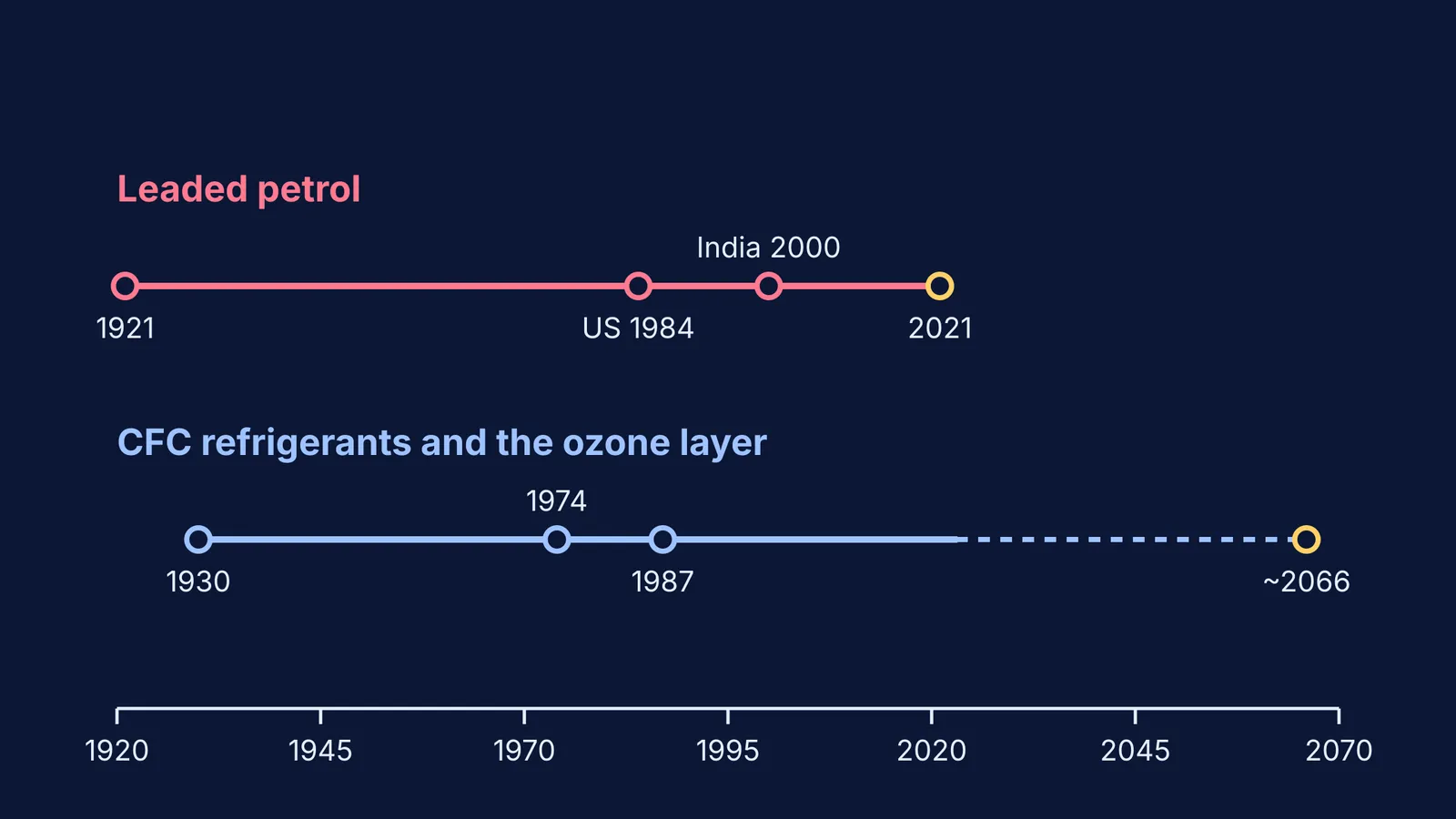
On 9 December 1921, Midgley added tetraethyl lead (TEL) to the fuel of a one-cylinder test engine and the engine knock stopped, according to the Collaborative on Health and the Environment's history of Midgley. General Motors and Standard Oil of New Jersey set up the Ethyl Corporation to make it.
In 1930 he identified dichlorodifluoromethane, or Freon-12, as an odour-free, nontoxic and nonflammable refrigerant gas, the Science History Institute records. It was a CFC (chlorofluorocarbon).
What harm did leaded petrol cause?
The warnings came early. Two workers died from exposure to what the press called "loony gas", Midgley himself got lead poisoning, and the US Public Health Service warned about lead in 1922, says the same history. It was sold anyway. By the US phase-out in 1984, an estimated 7 million tons of lead had gone into the air from petrol in the United States alone, the same source adds. India brought in low-leaded petrol in four big cities in 1994 and mandated unleaded petrol nationwide in April 2000, Down To Earth reports.
There is no level of lead exposure known to be without harmful effects, according to the World Health Organization. The WHO says lead can permanently affect children's brain development, lowering IQ and shortening attention span.
A 2022 study in PNAS by McFarland, Hauer and Reuben found that more than 170 million Americans alive in 2015, over half the population, had blood lead levels above 5 µg/dL in early childhood. The study estimated an average loss of 2.6 IQ points per person, about 824 million IQ points in total.
Algeria, the last country selling leaded petrol, stopped in July 2021. The UN Environment Programme said the global end of leaded petrol would prevent more than 1.2 million premature deaths a year.
What harm did CFCs do to the ozone layer?
Freon-12 was safe beside the fridge, but too stable to break down in the lower atmosphere. In 1974, Mario Molina and F. S. Rowland published a paper in Nature titled "Stratospheric sink for chlorofluoromethanes: chlorine atom-catalysed destruction of ozone". Our post on Mario Molina and the chemistry that warned of the ozone hole tells that story.
The US Environmental Protection Agency explains the steps. Ozone-depleting substances can take as long as two to five years to reach the stratosphere, where intense UV light releases chlorine. One chlorine atom can destroy over 100,000 ozone molecules before it is removed. Less ozone lets more UVB through, and the EPA links UVB to skin cancers, cataracts and harm to some crops and marine life. For the measurements that confirmed the loss, see Joseph Farman and the discovery of the Antarctic ozone hole.
The Montreal Protocol was signed in 1987 and came into force in 1989 to phase out ozone-depleting substances. Nearly 99% of the banned substances have now been phased out, the World Meteorological Organization reports. It projects that ozone will return to 1980 levels around 2066 over Antarctica, 2045 over the Arctic and 2040 elsewhere.
How should new chemicals be tested for environmental effects?
With TEL, warning signs were ignored. With CFCs, nobody asked the right question. Both lessons fit into six questions for any substance:
Does it break down, and how fast?
Where does it go after it is used: air, water, soil, or upwards?
What does it do at tiny doses over many years, not just at one big dose?
Is it used up when it reacts, or does it act like a catalyst and keep going?
Who is exposed who never chose to use it?
If it goes wrong, how long would it take to undo?
A worked example for Freon-12, using figures from the EPA and WMO:
Breakdown: very slow in the lower air, which is why it was chosen and why it reached the stratosphere.
Destination: up, over as long as two to five years.
Low dose: harmless to breathe, but UV releases chlorine high up.
Catalyst: yes. One chlorine atom can destroy over 100,000 ozone molecules.
Exposed: everyone under the ozone layer.
Undo time: recovery over Antarctica is expected around 2066, almost 80 years after the Montreal Protocol.
Now try the six questions on TEL: question 3 stands out, because the WHO knows of no safe level of lead.
If the idea of a catalyst that is not used up feels shaky, the Fermi Concept Library has a lesson for every concept in chemistry, so you can go back to the idea behind the ozone story. For a related history of lead, read Clair Patterson and how lead isotopes dated the Earth.