On this page
On 1 February 2026, Finance Minister Nirmala Sitharaman presented the Union Budget 2026-27 speech in Parliament. One official document, Budget at a Glance 2026-27, puts the headline numbers on its first four numbered pages. Here is how to read them.
What is the Union Budget, in simple words?
The Union Budget is the central government's plan of how much money it expects to receive and spend in one financial year. If you have ever drawn up a monthly budget for a college student, you know the three questions it answers: what comes in, what goes out, and how to cover the difference.
Budget at a Glance 2026-27 puts central government spending for 2026-27 at ₹53,47,315 crore, about ₹53.5 lakh crore. Receipts that are not borrowing are about ₹36.5 lakh crore, says the Budget speech.
Where does each rupee come from?
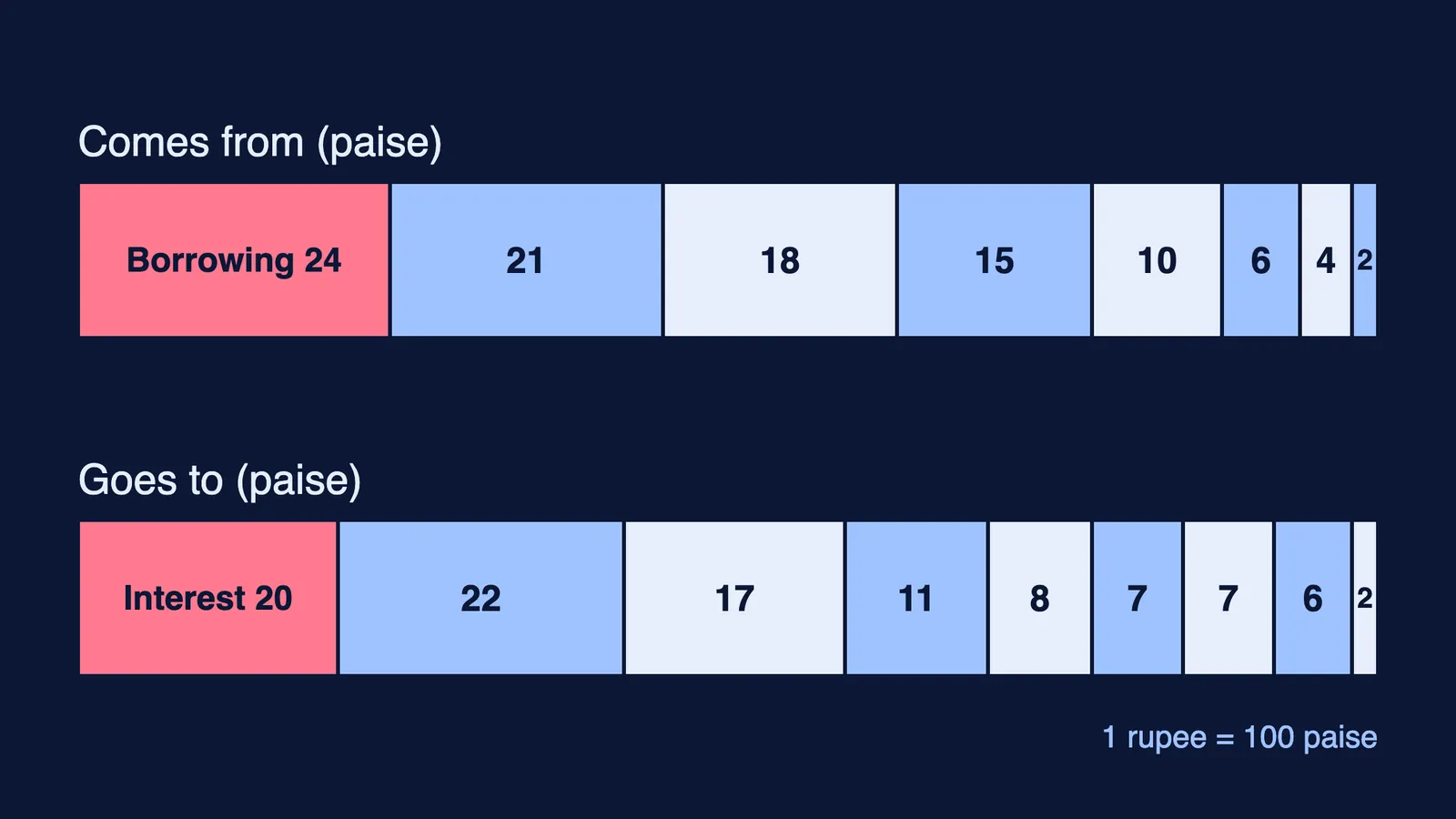
The "Rupee Comes From" chart on page 2 of Budget at a Glance 2026-27 splits every rupee the government receives into paise:
Borrowings and other liabilities: 24 paise
Income tax (including Securities Transaction Tax): 21 paise
Corporation tax, paid by companies on their profits: 18 paise
GST and other taxes: 15 paise
Non-tax revenue, such as dividends and fees: 10 paise
Union excise duties: 6 paise
Customs duties on imports: 4 paise
Non-debt capital receipts, such as loan recoveries: 2 paise
Where does each rupee go?
The "Rupee Goes To" chart on page 3 of the same document shows the other side:
States' share of taxes: 22 paise
Interest payments: 20 paise
Central sector schemes: 17 paise
Defence: 11 paise
Centrally sponsored schemes, run with the states: 8 paise
Finance Commission and other transfers: 7 paise
Other expenditure: 7 paise
Major subsidies: 6 paise
Civil pensions: 2 paise
What is the fiscal deficit in plain words?
The official definition in Budget at a Glance 2026-27 is: "Fiscal Deficit (FD) is the difference between total expenditure and total receipts (excluding Debt Capital Receipts)." In plain words, it is how much the government must borrow this year to pay for everything it plans to do.
Here is the sum, using the page 1 table of that document:
Total spending: ₹53,47,315 crore.
Receipts without borrowing: ₹35,33,150 crore of revenue receipts, plus ₹38,397 crore of loan recoveries, plus ₹80,000 crore of other receipts, which makes ₹36,51,547 crore.
Fiscal deficit: ₹53,47,315 crore minus ₹36,51,547 crore, which is ₹16,95,768 crore.
As a share of the economy: ₹16,95,768 crore divided by the estimated GDP of about ₹393 lakh crore is 4.3%.
So for every ₹100 of goods and services India is expected to produce in 2026-27, the Centre plans to borrow about ₹4.30. New to GDP? Start with what GDP measures, with India's numbers.
The same table lists interest payments of ₹14,03,972 crore. Subtract that from the fiscal deficit and you get the primary deficit: ₹2,91,796 crore, or 0.7% of GDP. The Budget speech estimates central government debt at 55.6% of GDP in 2026-27, down from 56.1% in 2025-26, with a target of 50±1% by 2030-31. The speech says a falling debt-to-GDP ratio will reduce the outgo on interest payments over time and free up money for priority spending.
How can you read the budget yourself in 15 minutes?
Open Budget at a Glance and work through this checklist with a pencil:
Page 1: write down total expenditure, fiscal deficit (with its % of GDP in brackets) and interest payments.
Compare columns: the fiscal deficit was 4.4% of GDP in the 2025-26 Revised Estimates and is 4.3% in the 2026-27 Budget Estimates. Did it fall or rise?
Pages 2 and 3: note the borrowing and interest paise.
Page 4: see how the deficit is financed. Net market borrowing through government securities is ₹11,73,210 crore.
Check one ratio yourself: interest divided by total expenditure.
Step 5 hides a lesson. ₹14,03,972 crore divided by ₹53,47,315 crore is 26%, yet the pie chart says 20 paise. Both are right: the chart notes say their totals include the states' share of taxes, which the page 1 table nets out. Same numerator, different denominator, so always ask what a percentage is a percentage of. If ratios still feel shaky, the Fermi Concept Library has a lesson for every concept in mathematics.
Next, see how prices change with our samosa price index for inflation.