On this page
When your child leaves for college, the monthly money question arrives fast: too little and they skip meals or borrow from friends, too much and nobody learns to budget. The answer is not a number you copy from someone else. It is a short list you build together, a fixed way of sending money, and a simple rule for top-ups.
What does a college student actually spend each month?
Official data gives you a sense of scale, not a target. The NSS 75th round survey on household spending on education, run by the National Statistical Office from July 2017 to June 2018, asked households about former members, aged 3 to 35, who had moved out and were still studying.
Urban households that spent money on such a member spent an average of ₹1,00,693 in the academic year, and rural households ₹41,079, counting education and every other expense (NSS Report 585 summary).
The same survey found that spending on the course itself averaged ₹14,264 per student in the academic session for a general graduate course and ₹63,495 for a technical or professional graduate course. Prices have risen since 2017-18, and your child's city and college matter far more than a national average. So use these figures as a sense check, and build your own list.
How do you estimate your child's monthly costs?
Sit down together, ideally before the first term, and work through these steps.
Take out what you pay directly. Tuition, hostel rent and mess fees usually go straight to the college, so keep them out of the allowance. Our guide to planning hostel and mess fees for college covers that side.
List the essentials: phone and data, local travel, laundry and toiletries.
Add study costs: printouts, stationery, lab supplies, the occasional book.
Add food beyond the mess: snacks, a weekend meal out, late-night tea.
Agree a personal amount for outings, clothes and small treats, so this spending is planned and not hidden.
Add a small buffer for surprises such as a medicine, a broken charger or a group trip fare.
Treat the first month as a trial. Your child records every spend, and you both adjust the numbers at the end of it.
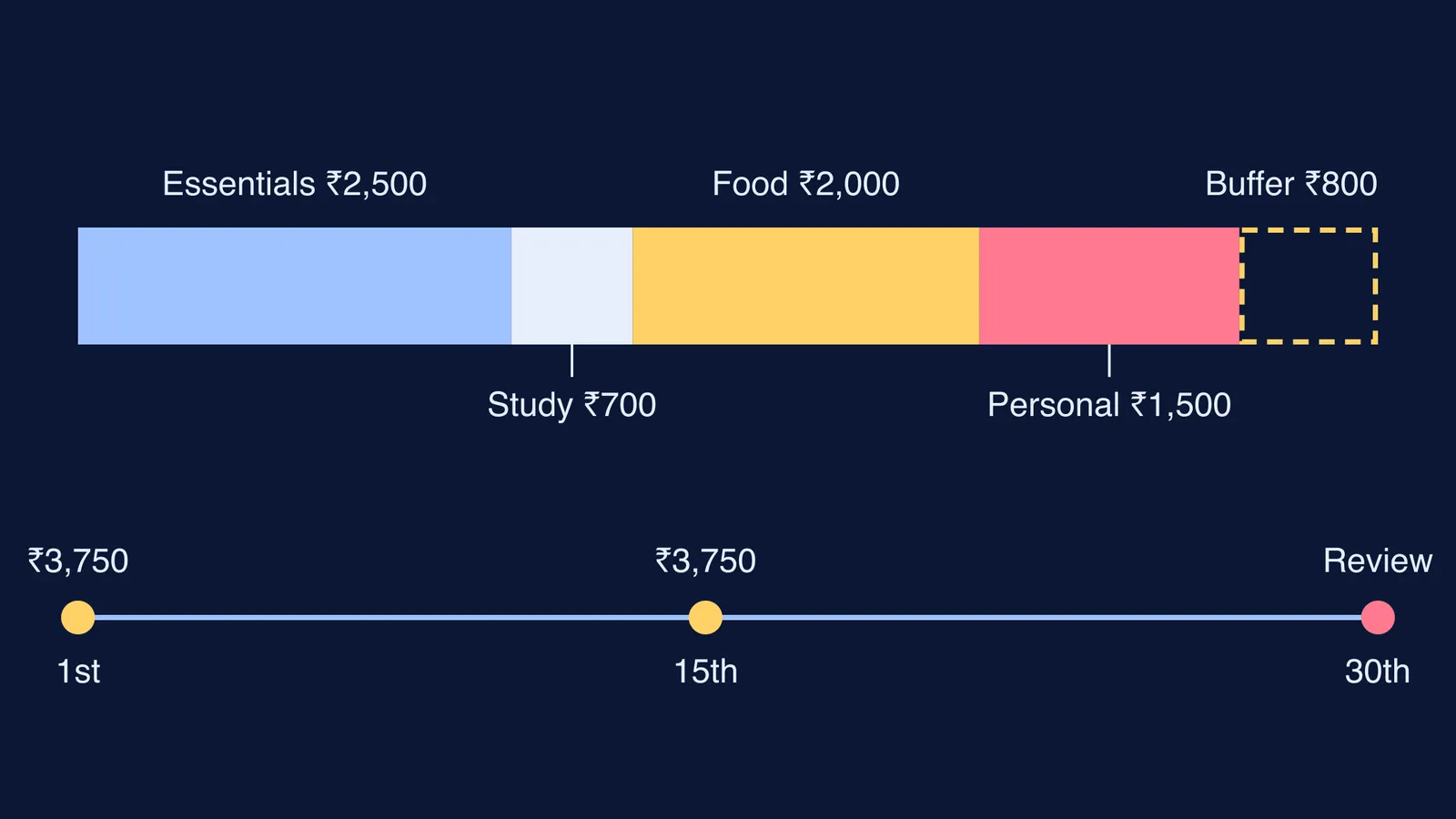
Here is a worked example. Take Anika, an imagined second-year BSc student who lives in a hostel in another city. Her family pays the fees and mess charges directly to the college. Her monthly allowance looks like this:
Essentials: ₹2,500 (phone and data ₹400, local travel ₹1,300, laundry and toiletries ₹800)
Study: ₹700
Food beyond the mess: ₹2,000
Personal: ₹1,500
Buffer: ₹800
That adds up to ₹7,500 a month. Your numbers will differ; keep the structure of five lines, with the buffer named separately so it isn't quietly spent early.
How should the money be sent and topped up?
A predictable system prevents most arguments. Agree these rules once and write them down.
Send the money in two parts, on the 1st and the 15th. Anika gets ₹3,750 each time, so one bad week cannot wipe out the month.
Allow one top-up request a month, with a one-line reason. If top-ups become routine, the budget is wrong, so fix the budget.
Let your child keep unspent buffer money, or move it towards something they are saving for. That rewards planning.
Keep big items such as a laptop, train tickets home or exam fees outside the allowance, as separate requests discussed in advance.
Review the five lines at the end of each month for the first term, then once a term after that.
For tracking, the UPI history on your child's phone already records most spends. Ask for a five-line monthly summary, not every receipt. You are checking that the plan works, not auditing your child.
That advice comes from the safe digital banking practices in the RBI's consumer awareness note on cyber threats and frauds.
What should you say when you set it up?
The conversation matters as much as the amount. You could try:
"This is your money for the month, and you decide how to spend it. We picked these five lines together. If something unexpected comes up, tell me early and we'll sort it out. Asking for help with money is fine. Hiding a problem isn't."
Then hand over real decisions. If your child walks to class and spends the travel savings on an outing, that is the budget working. Our post on life skills to build before moving to a hostel has more on cooking, laundry and paperwork.
If printouts and extra books keep pushing up the study line because a subject feels shaky, the Fermi Concept Library has every concept in physics, chemistry, biology, mathematics and computing, each with its own lesson.
If your child is younger and you're still working out pocket money, start with our guide to how much pocket money to give a teenager in India.