On this page
Most families settle on pocket money by guessing, or by copying what a cousin gets. A better starting point is a short list of what your teen will now pay for themselves, priced honestly, with a little on top to save.
How much pocket money should a teenager get in India?
There is no single right number. Costs differ between a small town and Mumbai, and even between two teens in one class. So build the figure instead of picking it:
Ask your teen to list what the money must cover each month.
Price each item from what they actually spent last month, not from a guess.
Add a saving amount you both agree on, tied to something they want.
Fix a pay day and a review date, such as the start of each term.
Raise the amount when responsibilities grow, not when the money runs out.
What does a ₹1,200 monthly budget look like?
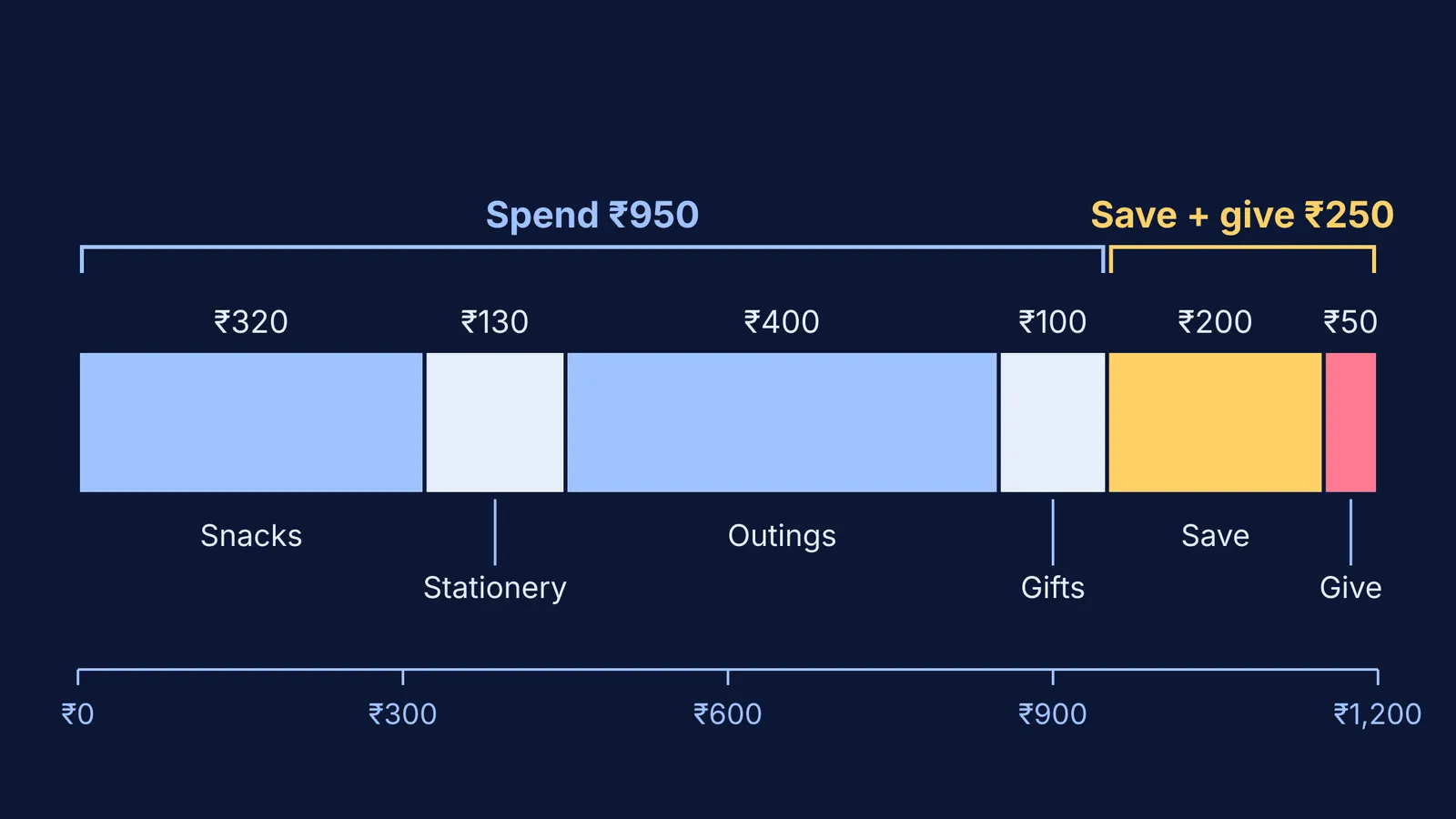
Riya is 15 and in Class 10. Her parents pay for the school bus, her phone plan and all books. Her own list, priced from last month (example figures, not a benchmark):
After-school snacks: ₹320
Small stationery: ₹130
Two outings with friends: ₹400
Friends' birthday gifts: ₹100
That is ₹950 of spending. Add ₹200 a month saved towards headphones and ₹50 to give away or keep as a buffer, and her pocket money is ₹1,200.
What should pocket money cover, and what should it not?
Pocket money works best for things your teen can choose, delay or skip:
snacks and treats outside home meals
outings, films and food with friends
small gifts and hobby supplies
in-game or app purchases, if you allow them at all
Keep essentials on your side of the ledger: school fees, textbooks, coaching, medical costs, travel to school and anything safety-related. A teenager should never have to choose between lunch and a lab notebook. If you want them to see the bigger picture, try bringing your teenager into the family budget once a quarter.
How do you link pocket money to responsibility?
The US Consumer Financial Protection Bureau's building blocks of financial capability say financial habits and norms really start to take shape in middle childhood (ages 6 to 12). In the same framework, financial knowledge and decision-making skills become more relevant in everyday life during adolescence and young adulthood (ages 13 to 21). Teenagers need real decisions to practise on.
OECD's PISA 2022 financial literacy assessment found that students who discuss money matters with their parents, and those who make their own decisions about how to spend their money, achieve higher financial literacy (PISA in Focus No. 126). Across 14 OECD countries and economies, 64% of 15-year-olds talked to their parents weekly or monthly about their own spending decisions. On average, those students scored 12 points higher in financial literacy than peers who never speak with their parents about money (Teacher magazine summary of the PISA report).
So the amount matters less than the rules around it:
Pay on a fixed day, with no mid-month top-ups. An advance is a loan, repaid from next month's money.
Let small mistakes happen. Running out by the 20th of the month can teach more than a lecture.
Don't pay for everyday chores. Making the bed is part of living at home. Pay only for extra jobs, and use age-wise household chores for Indian kids as a guide to what counts as everyday.
Hand over a new cost when they manage well. At 16, that might be their own phone recharge, with the amount raised to match.
Should a teenager have their own bank account?
It helps, because a bank statement shows where the money went. The Reserve Bank of India's directions of 21 April 2025 allow minors above an age set by each bank, not less than 10 years, to open and operate savings accounts on their own, within limits the bank fixes. Banks had to bring their policies in line by 1 July 2025. A minor's account must always stay in credit, and banks may offer debit cards or internet banking according to their own policies. For more, read our guide to opening a bank account for a minor child.
What do you say when you start?
You might say something like this:
"From next month you'll get ₹1,200 on the 1st. It covers snacks, outings and gifts. We still pay for school, books and travel."
"If it runs out early, I won't top it up, but we can talk about what happened."
"Whatever you save is yours. Tell me what you're saving for and I'll help you track it."
Saving ₹200 a month raises an easy maths question: how long until the headphones, and what if the money earned interest? The Fermi Concept Library gives every concept in mathematics its own lesson, so your teen can look up the idea and work out the answer themselves.
Start with the list this weekend. The amount will follow from it.