

On this page
Opening a bank account for your child is one of the most effective ways to introduce practical financial responsibility before adulthood. In India, the Reserve Bank of India establishes clear frameworks allowing children to hold and operate savings bank accounts. Moving beyond a traditional piggy bank gives young learners real experience with balances, interest calculation, and digital transactions within secure guardrails.
What are the age rules for a minor's bank account in India?
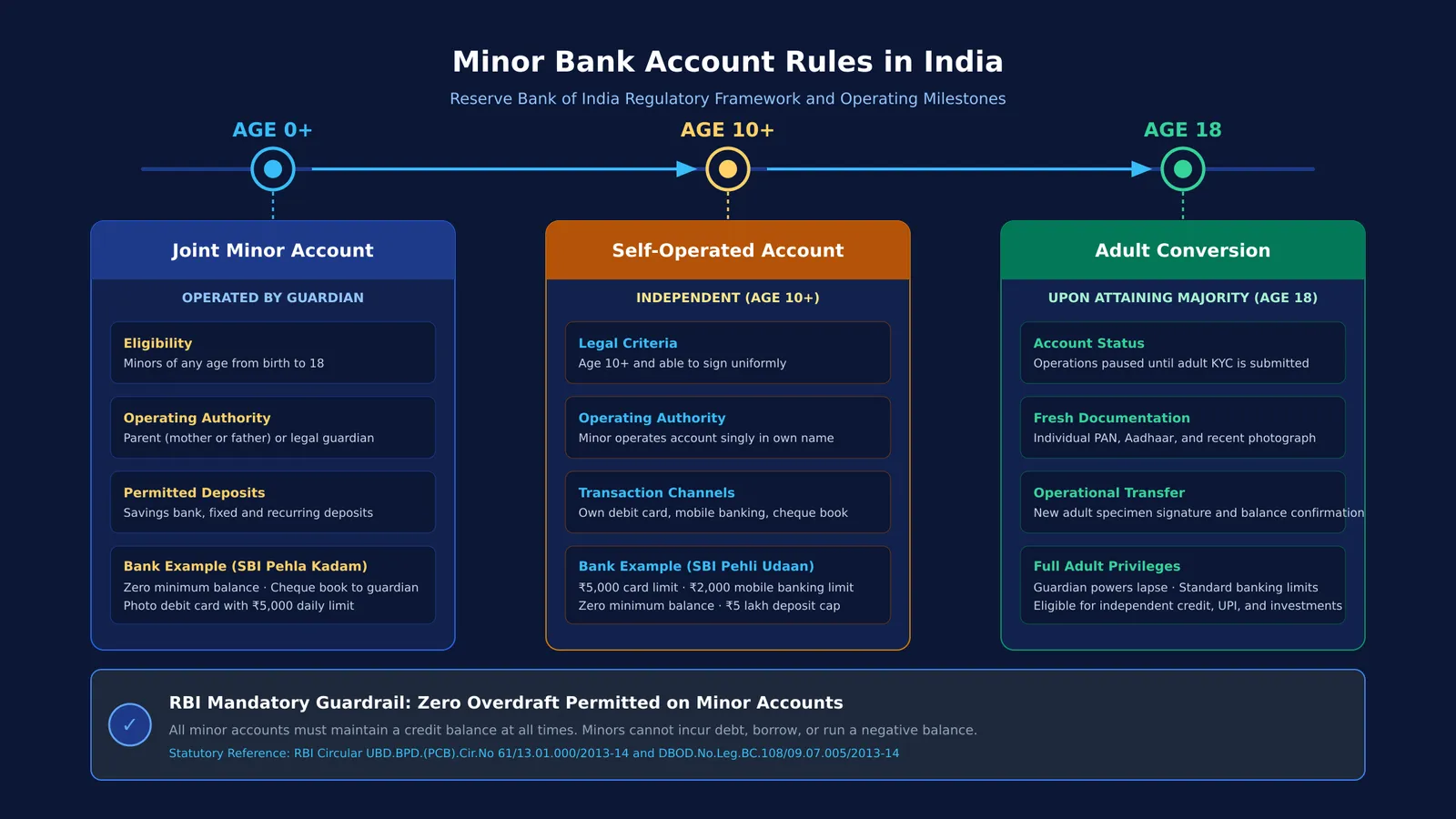
Under Reserve Bank of India guidelines, bank accounts for individuals under 18 years of age fall into two distinct operating categories:
Accounts for minors of any age (operated jointly): A parent or legal guardian can open and operate a savings or term deposit account for a child from birth up to age 18. Both mothers and fathers are recognised as natural guardians.
Independent accounts for minors aged 10 and above: Children who have reached the age of 10 are legally permitted to open and operate a savings bank account independently, provided they can sign uniformly.
Commercial banks tailor specific products around these rules. State Bank of India, for instance, offers two accounts: Pehla Kadam and Pehli Udaan. Pehla Kadam serves minors of any age and is operated jointly with a parent or guardian. Pehli Udaan is designed for children aged 10 and older who can sign uniformly, operating singly. Both accounts have no minimum balance requirements and cap deposits at ₹5 lakh. Banks also enforce daily limits—including ₹5,000 on photo debit cards and ₹2,000 on mobile banking. Crucially, the Reserve Bank of India mandates that minor accounts may never be overdrawn; they must maintain a credit balance at all times.
What documents do you need to open a child's bank account?
Opening an account requires standard Customer Due Diligence under Reserve Bank of India Know Your Customer (KYC) norms. The primary documents include:
Proof of date of birth: A birth certificate from a municipal authority or gram panchayat, an Indian passport, or an Aadhaar card.
Identity and address verification: The child's Aadhaar card (or enrolment slip) and recent photographs.
Guardian KYC: For joint accounts or minors under 10, the parent provides their Aadhaar card, proof of address, and PAN card (or Form 60).
Parents often wonder about taxation. A minor can obtain a PAN card, but under Section 64(1A) of the Income-tax Act, 1961, any interest income earned by a minor is clubbed with the income of the parent whose total income is higher. Under Section 10(32), parents filing under the old tax regime can claim an exemption of up to ₹1,500 per child per financial year for up to two children. Banks only deduct Tax Deducted at Source (TDS) if total annual interest across branches on fixed or recurring deposits exceeds the statutory ₹40,000 threshold.
How can a minor account teach real money habits?
Financial literacy is built through deliberate practice rather than abstract instruction. In the OECD PISA 2022 Financial Literacy assessment, which evaluated 15-year-old students across 20 countries and economies, researchers found that 63% of students hold an account at a bank or financial institution. Students holding an account scored 28 points higher in financial literacy than peers without accounts (24 points higher after adjusting for student characteristics and socio-economic status). Furthermore, students who reported independently deciding what to spend their money on scored 30 points higher than those who could not.
Research in autonomy-supportive parenting shows that providing structured autonomy within safe limits strengthens self-regulation. To help children learn without adding pressure, parents can introduce a three-bucket budgeting system rather than controlling every rupee:
Day-to-day spending (30%): Managed via debit card for school supplies, books, and small outings.
Medium-term goals (40%): Set aside for three to six months to purchase a desired gadget or sports equipment, reinforcing patience and delayed gratification.
Long-term savings (30%): Placed into an auto-sweep recurring deposit to observe compounding interest firsthand.
This routine connects directly to school mathematics. Budget discussions extend everyday maths talk with children into the teenage years, turning percentages into tangible decisions. When students see interest accumulate, compounding becomes concrete. If your child struggles to connect theoretical formulas to real numbers, Fermi's AI tutor works through problems alongside the student, noticing where they are stuck and deciding whether to explain, ask, or show. To explore how percentages and rate equations work across mathematics, students can also turn to the Fermi Concept Library, where every concept has its own lesson and its place in the map.
What happens to the account when your child turns 18?
Under Reserve Bank of India rules, a minor's bank account does not automatically convert into a full adult account upon their eighteenth birthday. When an accountholder attains majority, banks restrict operations until a formal transition is completed:
Fresh KYC submission: The now-adult accountholder must submit their own PAN card, Aadhaar card, and fresh passport-size photographs.
Specimen signature: The individual must provide a new specimen signature, replacing any guardian-operated authority.
Balance confirmation: If the account was previously operated by a guardian, the account holder must review and formally confirm the existing balance.
Once verified, the account gains full adult operating privileges, allowing unrestricted digital banking and independent cheques. Taking these steps early equips your teenager with both legal financial standing and practical money discipline.


