

On this page
A baby brother or sister arriving in the same year as Class 10 or Class 12 boards usually brings two worries at once: will the house be too unsettled to study, and will the older child feel pushed aside? Both are manageable. The trick is to decide early what stays fixed, what the teen helps with, and who picks up the extra housework.
Will a new baby hurt my child's board exam preparation?
Not necessarily. Psychologist Brenda Volling reviewed 30 studies on how firstborn children adjust when a sibling is born, and found that the evidence did not support the idea that the change is a crisis for most children (Volling, Psychological Bulletin, 2012). Children varied widely: the review describes the transition as a time of disruption for some, an occasion for developmental advances for others, and for others a quiet period with no noticeable change (full text).
One honest caveat: most of the firstborns in those studies were toddlers and preschoolers, not teenagers. Treat it as reassurance, not a promise. If your teen seems jealous or quiet, our guide on helping an older child who feels left out after a new baby has words to try.
What should stay fixed when everything else changes?
Two things: sleep and a small number of fixed study blocks. Everything else can bend.
The American Academy of Sleep Medicine recommends that teenagers aged 13 to 18 sleep 8 to 10 hours in every 24 hours (Paruthi et al., Journal of Clinical Sleep Medicine, 2016). Night feeds are the biggest threat to that. The simplest rule is that the board student is never on night duty. If the teen shares a room with the baby, move one of the beds. More on this in how much sleep teenagers need and how parents can help.
For study, two or three blocks at the same time every day beat a vague promise to study whenever the house is quiet.
What does a board-year weekday look like with a newborn?
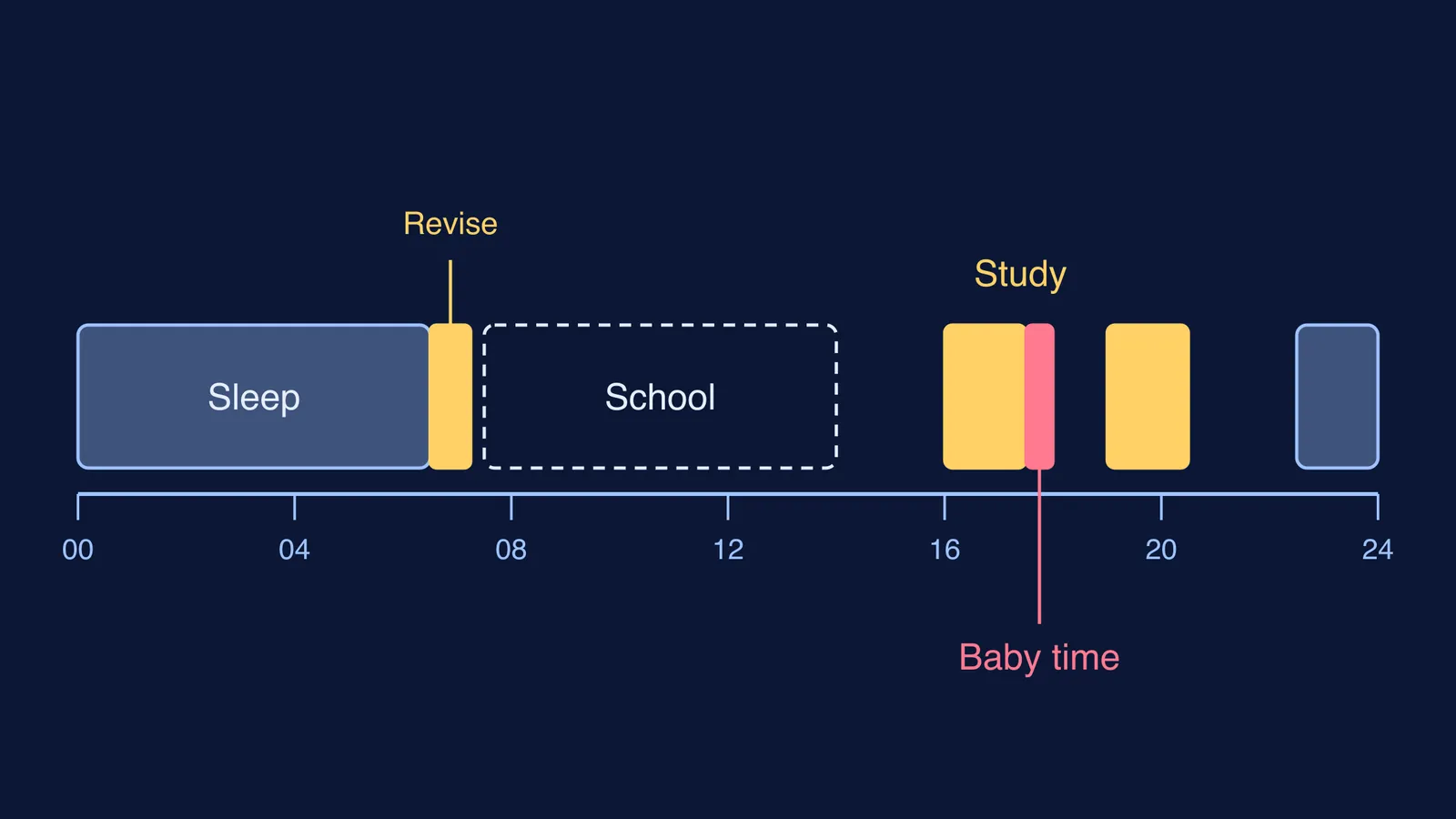
Here is a sample weekday for a Class 12 student:
6:30 to 7:15 am: a short revision block before school.
7:30 am to 2:00 pm: school.
4:00 to 5:30 pm: main study block, door closed, phone in another room.
5:30 to 6:00 pm: baby time, chosen by the teen (see below).
7:00 to 8:30 pm: second study block, practice questions rather than reading.
10:30 pm to 6:30 am: sleep, with no night-feed duty.
That is close to four hours of study, and nobody has to fight for it. When a block shrinks to 45 minutes because the day went wrong, Fermi's AI tutor can work out what your teen already knows and build a plan for the session, so they sit down to a clear next step instead of a blank page.
How can a teenager help with the new baby without losing study time?
Keep involvement small, chosen and time-boxed. Let the teen pick one or two jobs they enjoy, such as the evening bath or a walk with the pram, in a fixed slot like the 5:30 pm half-hour above.
A script you can use:
"Your exams matter to us as much as the baby does. You are not on night duty this year."
"We would love you to have one special job with your sister. Which would you like?"
"If you ever feel left out, tell us, even if it sounds silly. We will not be cross."
Who should do the housework when the baby arrives?
In many Indian homes, the default answer is the mother, which is exactly when she has the least time. India's Time Use Survey 2024 found that 81.5% of women and girls aged 6 and above took part in unpaid domestic work, against 27.1% of men and boys (MoSPI press release, February 2025; Business Today report of the survey). Among people aged 15 to 59 who did caregiving, women spent about 140 minutes a day on it and men about 74.
A new baby is a good moment to redraw the list:
Father or other adults: cooking or ordering meals, laundry, school runs, shopping.
Grandparents or relatives: cooked food or an afternoon with the baby, not long visits that need hosting.
Paid help, if you can afford it: cleaning or a cook for the first few months.
The teen: their own room, their own plate, one small household job on non-exam days.
If relatives want to visit, our guide to managing visitors during board exams helps you say yes without losing study evenings.
When should you get outside help?
If your teen stops sleeping well, drops subjects they used to enjoy, or seems low for more than a couple of weeks, talk to them, then to the school counsellor or your family doctor. The same goes for either parent: the weeks after a birth are hard, and a doctor can help. For free support at any hour, call Tele MANAS on 14416 or 1800-891-4416, a national mental-health helpline launched by the Ministry of Health and Family Welfare (details).
Start tonight: agree the study blocks and the no-night-duty rule, and write them on the fridge.


