

On this page
Most teenagers watch money leave the house every month but never see the plan behind it. You can change that in one evening: share a simplified monthly budget, give your teen one category to run for a month, and use their choices to practise percentages and saving.
Why involve a teenager in the family budget?
The OECD's PISA 2022 assessment tested the financial literacy of 15-year-olds in 20 countries and economies, and a short OECD report on the role of parents pulls out what home conversations are linked to. India was not part of this assessment, but the pattern is worth knowing.
Students who discussed their own spending decisions with their parents weekly or monthly scored 12 points higher in financial literacy than those who never did, on average across OECD countries, after accounting for gender, socio-economic status and immigrant background (OECD).
Students who agreed they could decide independently how to spend their money scored around 30 points higher than those who disagreed, after accounting for student characteristics (OECD).
The family budget was one of the topics students reported discussing with their parents least often.
The OECD says these are associations, not proof of cause: teens who are good with money may simply start more money conversations. Its advice to parents still fits: help by "discussing money matters and giving their children some autonomy in spending decisions". A budget category your teen plans does both.
In India, the National Strategy for Financial Education 2020-25, prepared by the National Centre for Financial Education and released by the RBI's Deputy Governor on 20 August 2020, includes building financial content into school curricula. Home is where your teen uses it with real rupees.
How much of the family budget should you share with your teen?
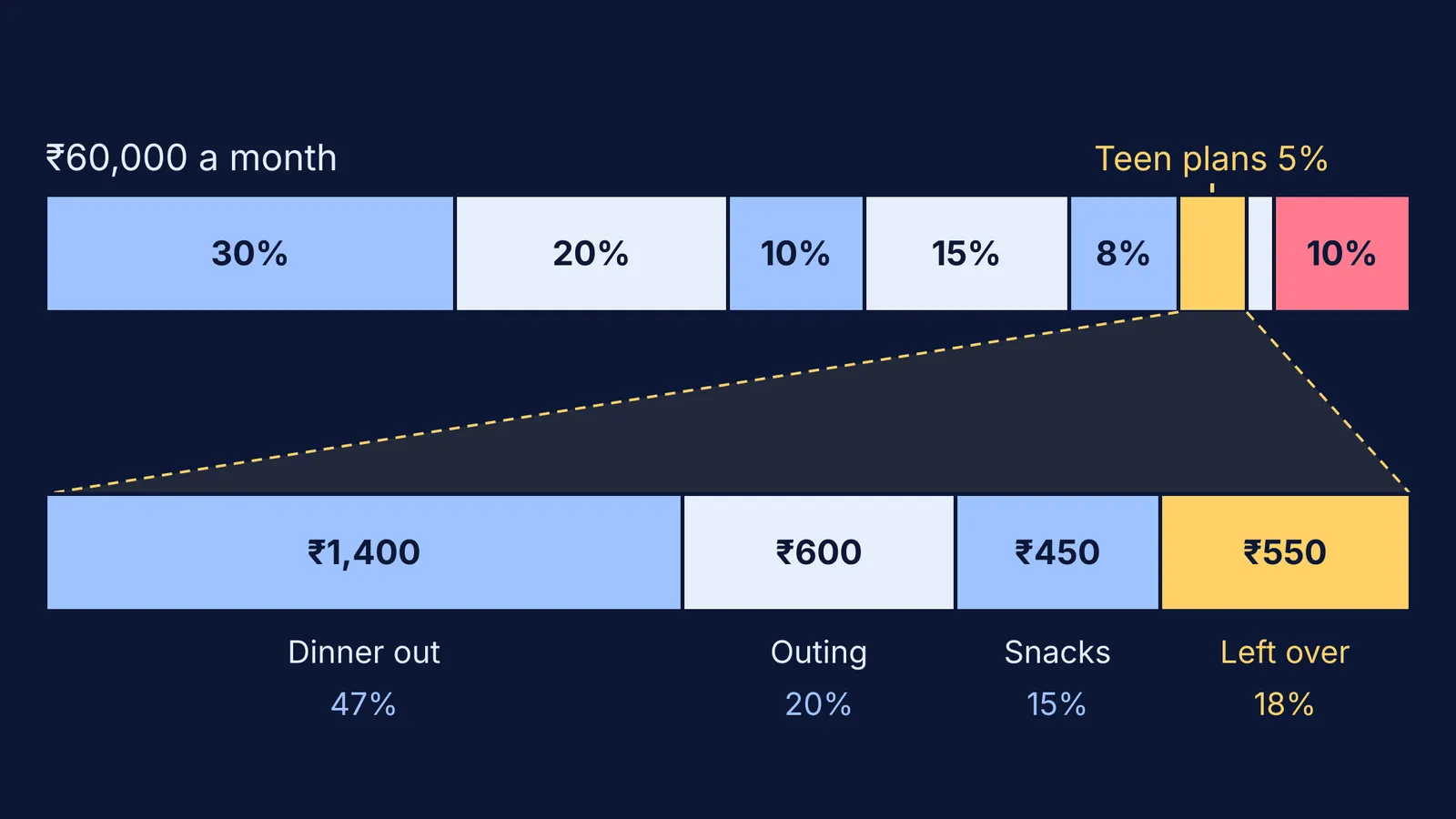
You do not need to show salary slips or bank balances. Share round figures, six to eight categories, and each as a percentage of the total. Here is an illustrative budget for a family spending ₹60,000 a month:
Rent or home loan: ₹18,000 (30%)
Groceries and household: ₹12,000 (20%)
School, coaching and books: ₹9,000 (15%)
Electricity, gas, phone and internet: ₹6,000 (10%)
Savings: ₹6,000 (10%)
Transport: ₹4,800 (8%)
Outings and treats: ₹3,000 (5%)
Medical and other: ₹1,200 (2%)
How do you let your teen plan one category?
Pick a low-risk category with real choices: outings and treats, festival snacks or stationery, not rent or school fees.
Hand over the amount for one month, in cash or as a fixed sum on a family UPI account.
Ask your teen to write a plan before the month starts: what they will spend it on and roughly how much each item costs.
They record every spend in a notebook or notes app on the day it happens.
At the end of the month, sit down for 15 minutes and compare the plan with what actually happened.
After two or three months, rotate to a new category.
How does a family budget teach percentages and saving?
Say your Class 10 teen plans the ₹3,000 outings budget like this: one family dinner out for ₹1,400, a weekend outing for ₹600 and snacks for ₹450. That totals ₹2,450, leaving ₹550. At the month-end review, ask them to work out:
What share of the whole budget is their category? 3,000 ÷ 60,000 × 100 = 5%.
What share of their category was the dinner? 1,400 ÷ 3,000 × 100 ≈ 47%.
How much is left over as a percentage? 550 ÷ 3,000 × 100 ≈ 18%.
If the restaurant raises prices by 10%, the same dinner costs ₹1,540. How much is left then, as a share of ₹3,000? (₹410, about 14%.)
Then comes the saving decision. Let your teen choose what happens to the ₹550: carry it into next month, move half to a goal they are saving for, or add it to the family savings line. Ask them to say why; that reasoning matters more than the arithmetic.
For faster mental maths, our guide to calculating percentages in your head with the 10% rule helps. If percentages themselves still feel shaky, the Fermi Concept Library has every concept in mathematics with its own lesson, so they can go back to the idea behind the sum.
What if your teen overspends or loses interest?
Overspending a ₹3,000 category is a cheap lesson, so do not top it up quietly. Agree in advance what happens: next month's amount shrinks by the overspend, or you lend the difference and they repay it. Keep the review about the plan, not blame.
If interest fades, hand over a category they care about, such as a birthday outing. For next steps, see our simple system for pocket money by age and this teen guide to budgeting and debt in India.
This week, choose one category, write down its amount, and hand it over on the first of the month.


