On this page
Pocket money is one of the few places a child makes a real decision with real consequences, at a cost you control. Kept simple, it also becomes weekly maths practice.
Should you give your child pocket money?
If you can afford a small, regular amount, the evidence leans towards yes, as long as your child really gets to choose. In the OECD's June 2024 PISA in Focus brief Shaping Students' Financial Literacy, based on PISA 2022, 15-year-olds who said they could decide independently how to spend their money scored 30 points higher in financial literacy than those who said they could not, after accounting for gender, immigrant background and socio-economic status.
The same brief found that students who talked with their parents weekly or monthly about their own spending decisions scored 12 points higher than students who never did. The OECD notes that PISA data cannot show cause and effect: higher-performing students may simply start more of these conversations.
A review for the UK's Money Advice Service by Cambridge researchers David Whitebread and Sue Bingham, Habit Formation and Learning in Young Children (2013), points the same way for younger children. It concludes that teaching them explicit financial knowledge is likely to be ineffectual, and says situations should be set up so the child experiences the process rather than just being told about it.
What should change as your child grows?
The Cambridge review also sets out what young children can usually handle. By four to five, children understand that they need to pay for things but may not understand that coins have different values. Only as they approach seven do they begin to understand that change comes back when they pay with more than the price. Seven-year-olds cannot judge future time beyond about a month, while by about eight they become able to judge the timing of future months.
That suggests how far away a savings goal should be. One way to set it up:
Ages 5 to 7: two jars, Spend and Save. Pay in coins on the same day each week. Keep the first savings goal two to four weeks away. The review suggests a savings chart where the child colours in coins to show how much has been saved and how much is still to go, so waiting becomes something they can see.
Ages 8 to 11: three jars, Spend, Save and Share. Add a written weekly record, described below. Goals can stretch to eight or ten weeks.
Ages 12 and up: one monthly amount and one notebook. Hand over a cost you already pay, such as school snacks or stationery, so the budget covers needs as well as wants.
The amount is your call: pick a sum you can keep paying, and write the rules down.
What does a weekly money record look like?
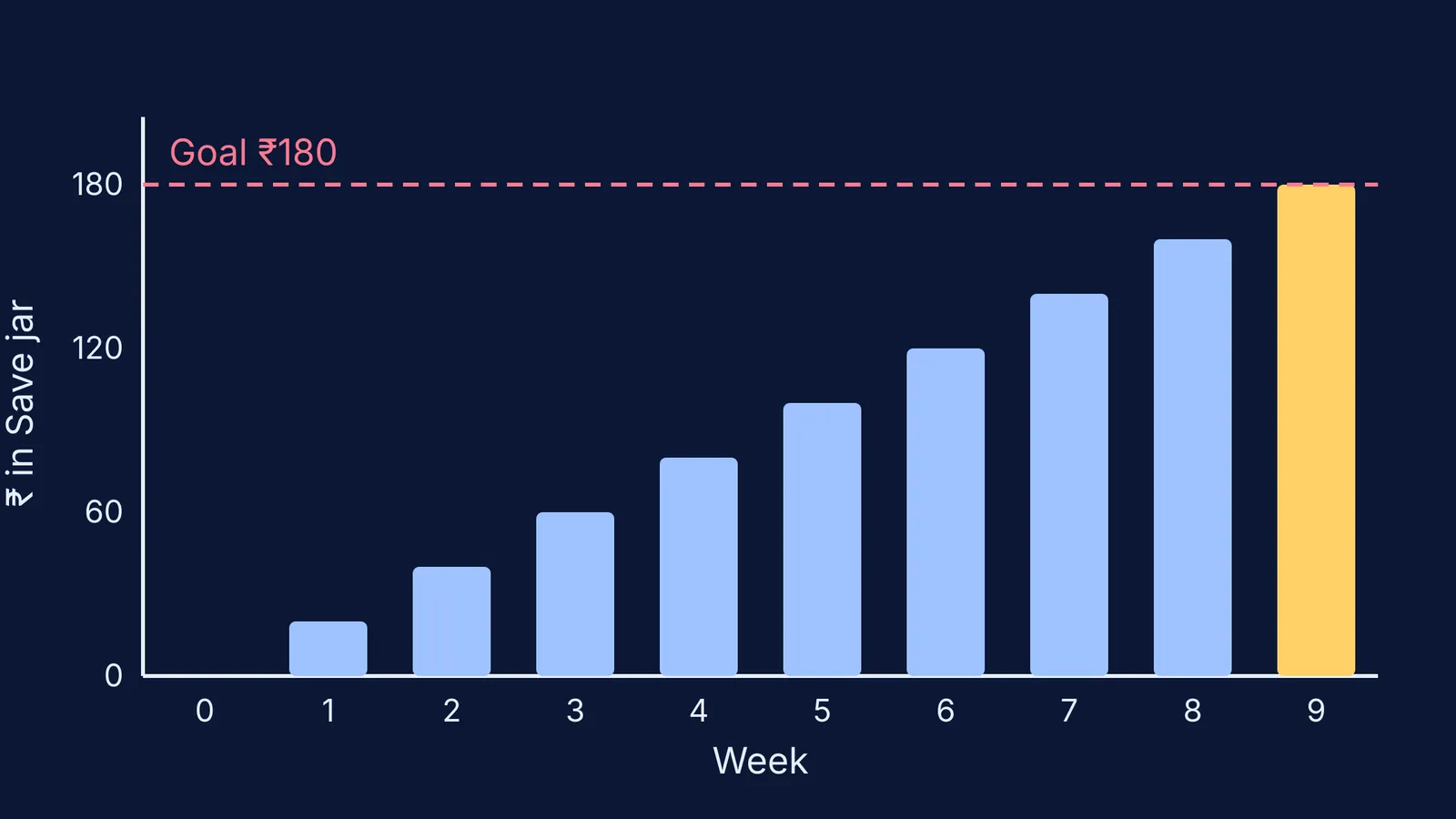
Here is a worked example. Meera is nine and gets ₹60 every Sunday. She splits it ₹30 Spend, ₹20 Save and ₹10 Share. She wants a storybook set that costs ₹180.
How long will it take? ₹180 ÷ ₹20 = 9 weeks. That is the first sum, and she does it, not you.
Her notebook has one line a week with five columns: date, money in, money out, what for, and Save total. In week 4 her entries read:
Sunday: ₹60 in, split 30, 20 and 10.
Wednesday: ₹15 out of Spend for stickers. Spend left: ₹15.
Save total: ₹80. Weeks left: (180 − 80) ÷ 20 = 5.
Then her aunt gives her ₹50 for Diwali and she puts all of it in Save. Ask her to work it out again: (180 − 130) ÷ 20 = 2.5. Since she cannot buy the set halfway through a week, she needs 3 more Sundays. That is what rounding up a remainder means, learned with her own money.
Every line is subtraction, division and a running total: primary-school arithmetic with a real reason to check it. If division with remainders or percentages keeps tripping your child up, the Fermi Concept Library has a lesson for every concept in mathematics, so you can look it up together.
What if your child spends it all on day one?
Let them, and do not top up the jar. The Cambridge review suggests a 'one pound' shopping trip: the child chooses one thing, and once the money is spent it is 'gone for good'. That is the lesson. Some words for the moment:
"You chose the chips on Monday. That was your call. The jar fills again on Sunday."
"Do you want to change how you split it next week, or keep it the same?"
Avoid "I told you so" or a lecture about wasting money.
Then talk it over at the weekly record. That short, regular conversation about their own spending is the kind the OECD data link to higher scores. For more on stepping back while your child makes choices, read our guide to autonomy-supportive parenting. The jars build the same habits as teaching your child planning skills, and for under-sevens, counting coins together fits naturally into everyday maths talk with young children.
This Sunday, set out two jars, agree the amount and write the first line in the notebook together.