

On this page
Most schools teach complex calculus and balancing chemical equations, but when it comes to managing a salary, paying taxes or saving for retirement, many students are left to figure it out alone. A 2022 survey by Streak found that only 16.7% of Indian teenagers are financially literate. The same survey noted that 45% of students do not know how to create a budget, and 60% struggle to understand investment concepts and risk.
This gap leaves young adults vulnerable as they move to college and start earning. Building good financial habits early is one of the most useful skills a teenager can learn.
How do you create a budget?
A budget is just a plan for every rupee you get, whether it is pocket money, gifts, or a part-time income. The simplest way to start is the popular fifty-thirty-twenty budgeting rule. You divide your money into three buckets:
Needs: Half of your money for essentials like phone recharges, transport or school supplies.
Wants: Three-tenths for discretionary spending, such as movies, gaming or eating out with friends.
Savings: One-fifth set aside for the future or big purchases.
If you receive a thousand rupees as pocket money or a gift, you would allocate five hundred rupees to essentials, three hundred rupees to a movie or snacks, and put two hundred rupees straight into your savings.
When you look at your budget, drawing numbers for the eye with a chart in a tracking app makes it easier to see where your money goes compared to writing it in a notebook.
What is compound interest and why start early?
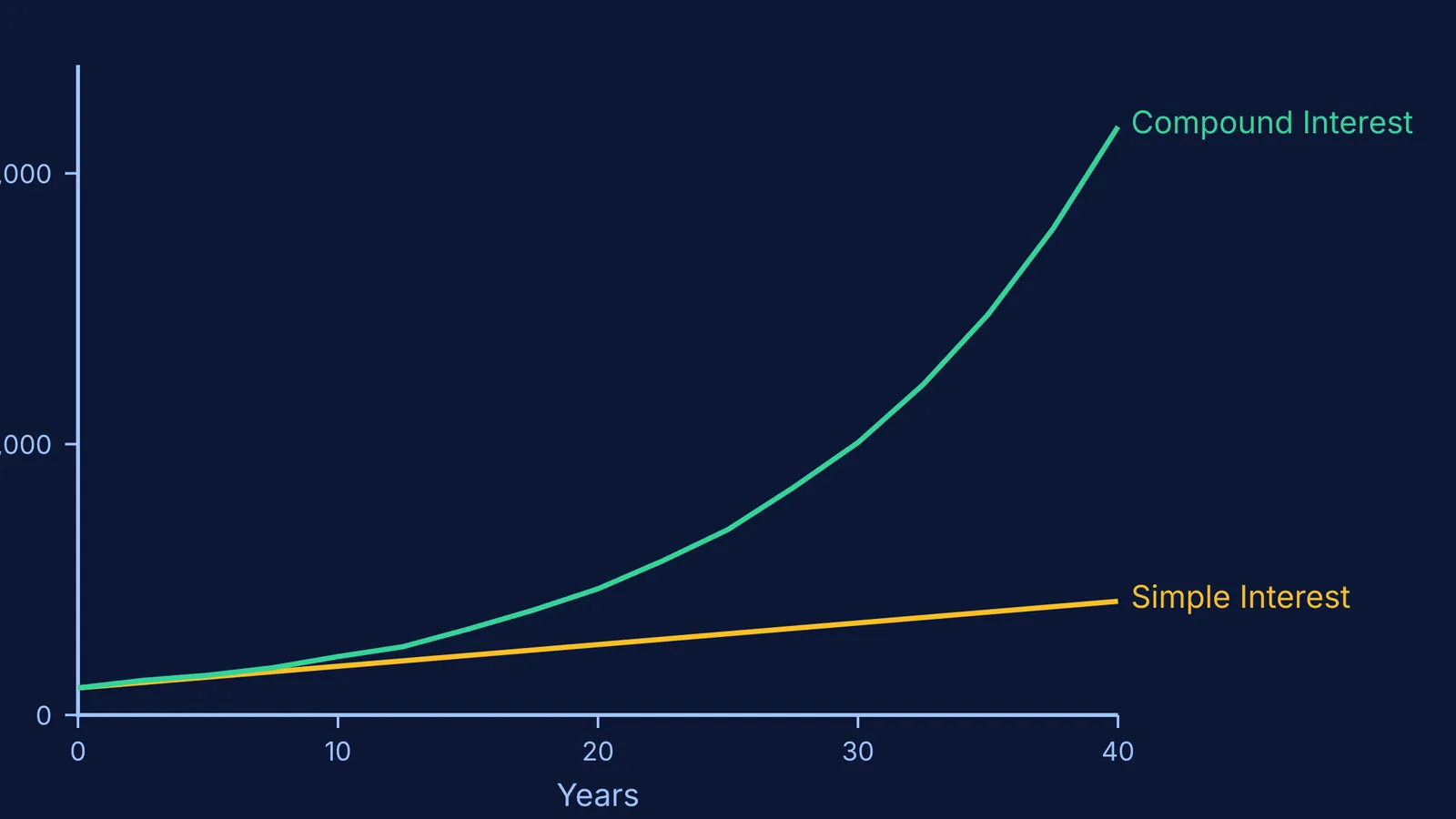
Simple interest pays you a percentage only on the money you originally put in. Compound interest pays you interest on your original money *plus* the interest you have already earned. It relies on exponential models that show how a small amount grows rapidly over time.
For example, if you save a thousand rupees at an eight per cent annual return, you earn eighty rupees in the first year. In the second year, you earn interest on both the original thousand and the eighty rupees. Over four decades, that single thousand rupees grows to over twenty-one thousand through compound interest, while simple interest would only grow it to four thousand two hundred.
If you struggle with the maths behind compound interest, Fermi's AI tutor can work out what you already know and build a plan for the session to teach you the formulas step by step. Or, to explore how different interest rates change your returns over decades, try the Fermi Simulation Lab, which has interactive simulations for the ideas that are easier to see than to read.
How do bank accounts work for teenagers?
Most Indian banks offer minor accounts for teenagers, often managed jointly with a parent. These accounts come with debit cards and UPI access with set daily limits.
Opening one gives you a safe place to hold your savings and earn a small interest return. More importantly, it trains you to use digital payments responsibly and check your balance before spending. Many teenagers are accustomed to handling physical cash, but the real world operates mostly on digital transactions. A minor account bridges this gap safely. It helps you understand how online statements work, how to track your transaction history, and how to spot any unauthorised charges.
How can you avoid debt traps?
Debt is borrowing money you do not have. While a student loan for college can be an investment in your future, consumer debt destroys wealth.
Buy Now, Pay Later schemes and credit cards increasingly target young adults. They make it easy to buy an expensive phone or clothes today and pay in installments. The psychological trap of Buy Now, Pay Later is that it separates the pleasure of getting an item from the pain of paying for it. This separation encourages impulsive spending.
If you rely on credit for everyday wants, a single unexpected expense—like a broken phone or a medical bill—can make you miss a payment. When you do miss a payment, the interest rates are punishing, triggering late fees and a cycle of debt that takes years to clear.
Understanding investment risk is essentially a probability exercise; if you are not sure how to weigh odds in favour and odds against, taking on risky investments or high-interest debt can lead to severe losses.
Your first money checklist
Open a minor bank account with a parent to start tracking your digital spending.
Set a monthly savings goal, even if it is just a few hundred rupees.
Wait a full day before buying anything you do not strictly need.
Learn how compound interest works so you understand the cost of debt and the value of saving.
Financial literacy is not about getting rich overnight; it is about building security and independence. The habits you form now will stick with you for life. By learning to budget effectively, taking advantage of compound interest early, and steering clear of consumer debt, you are setting yourself up for a stable and confident future.


