

On this page
How to calculate percentages in your head?
Mental calculation is the process of solving arithmetical problems in your mind without the help of a pencil, paper, or calculator. When it comes to percentages, the most reliable method is to stop trying to do long division in your head and instead use "anchor" percentages.
In a 2009 study published in *ZDM Mathematics Education*, researcher John Threlfall found that proficient mental calculators rarely rely on rigid formulas; instead, they construct solutions flexibly by noticing the characteristics of the numbers in front of them.
The word "percent" literally translates to "per hundred", which means it fits perfectly into our base-10 number system. Because of this, the most important anchor is 10%. To find 10% of any number, you simply move the decimal point one place to the left. For example, 10% of 450 is 45. From there, you can easily find 1% by moving the decimal point two places to the left (1% of 450 is 4.5). These two anchors are the foundation of all mental percentage calculations.
How do you build complex percentages?
Once you have your 10% and 1% anchors, you can build any other percentage by combining them. Think of it as stacking mathematical building blocks. You no longer have to multiply by a messy decimal; you just add or subtract simple numbers.
Here is a practical framework for common percentages:
5%: Find 10% and halve it. If 10% of 250 is 25, then 5% is 12.5.
20%: Find 10% and double it. If 10% of 250 is 25, then 20% is 50.
15%: Add your 10% block and your 5% block together. This is extremely useful for calculating a standard restaurant tip.
90%: Find 10% and subtract it from the original whole number.
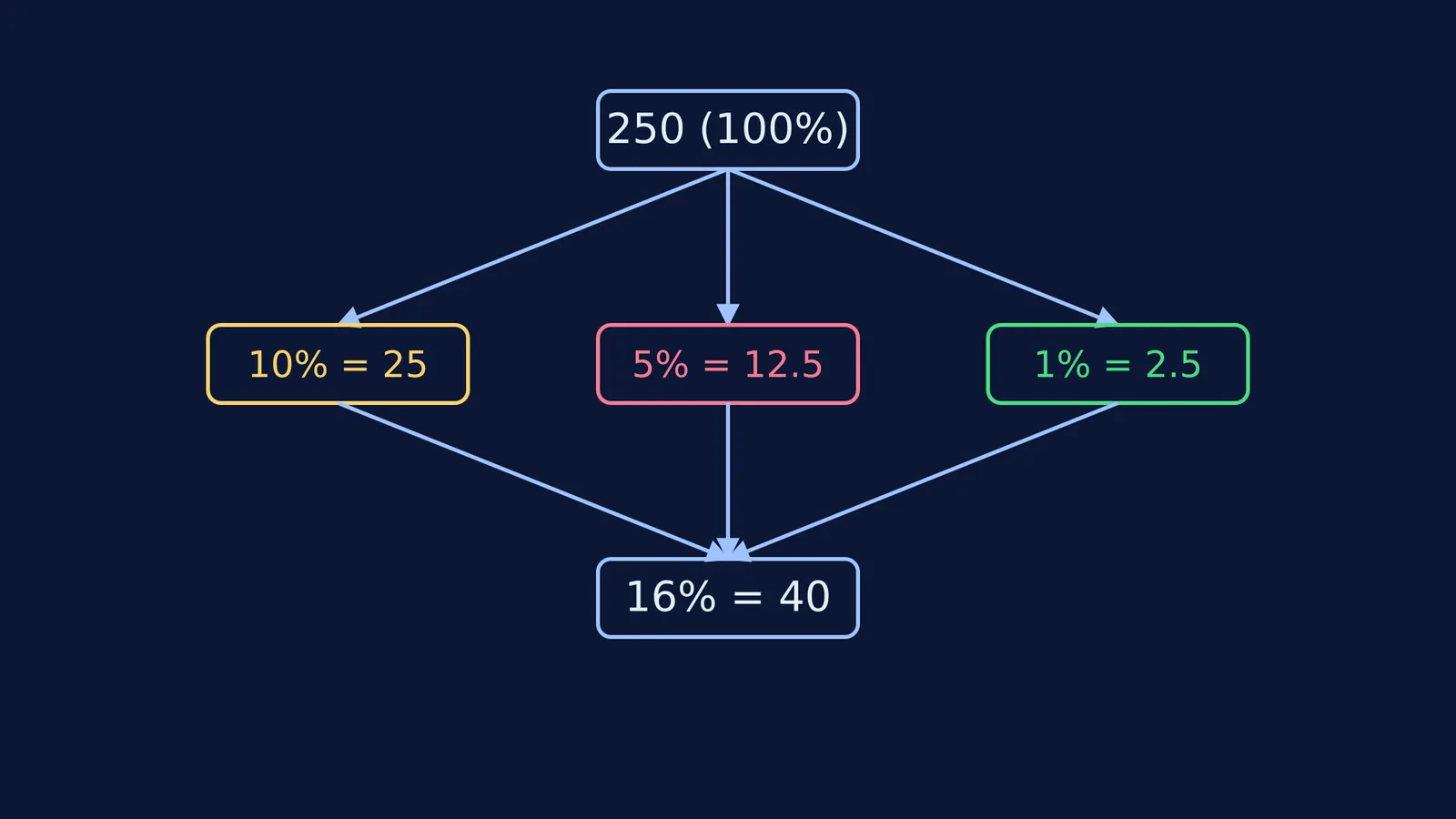
Let us work through calculating 16% of 250 step by step:
Find 10%: Move the decimal one place left to get 25.
Find 5%: Halve the 10% value (half of 25 is 12.5).
Find 1%: Move the decimal two places left on the original number to get 2.5.
Add them together: 25 + 12.5 + 2.5 = 40.
You can apply this to deductions as well. If a shop offers a 2% discount on a 300 rupee item, you first find 1% (which is 3), double it to get 2% (which is 6), and then subtract 6 from 300 to find the final price of 294.
Which fraction equivalents should you memorise?
Another powerful tool for mental calculation is memorising the percentage equivalents of common fractions. When you know these by heart, you can bypass multiplication entirely and use division instead.
50% is 1/2 (divide by 2)
25% is 1/4 (divide by 4)
75% is 3/4 (divide by 4, then multiply by 3)
33.3% is 1/3 (divide by 3)
20% is 1/5 (divide by 5)
If you need to calculate 20% of 150, you could use the 10% rule, doubling 15 to get 30. Alternatively, knowing that 20% is one-fifth, you can simply divide 150 by 5 to reach the same answer of 30. Having multiple strategies gives you the flexibility to choose the fastest route for the specific numbers in front of you.
Can you swap percentages?
Yes, you can always flip the numbers. Because of the commutative property of multiplication, x% of y is exactly the same as y% of x.
For example, calculating 16% of 25 in your head sounds difficult. However, if you swap the numbers, the problem becomes 25% of 16. Since 25% is exactly one quarter, you simply divide 16 by 4 to get 4. Another example is 4% of 75. Swapping it gives 75% of 4, which is three-quarters of 4, making the answer 3.
If you find yourself stuck applying the wrong method to these simple proportional swaps in your physics or chemistry numericals, the Fermi Problem Library has worked problems with a step-by-step solver that explains the reasoning rather than printing an answer.
How to check if your answer is reasonable?
Before you calculate anything, make a rough estimate using 10% or 50% benchmarks to prevent careless errors. If you are calculating 12% of 400, you know that 10% is 40. Your final answer must be slightly higher than 40. If you accidentally calculate 480 or 4.8, your estimate tells you instantly that the decimal point is in the wrong place.
In competitive exams, doing a quick mental check can sometimes eliminate three out of four multiple-choice options before you even touch a pen. Estimating first is a key habit for problem-solving; to see how missing these checks holds students back, read our guide on Why some JEE aspirants plateau despite studying every day.
For inspiration on what the human brain can achieve with numbers, read about Shakuntala Devi: what a scientist learned testing her mind.


